Engagement Rings
Making a Stone Look Larger Without Buying a Larger Stone
Seven design levers, ranked by how much apparent size they buy per pound spent.
Written by the Mapple Gems workshop, Surat · Updated 14 September 2026
Short answer
In order of value: a halo adds the most apparent size per pound, then a thin or tapered shank (the stone gains by comparison), then an elongated shape (more weight in the face, less in the depth), then a hidden halo, then buying just under a round carat weight. Apparent size is a ratio between stone width and everything around it — which is why the cheapest lever is narrowing the metal rather than widening the stone.
Carat weight is the most expensive way to buy apparent size, and it is non-linear — going from 0.50 to 1.00 ct only widens a round from 5.0 mm to 6.5 mm. Everything below buys visible size more efficiently.
The seven levers, ranked
| Lever | Effect | Trade-off |
|---|---|---|
| Halo | Largest — can read a full step up | Maintenance; amplifies moissanite fire |
| Thin or tapered shank | Large, and costs less gold | Never go below 1.8 mm thickness |
| Elongated shape | Large — more face per carat | Points need V-prongs; bow-tie risk |
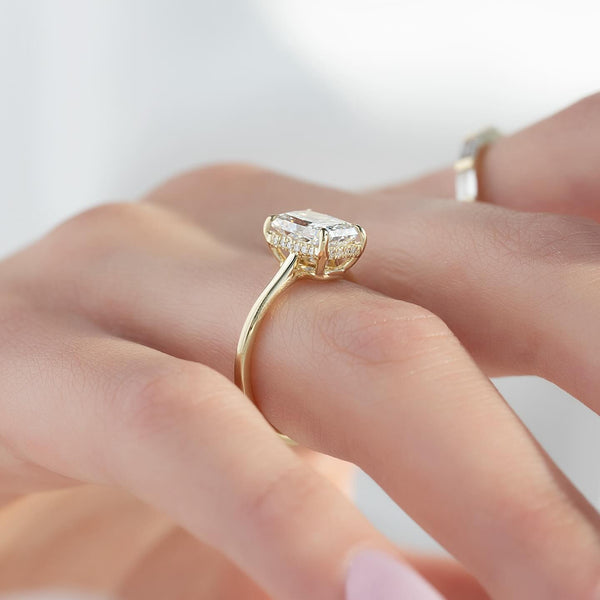
| Hidden halo | Moderate — adds presence from the side | Raises profile height |
| Just under a round weight | Same size, lower price | None — pure saving |
| Side stones | Moderate — widens the whole setting | Usually needs a contour band |
| Thin bezel or claw prongs | Small — less metal covering the stone | Claws snag more than rounded tips |
The tapered shank is the one that costs nothing — it actually costs less. Your eye judges the stone against the metal immediately beside it, so narrowing the shank toward the head gives the stone a smaller frame exactly where it is seen, while keeping comfort and strength at the back where the ring is gripped. A shank tapering from 2.2 mm at the base to 1.8 mm at the shoulders reads noticeably more generous than a straight 2.2 mm — and it uses less gold, so it is cheaper to make. It is the only lever on this page that improves apparent size, comfort and price simultaneously, and almost no listing offers it as an option. Ask for it by name.
Halos: the arithmetic
A halo of 1.3 mm stones adds roughly 2.6 mm to the overall diameter, so a 6.0 mm centre presents as about 8.6 mm — visually somewhere near a 2 ct stone, at a fraction of the price. Nothing else on this list comes close per pound spent.
Three honest caveats. It carries twenty to forty extra settings to maintain over decades. It raises the profile, which affects band fit and snagging. And with moissanite specifically, a halo surrounds the centre with dozens of small brilliant stones that all disperse light — amplifying exactly the characteristic that identifies the material. If discretion matters, side stones do a similar job with less fire.
Shape: where the weight sits
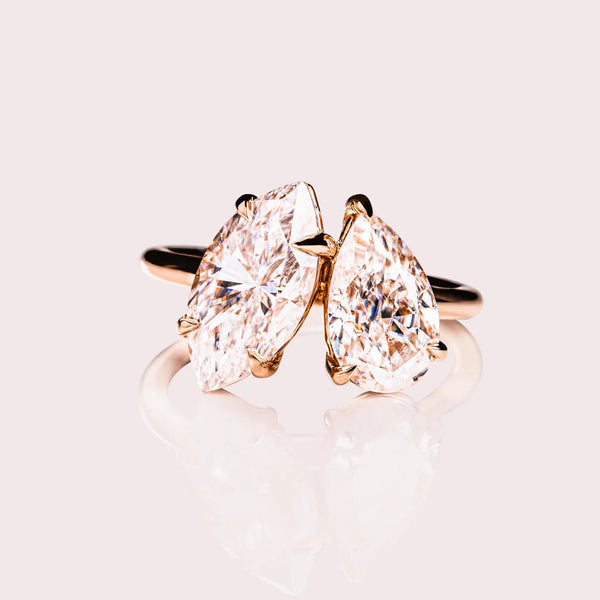
At the same carat weight, elongated shapes carry more of their mass in the face and less in the depth.
- Marquise spans about 10 mm at 1 ct — the largest visual footprint of any shape at that weight.
- Oval and pear sit around 7.5–8 mm long, against 6.5 mm for a round.
- Emerald is around 7 mm long, and its large table reads wide.
- Asscher and princess are the smallest face-up per carat, near 5.5 mm.
An oval also lengthens the finger, which compounds the effect. Ask for the ratio as well as the dimensions — 1.45 reads considerably longer than 1.30 at the same weight.
What to be careful of
Two things that look like value and are not.
A shallow-cut stone. Cutting shallow spreads the face wider for the same weight, so it measures larger than standard — which sounds ideal and is not. Light escapes through the bottom instead of returning, so the stone is bigger and flatter. A stone measuring noticeably larger than standard for its weight is a warning, not a bargain.
A shank below 1.8 mm. Thinner metal does make the stone look larger, and it also flexes under grip pressure until the ring goes out of round and set stones work loose. Take the taper; do not take the thickness below 1.8 mm on a ring worn daily.
The finger factor
Worth remembering, because it changes the maths entirely. Apparent size is a ratio of stone width to finger width — so on a size 4–5 hand a stone reads roughly one step larger than the same stone on a size 7.
Practically: 5.8 mm on a small hand does the job 7 mm does on a larger one, and the price difference between those two stones is considerable. It is the largest free lever of all, and it costs nothing but knowing about it.
Keep reading
Frequently asked questions
What setting makes a diamond look biggest?
A halo. A row of 1.3 mm stones adds roughly 2.6 mm to the overall diameter, so a 6.0 mm centre presents as about 8.6 mm at a fraction of the price of a stone that size. The trade-offs are twenty to forty extra settings to maintain and a raised profile.
Does a thinner band make the stone look bigger?
Yes, because your eye judges the stone against the metal beside it. The best version is a tapered shank — narrower toward the head, full thickness at the back — which uses less gold and so costs less. Do not take the thickness below 1.8 mm on a ring worn daily, whatever the width.
Which shape looks largest for its carat weight?
Marquise, which spans about 10 mm at 1 ct, followed by pear and oval at around 7.5–8 mm against 6.5 mm for a round. Elongated shapes carry more weight in the face and less in the depth. Asscher and princess are the smallest face-up per carat.
Is a stone that measures larger than standard a good deal?
No — treat it as a warning. Cutting shallow spreads the face wider for the same weight, so light escapes through the bottom instead of returning to your eye. The stone is bigger and flatter. Ask for video in ordinary light and check for permanently dark zones.
Ask for a tapered shank.
More apparent size, the same comfort, and less gold — the only lever here that improves all three at once.
Leave a comment