Buying Guide
Affordable Diamond Alternative Engagement Rings
Where the money should go, how big is too big, and the questions that come afterwards.
The short answer: Choose moissanite or a lab grown diamond — those are the only two affordable alternatives hard enough for a ring worn every day. Then spend the freed-up budget on a solid gold setting and good workmanship rather than on the largest possible stone. The most common regret is not the choice of stone; it is a centre stone bought at the top of the size range that turns out to catch on everything.
An engagement ring is a different problem from any other piece of jewellery. It gets worn daily rather than occasionally, it has to live beside a wedding band for decades, it usually cannot be tried on before it is made, and unlike a pendant, people ask about it. Those four constraints, not the stone comparison itself, are what should drive the decision.
If you have not yet settled on which stone, start with our comparison of every affordable diamond alternative, which covers moissanite, lab grown diamond, white sapphire, cubic zirconia, topaz and zircon on hardness, fire and how each ages. This guide picks up from the point where you have narrowed it down and are designing the actual ring.

Where the budget should actually go
The traditional split — most of the money on the stone, whatever is left on the setting — came from a market where the stone was the overwhelming cost. That has stopped being true. With moissanite and lab grown prices where they now are, the centre stone is often no longer the largest line item, and continuing to allocate as though it were produces a large stone in a thin, poorly finished mount.
| Component | Rough share of budget | Why |
|---|---|---|
| Centre stone | 25–40% | Cheap relative to the past; do not over-allocate |
| Metal — solid, not plated | 25–35% | Determines whether the ring survives at all |
| Setting and workmanship | 25–35% | Prong quality, head design, finishing — where failures come from |
| Accent stones | 5–15% | Pavé and halos add a lot of look for little cost |
The single highest-return change most buyers can make is stepping the centre stone down a little and putting the difference into the metal and the head.
How big is too big
With an affordable stone, the size ceiling is no longer set by cost. It is set by the hand and by the life the ring will lead. Two practical limits:
Width across the finger
A centre stone significantly wider than the finger it sits on will rotate, catch on the finger beside it, and look like it belongs to someone else. Measure the width of the finger at the base and treat that as the outer limit for the stone's width, not its length.
Height above the finger
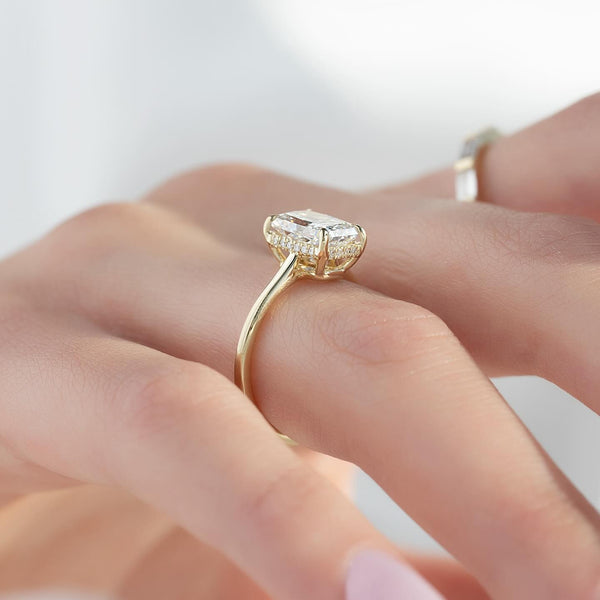
Profile height is what actually decides how often a ring snags. A tall setting catches jumper sleeves, pockets, gloves and hair; a low one does not. If the wearer works with their hands, has small children, or wears knitwear for half the year, a low-profile head matters far more than an extra half carat.
The useful test: the average centre stone in engagement rings now sits close to two carats. When cost stops constraining size, most people still land near that figure once they have worn a larger one for a week. If you are choosing above three carats, choose it because you want that presence — not because the price made it possible.
The wedding band problem nobody plans for
This is the most common avoidable regret, and it arrives a year later.
A wedding band has to sit flush against the engagement ring. If the engagement ring has a low head, a straight band fits. If it has a tall or wide head, or a halo that overhangs, a straight band will not sit flat — leaving a visible gap, or requiring a contoured band cut to match the specific ring, which is a bespoke job.
- Decide the band style before the engagement ring is made. If you want a plain straight band, choose an engagement ring head that allows one.
- Watch overhanging halos. A halo that projects sideways past the shank is the usual culprit.
- Rings in constant contact wear each other. Two rings rubbing at the same point for years will both thin there. A slightly wider or harder band on the outside takes the wear.
Ring size, and why it matters more with made-to-order
A made-to-order ring is cast to a specific size, which is what makes the price possible. Two things follow from that:
- Get the size right the first time. Measure at the end of the day when fingers are largest, at normal room temperature, and measure the knuckle as well as the base — the ring has to pass over the knuckle and then sit without spinning.
- Some designs cannot be resized later. Full eternity bands and rings with stones set all the way around the shank have no plain section to cut and rejoin. If size confidence is low, choose a design with a plain back half.
If you are buying as a surprise, our guide to buying jewellery online covers the practical ways to get a size without asking.
Insurance and appraisal
Non-diamond and lab-grown centre stones are insurable, but the process differs from a mined diamond. Two things make it straightforward:
- Keep the order confirmation. For a made-to-order ring it is the only document recording the exact specification — stone type, carat, cut, metal, karat, setting. An insurer needs identification more than valuation.
- Photograph it with a scale reference. A ruler alongside the ring is the shot everyone forgets. Without scale, a photograph cannot distinguish a one-carat stone from a three-carat one.
Lab grown stones from Mapple Gems are IGI certified, and the report is the strongest supporting document you can give an insurer. Moissanite is a different mineral and is not graded on the diamond scale, so the order record does that job instead. More detail in can you insure moissanite.
What to say when someone asks
People do ask, and the anxiety about it is usually worse than the reality. A few things that hold up:
- Say what it is, plainly. "It's moissanite" or "it's a lab grown diamond" is a complete answer, and delivered without hesitation it ends the topic. Awkwardness comes from hedging, not from the stone.
- Never let it be described as a mined diamond. Moissanite is a different mineral and should never be called a diamond; a lab grown diamond is a diamond and should always be disclosed as laboratory-grown. Being straightforward about this is what makes the ring comfortable to wear for decades.
- The context has changed. Lab-grown now accounts for the clear majority of engagement ring purchases. This is no longer an unusual choice that needs defending; it is the mainstream one.
A quick checklist before you order
- Stone: moissanite or lab grown diamond — nothing softer for a daily-wear ring.
- Metal: solid 925 sterling silver or solid 10K, 14K or 18K gold. Never plated base metal.
- Karat: 14K for a large or exposed centre stone; 18K where colour matters more than hardness.
- Head: low profile if the wearer uses their hands; prongs shaped to protect any points on the stone.
- Band: decided with the engagement ring, not a year later.
- Size: measured warm, at the end of the day, knuckle included.
- Records: order confirmation and a photograph with a ruler, stored somewhere other than your phone.
Keep reading
Frequently asked questions
What is the best diamond alternative for an engagement ring?
Moissanite or a lab grown diamond. They are the only affordable alternatives hard enough to survive daily wear on a hand without their facet edges abrading over time. Softer stones such as cubic zirconia and white topaz dull within a couple of years in a ring, and white sapphire, while durable, returns much less light.
How much should I spend on an engagement ring with an alternative stone?
There is no rule, but the allocation matters more than the total. Because moissanite and lab grown prices have fallen, put roughly a quarter to two-fifths into the centre stone and the rest into solid precious metal and setting quality. Over-spending on stone size and under-spending on the mount is the most common structural mistake.
Will people be able to tell it is not a mined diamond?
A lab grown diamond is a diamond, so no — it is identical to the eye and to standard testing, and is disclosed as laboratory-grown on its certificate. Moissanite is a different mineral with much stronger dispersion, so at larger sizes its coloured fire is visible to anyone who knows what to look for. Smaller moissanites are far harder to distinguish than large ones.
How big should the centre stone be?
Let the hand set the limit rather than the budget. A stone wider than the finger it sits on will rotate and catch, and a tall setting snags on knitwear, pockets and hair regardless of carat. The average engagement ring centre stone now sits close to two carats, and most people settle near that once they have worn something larger for a week.
Can you insure a moissanite or lab grown diamond ring?
Yes. Insurers need identification more than valuation, so keep the order confirmation, which for a made-to-order ring is the only record of the exact specification, and photograph the ring next to a ruler so scale is documented. Lab grown stones additionally carry an IGI report, which is the strongest supporting document available.
Will a wedding band sit flush against it?
Only if the engagement ring was designed with that in mind. A tall head or a halo that overhangs the shank prevents a straight band from sitting flat, which then requires a contoured band cut to match that specific ring. Decide the band style before the engagement ring is made rather than a year later.
Engagement rings made to your specification
Moissanite or IGI certified lab grown diamond, set in 925 sterling silver or solid 10K, 14K and 18K gold. Handcrafted to order in Surat.
Shop engagement rings
Leave a comment