Design
Designing Around a Large Stone
An alternative makes size affordable. It does not make the ring underneath it any stronger — and that is where large-stone rings actually fail.
Written by the Mapple Gems workshop, Surat · Updated 25 August 2026
Short answer
Above about three carats the ring stops being jewellery around a stone and starts being a structure carrying one. Specify six prongs, a 2mm shank, a euro shank, a low profile and an open gallery — and check the stone's millimetres against the hand before choosing a shape, because a large elongated stone can outrun the finger.
The most useful thing a diamond alternative does is make size a choice rather than a limit. Someone who could afford a one carat centre can afford three or four, and the price curve for moissanite rises gently enough that the step up is genuinely small.
What changes far less is the ring. A four carat head is roughly twice the mass of a two carat one sitting on the same geometry, and on an elongated shape that mass loads one axis rather than sitting symmetrically. Almost every large-stone disappointment we see is a setting failure rather than a stone failure.
Check the hand before the shape
Apparent size is a ratio between stone and finger, not an absolute. A 5.8mm stone on a size 4 hand reads roughly the way a 7mm one does on a size 7. So a large stone on a small hand is dramatic and a large stone on a larger hand can simply read as normal.
Two checks, both free, both done before choosing anything:
The paper circle test. Cut a shape at the stone's actual millimetre dimensions and hold it on the hand it is for. Most size regret is prevented here.
The finger-span check, for elongated shapes only. Measure the flat span between the knuckle joints. A 4ct marquise runs 15–16mm and on many hands that exceeds the span — the stone then sits over the joints rather than between them and the ring rocks slightly as the finger bends. A 4ct oval is around 12mm and rarely hits this.
| Shape at 4ct | Approx. mm | Watch for |
|---|---|---|
| Cushion | ~9.5 × 9.5 | Most compact footprint; easiest to carry |
| Round | ~10.2 diameter | Sits tall — profile height matters most here |
| Emerald | ~11.0 × 8.0 | Scale without rainbow; a prong per corner |
| Oval | ~12.0 × 8.0 | Covers most of the finger width |
| Pear | ~13.5 × 8.5 | One point — V-prong mandatory |
| Marquise | ~15–16 × 7.5–8 | Measure the knuckle span first |
The five structural specifications
- Six prongs, not four, above roughly 8mm. And V-prongs over every point if the shape has any — on a marquise that means both ends, on a pear the tip, on a princess all four corners.
- Shank at 2mm at the base. Width is cosmetic and can taper toward the head; thickness is the structural story and almost no listing states it. Under 1.8mm a shank carrying this much mass goes out of round within a few years, and once it deforms the setting stops sitting square.
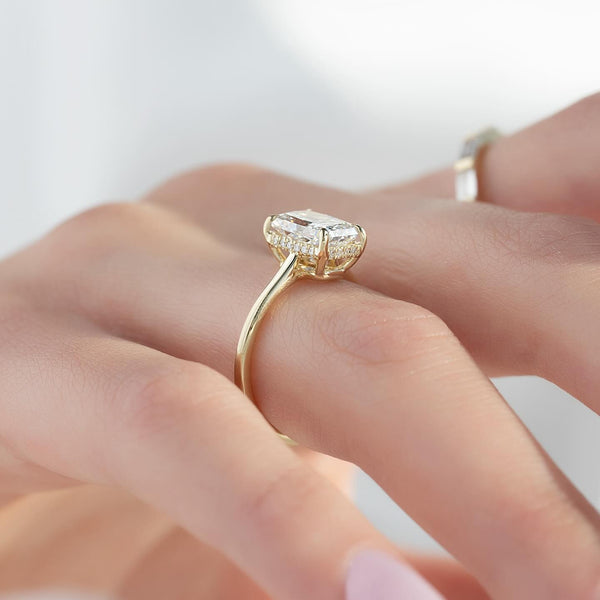
- A euro shank — a flattened section under the band that meets the flat underside of the finger. A heavy head turns readily, and this is the only fix that is invisible, permanent and maintenance-free. It has to be drawn in before casting.
- Profile height decided deliberately, in millimetres, on a side elevation. A large stone set high is a large stone that catches on everything, and on a pointed shape extra height lengthens the lever arm acting on the tips.
- An open gallery. Light entering from beneath fills the pavilion, and it is the only way the underside of a big stone can actually be cleaned. Film on the pavilion causes nearly every "my stone went dull" message.
One metal note: 14K rather than 18K where the metal is doing structural work. More gold means a softer alloy, and under a heavy head that matters. Both are solid gold; the choice here is durability, not quality.
From our bench in Surat
The delicate, thin-shanked designs are the ones we most often have to talk customers out of at this weight, and we understand why they want them: a narrow band makes a large stone look even larger in a photograph. That is a real optical effect and it is why those designs dominate catalogues, ours included.
The trade is that it is also the specification most likely to bring the ring back to a bench before its tenth birthday. We will make a thin shank under a four carat stone if you insist. We would rather you heard the sentence first, because a reshank later costs more than the extra half millimetre would have.
Design choices that carry scale well
A bezel. At large sizes it comes into its own: lowest possible profile, complete protection of any vulnerable outline, one setting point instead of six, and it usually takes a straight wedding band. In warm metal it also transfers the most colour into the stone, which calms a large moissanite noticeably.
A plain solitaire. With a stone this size, decoration competes rather than supports. A simple head lets the scale be the statement and keeps every future option open.
Step-cut side stones if you want width without adding fire — baguettes frame a large centre with far less dispersion than a halo of brilliants.
And two to think twice about. A full halo around a large moissanite multiplies an effect that is already the loudest thing on the hand. A hidden halo adds one to two millimetres of height and no apparent size at all — if you want it, ask for the low-profile version.
The band, decided now
A large centre almost always needs a contoured wedding band, and a contour is cut to one specific ring's profile. Drawn alongside the ring from the same CAD file it nests exactly; modelled afterwards from a finished object it fits well rather than exactly.
Run the straight-edge test on the side elevation before approving anything: lay a ruler flat against the side of the ring and look for daylight under the stone. If a plain straight band matters to you, a bezel or an east-west setting can often deliver it — but only if that is decided before casting.
Frequently asked questions
What changes in a ring above three carats?
The ring becomes a structure carrying a stone rather than jewellery around one. Six prongs instead of four, a 2mm shank, a euro shank, a deliberately low profile and an open gallery. Most large-stone problems are setting failures, not stone failures.
Can a stone be too large for a finger?
Elongated shapes can. A 4ct marquise runs 15–16mm, which on many hands exceeds the flat span between the knuckle joints, so the stone sits over the joints and the ring rocks as the finger bends. Measure that span before choosing the shape.
Which shape carries four carats most easily?
A cushion, at roughly 9.5 × 9.5mm, has the most compact footprint. An emerald cut gives scale with the calmest light return, which matters if the stone is a moissanite. Marquise and pear demand the most from both the hand and the setting.
Why does a large ring spin on the finger?
Because a heavy head is top-heavy and the round underside of a band sits on the flat underside of a finger. A euro shank — a flattened section under the band — fixes it permanently and invisibly, but it must be drawn in before casting.
Should a large stone have a halo?
Usually not. At this size the scale is already the statement, and around a moissanite a full halo adds 25–45 more dispersing stones to an effect that is already strong. Step-cut side stones add width with far less fire if you want it.
Size is the easy part now
The structure under it is the decision. Everything is made to order in our Surat workshop, so all five specifications are set before casting.
Leave a comment