Shape comparison
Emerald or Radiant
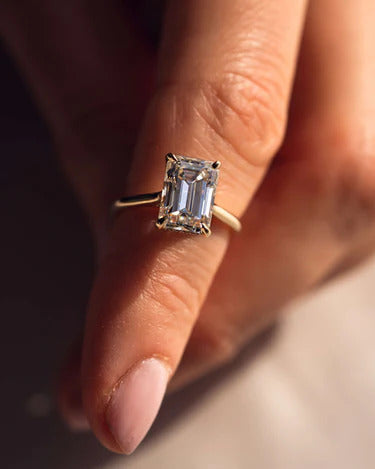
Two rectangles with cropped corners. One is a window and one is a firework, and the difference decides how much you have to spend on everything else.
Written by the Mapple Gems workshop, Surat · Updated 27 August 2026
Short answer
They share an outline and nothing else. An emerald cut is a step cut: few large facets, broad slow flashes, and a clear view into the stone that demands VS1 and a good colour grade. A radiant is brilliant-faceted inside the same shape: dozens of small facets, restless sparkle, and enough visual noise to carry an SI1 and a warmer colour comfortably. If the budget is fixed, the radiant lets you buy size; the emerald asks you to buy quality.
These two shapes get confused more than any other pair, and it is entirely reasonable that they do. Both are rectangular. Both have four cropped corners. Both are typically sold at similar ratios, both take the same style of setting, and in a small photograph on a phone they can be genuinely hard to separate.
Pick either one up and the confusion ends immediately. The radiant was designed in the 1970s specifically to solve the emerald cut's problem — that a rectangular stone with step faceting does not sparkle. It kept the outline and replaced everything underneath with brilliant-style faceting. So the two shapes are not variations on a theme. One is the deliberate opposite of the other.
The comparison that matters
| Emerald cut | Radiant cut | |
|---|---|---|
| Faceting | Step cut — long parallel planes | Brilliant — many small angled facets |
| Light behaviour | Broad, slow flashes; calm between them | Constant, busy scintillation |
| Clarity needed | VS1 or better | SI1 is usually eye-clean |
| Colour needed | G+ in white metal | H–I holds up; sparkle masks tint |
| Face-up size per carat | Smaller — weight sits in depth | Similar, sometimes fractionally larger |
| Hides a knock or scratch | No | Yes |
| Reads as | Restrained, architectural, vintage | Modern, showy, high-energy |
| Cut grade from a lab | None | None |
The last row applies to both and is worth stating plainly: no laboratory issues a cut grade for either shape. Cut quality on a rectangle is a buying decision you make with your own eyes on a rotating video, and nobody has done it for you.
What this means for a fixed budget
This is the practical heart of it. Take a figure — any figure — and the two shapes spend it differently.
On a radiant, the sparkle does work for you. An SI1 is usually eye-clean because the facet pattern is busy enough to break up an inclusion, and an H or I colour warms only slightly because the stone is throwing light rather than presenting a calm body of colour. Those two concessions free up real money, and the sensible place to put it is carat weight. A radiant is the shape where buying size is a defensible strategy.
On an emerald cut none of that is available. There is no sparkle to hide an inclusion and no scintillation to disguise a tint, so the concessions that make a radiant affordable make an emerald disappointing. The money has to go into clarity and colour, which means the stone will be smaller for the same spend. That is not a flaw in the shape; it is the shape. An emerald cut that has been bought like a radiant is the most common emerald cut regret we see, and the detail is covered in emerald cut clarity.
From our bench in Surat
We keep both shapes in the same tray and we still ask customers to look at them under a normal ceiling light rather than a lamp. Under a bright directional light the radiant wins every time — that is what it was designed for, and it is why jewellery shops are lit the way they are. Move to a kitchen at four in the afternoon and the picture reverses: the radiant goes slightly grey and busy, and the emerald keeps its depth.
Which is the honest way to choose. Most rings spend most of their life in ordinary indoor light, not in a showroom. So the question is not which sparkles more, but which you want to be looking at on a Tuesday. Ask any seller for video in unremarkable light. If everything they send is shot in a lightbox, they are showing you the radiant's best case and the emerald's.
Where they behave the same
- Corners. Both have four cropped corners that need prongs seated into them. Both are safer for it than a pointed shape.
- Wedding bands. Both have straight parallel sides, so both take a straight band more readily than an oval, pear or marquise.
- Depth. Both carry weight below the girdle, so both benefit from asking for depth percentage alongside the measurements.
- No cut grade. On both, your own eyes on a video are the assessment.
Which to choose
Choose the emerald cut if you want a stone that reads as considered rather than loud, if you like vintage and Art Deco design, if you are buying at a size where clarity is affordable, or if constant sparkle is something you actively find tiring.
Choose the radiant if you want maximum life from the stone, if the budget is the binding constraint and you would rather have size than grades, if the ring is for someone who wears it in bright environments, or if you like the rectangular outline but find a step cut too still. More on the shape itself in what is a radiant cut diamond and radiant cut engagement rings.
What to specify
- Video of both shapes in ordinary indoor light, not a lightbox, before deciding.
- Measurements line and depth percentage for each stone you are comparing.
- For an emerald: VS1 minimum, G+ in white metal.
- For a radiant: SI1 acceptable if confirmed eye-clean; H–I fine, and check it is not crushed-ice patterned unless you want that.
- Corner prongs seated into the girdle on either shape.
- The same ring quoted in both shapes, so you can see what the choice actually costs.
Keep reading
Oval vs emerald cut: a mirror or a window?
Frequently asked questions
What is the difference between an emerald cut and a radiant cut?
The outline is the same — a rectangle with four cropped corners. The faceting is opposite. An emerald cut is a step cut with a few large parallel planes, giving broad calm flashes. A radiant is brilliant-faceted inside that outline, giving constant sparkle. The radiant was designed to fix the emerald cut's lack of fire.
Which is better value, emerald or radiant?
A radiant stretches a fixed budget further, because its sparkle lets you accept SI1 clarity and an H or I colour and put the saving into size. An emerald cut needs VS1 and a better colour, so the same money buys a smaller stone. Neither is better value in the abstract — it depends whether you want size or stillness.
Does a radiant look bigger than an emerald cut of the same carat?
Usually a little, and it looks livelier, which reads as bigger again. Both shapes carry weight in depth, so neither faces up as large as a round of the same carat. Compare the actual millimetre measurements rather than the weights.
Can you tell them apart at a glance?
Not from the outline, which is why they are confused so often. You tell them apart by movement: an emerald cut flashes broadly and then goes calm, while a radiant sparkles continuously. In a still photograph the difference is subtle; in a video it is immediate.
Do both shapes take a straight wedding band?
Both are better at it than curved shapes like oval or pear, because their sides are straight and parallel. Whether a straight band actually sits flush still depends on the head design and setting height, so check the side elevation before casting either one.
See both before you decide
We will send the same ring quoted in both shapes, with video in ordinary light rather than a lightbox.
Leave a comment