Education
CT vs CTW vs CTTW: Reading Total Weight Correctly
Three letters that change what you are actually buying.
Written by the Mapple Gems workshop, Surat · Updated 19 August 2026
Short answer
CT is the weight of one stone. CTW and CTTW both mean carat total weight — every stone in the piece added together. A ring listed at “2 CTTW” may have a 1 ct centre and 1 ct spread across forty tiny accents, which looks nothing like a 2 ct solitaire. Always ask for the centre stone in millimetres separately. That single number tells you more than the total ever will.
This is the most common way a jewellery listing is technically accurate and completely misleading at the same time. Nobody is lying. The number is real. It just does not describe what you think it describes.
What each abbreviation means
| Abbreviation | Stands for | What it counts |
|---|---|---|
| CT | Carat | One individual stone |
| CTW | Carat total weight | Every stone in the piece, added up |
| CTTW | Carat total weight | Identical to CTW — just a different house style |
| DEW | Diamond equivalent weight | Used for moissanite: what carat a diamond of that size would weigh |
CTW and CTTW are the same thing. There is no hidden distinction between them, and any seller who tells you otherwise is improvising.
Why the total is a poor guide to how a ring looks
Carat is weight, and weight does not distribute itself evenly into visual impact. A single large stone dominates a hand. The same weight split into many small stones does not.
Consider two rings both listed at 2 CTTW:
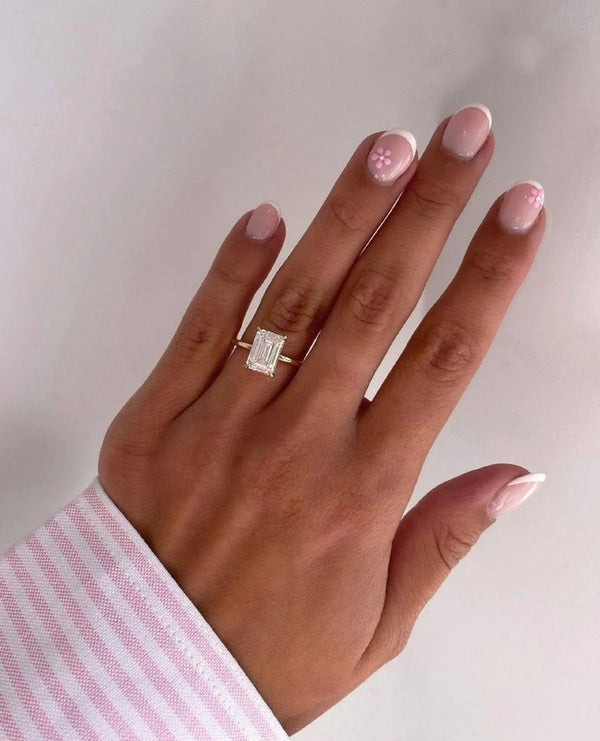
- Ring A — a 2 ct round solitaire. One stone, about 8.1 mm across.
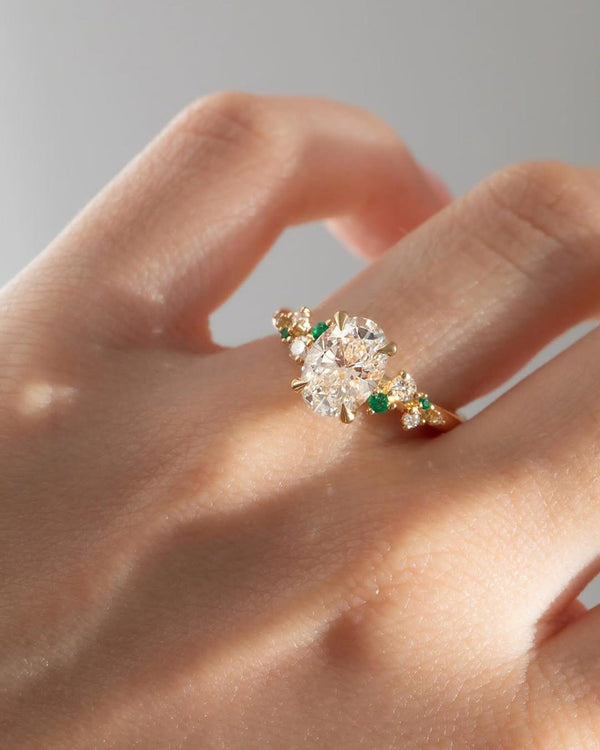
- Ring B — a 1 ct centre (about 6.5 mm) with a halo and a pavé shank carrying the other carat across sixty stones of 1.1 mm each.
Both are honestly described. On a hand they are not remotely comparable, and Ring B will usually cost less to make despite the identical total, because small stones cost far less per carat than large ones.
The one number to ask for. Not the total weight. The centre stone diameter in millimetres. It is unambiguous, it cannot be inflated by accents, and it is what someone actually sees across a table. Every listing we write gives it, and if a listing anywhere else does not, ask before you order — a seller who will not put a millimetre figure in writing is telling you something.
The moissanite complication
With moissanite there is a further layer, and it is not a trick — it is how the trade works.
Moissanite is silicon carbide, with a specific gravity of about 3.21 against diamond’s 3.52. It is roughly 15% less dense. So a moissanite cut to the same physical size as a 1 ct diamond actually weighs about 0.88 ct.
Rather than quote a confusing true weight, the trade quotes DEW — diamond equivalent weight. A stone sold as “1 ct moissanite” means “the size of a 1 ct diamond”, which is about 6.5 mm. It is a size statement dressed as a weight statement, which is why the millimetre figure matters even more here.
| Round diameter | Diamond weight | Moissanite true weight | Sold as |
|---|---|---|---|
| 5.0 mm | 0.50 ct | approx. 0.44 ct | 0.50 ct DEW |
| 6.5 mm | 1.00 ct | approx. 0.88 ct | 1.00 ct DEW |
| 8.1 mm | 2.00 ct | approx. 1.76 ct | 2.00 ct DEW |
| 9.5 mm | 3.00 ct | approx. 2.64 ct | 3.00 ct DEW |
Where totals are genuinely the right measure
None of this makes CTW a bad number. For some pieces it is exactly the correct one.
- Tennis bracelets and eternity bands. There is no centre stone. The total is the honest description, and a 5 CTW bracelet really does carry noticeably more than a 3 CTW one.
- Pavé and cluster pieces where the effect comes from many stones together rather than one.
- Insurance and valuation. Total weight is part of how a piece is described on a schedule.
The problem is only when a total stands in for a centre-stone figure that has been left out.
A short checklist before you buy
- Find the centre stone size in millimetres. If it is not stated, ask.
- Check whether the headline number is CT or CTW/CTTW. One stone, or all of them?
- If it is moissanite, confirm whether the carat figure is DEW or true weight. It is almost always DEW.
- Ask how many stones make up the total. “Sixty” and “three” are very different rings.
- Compare rings on centre-stone millimetres, never on totals.
Keep reading
- Round brilliant moissanite engagement rings — the millimetre rule in full
- Ten questions to ask any jeweller
- All Education guides
Frequently asked questions
What is the difference between CTW and CTTW?
There is none. Both stand for carat total weight — the combined weight of every stone in the piece. Different retailers simply use different abbreviations for the same measurement.
Is a 2 CTTW ring the same as a 2 carat ring?
No. A 2 CTTW ring contains 2 carats spread across all its stones, which might mean a 1 ct centre plus a halo and pavé. A 2 carat ring usually means a single 2 ct centre stone, about 8.1 mm across. They look completely different on the hand and are priced differently, because small stones cost far less per carat than large ones.
What does DEW mean for moissanite?
Diamond equivalent weight. Moissanite is about 15% less dense than diamond, so a stone the same physical size as a 1 ct diamond weighs closer to 0.88 ct. Rather than quote that, the trade quotes the diamond weight the size corresponds to. A 1 ct DEW moissanite is about 6.5 mm across.
How do I compare two rings fairly?
Compare centre stone diameters in millimetres, not total carat weights. Millimetres cannot be inflated by adding accent stones, and they describe what a person actually sees. Use total weight only for pieces with no centre stone, such as tennis bracelets and eternity bands.
We quote millimetres on everything.
Centre stone size, band width, profile height — in writing, before you order.
Leave a comment