Emerald cut
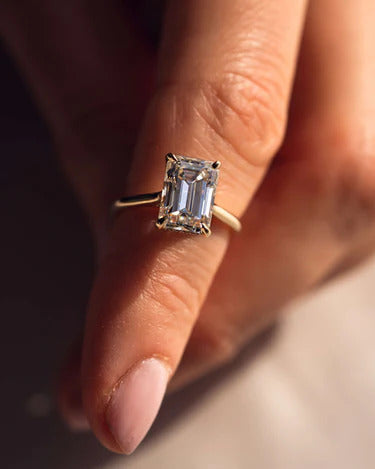
Two Carats, Step Cut
Two carats is the weight people ask for by name. On an emerald cut it buys a different ring than it does on a round, and the specifications you can safely economise on are not the same either.
Written by the Mapple Gems workshop, Surat · Updated 27 August 2026
Short answer
A two carat emerald cut measures roughly 8.8 × 6.0mm at a classic ratio, against about 8.1mm across for a two carat round. Despite being longer, it presents around a tenth less face-up area, because a step cut carries more of its weight in depth. Two carats is also the point where clarity and colour stop being negotiable: the open table that makes an emerald beautiful is the same table that shows everything.
Carat weight is a measure of mass, not of size, and the two only track each other within a single shape. Ask for two carats in a round brilliant and you get a fairly predictable 8.1mm circle. Ask for two carats in an emerald cut and what arrives depends on choices the cutter made about depth and proportion — choices no laboratory grades, because fancy shapes receive no cut grade at all.
This is worth understanding before you buy rather than after, because the difference is visible. If you have been comparing weights across shapes, which shapes look biggest for the carat covers the broader picture; this piece is about what happens at two carats specifically, in a step cut.
What two carats measures
Approximate face-up dimensions for an emerald cut at a classic ratio of around 1.45, with the round brilliant of the same weight for comparison.
| Weight | Emerald cut (mm) | Round brilliant (mm) | Note |
|---|---|---|---|
| 1.50 ct | 8.0 × 5.5 | 7.4 | Reads long without reading large |
| 1.75 ct | 8.4 × 5.8 | 7.8 | Sits below a price threshold |
| 1.90 ct | 8.7 × 5.9 | 8.0 | 0.1mm shorter than a 2.00 and materially cheaper |
| 2.00 ct | 8.8 × 6.0 | 8.1 | The named weight, and priced as one |
| 2.25 ct | 9.2 × 6.3 | 8.4 | Where the length starts to be obvious |
Figures are approximate and move with depth percentage, girdle thickness and the ratio the cutter chose. They are a guide for what to expect, not a substitute for the measurements line on a specific stone.
The line that surprises people is 1.90 against 2.00. A tenth of a carat separates them, one tenth of a millimetre of length separates them on the hand, and a meaningful sum separates them on the invoice — because two carats is a threshold buyers ask for by name and pricing responds to that, not to size. If somebody is going to see the certificate, buy the 2.00. If nobody is, the 1.90 is the same ring for less. The same logic applies at 1.40 against 1.50, and it is worth knowing what ct, ctw and cttw each refer to before comparing listings at all.
Why it faces up smaller than a round
A step cut is built from long, flat, parallel planes rather than dozens of small scattered facets, and it needs depth to make those planes work. That depth is weight you have paid for and cannot see from above. A well-cut emerald typically runs deeper as a percentage than a round of the same weight, so more of the two carats sits below the girdle.
Take the numbers above. A 2.00ct round covers about 52 square millimetres of finger. A 2.00ct emerald at 8.8 × 6.0mm, once you account for the four cropped corners, covers roughly 46. It is longer, and it is smaller. Both things are true, and the eye tends to register the length — which is why an emerald cut reads elegant rather than large, and why buyers who wanted large occasionally feel short-changed by a stone that is doing exactly what a step cut does.
The lever you have here is proportion rather than weight. A longer stone at the same carat buys visible length at the cost of width. We have written about the trade in oval vs emerald cut, where the same weight in a brilliant-cut outline behaves quite differently.
From our bench in Surat
Two carats is the size at which a step cut stops forgiving anything. On a brilliant, a small feather near the girdle disappears into the sparkle and an I colour warms up pleasantly in yellow gold. On an 8.8mm emerald table you are looking through a window into the stone, undisturbed, in ordinary indoor light. We have had customers accept a VS2 on a two carat emerald against our advice and ask us to reset a different stone within the year. Nothing was wrong with the diamond; they could simply see it.
The concession that goes with that: our product pages list carat weight, not the millimetre measurements or the depth percentage, so you cannot currently do this comparison from our listings alone. Ask us and we will send the measurements line for the specific stone. Any seller who answers a request for millimetres with a carat figure is describing a category, not a stone.
Where to spend, and where not to, at this size
- Spend on clarity. VS1 or better on a two carat emerald, and eye-clean confirmed on video rather than inferred from a grade. This is the one shape where clarity outranks almost everything.
- Spend on colour, in white metal. G or better if the stone is going into platinum or white gold. In yellow or rose, H is comfortable — the metal does the work.
- Spend on shank thickness. 2mm at the base is the minimum we would set a two carat emerald on. A large step cut is a heavy, top-loaded head and a thin shank goes out of round under it.
- Do not spend on the round figure. 1.90 against 2.00, unless the certificate is going to be read aloud.
- Do not spend on flawless. Above VS1 the difference on a two carat emerald is real to a loupe and invisible to a person.
What the setting has to do at two carats
An emerald cut has four cropped corners, and every one of them is a bearing point where the girdle runs thin. At two carats there is more mass pressing on those corners than at one, so the setting is doing more work than it looks like it is doing. Corner prongs, properly seated, are not optional — and this is the argument for a bezel or half-bezel on a large step cut, covered in the best settings for an emerald cut.
The other consequence is height. A two carat step cut is a deep stone, and a deep stone in a high head becomes a ring that catches on everything. Ask for the profile height in millimetres on a side elevation before casting, not after.
What to specify
- Full measurements line — length, width and depth in millimetres — for the actual stone.
- Depth percentage, and a note of anything above the mid sixties.
- Rotating video in ordinary indoor light, not a lightbox.
- Clarity VS1 or better, confirmed eye-clean on that video.
- Corner prongs seated into the girdle, and the shank at 2mm minimum at the base.
- Side elevation with profile height, before casting.
- A price for 1.90 alongside the price for 2.00, so you can see what the threshold costs.
Keep reading
Emerald cut engagement rings: what to check before you buy
Frequently asked questions
How big is a 2 carat emerald cut in millimetres?
Roughly 8.8 × 6.0mm at a classic ratio of about 1.45, though it varies with depth and proportion. A longer stone of the same weight might measure 9.1 × 5.8mm, a squarer one 8.4 × 6.3mm. Always ask for the measurements line rather than working from carat weight.
Does a 2 carat emerald cut look smaller than a 2 carat round?
In face-up area, yes — about a tenth smaller, because a step cut carries more of its weight in depth. It is longer than the round, though, and length is what the eye tends to register on a hand. Emerald cuts read elegant rather than large.
What clarity do I need for a 2 carat emerald cut?
VS1 or better, and confirmed eye-clean on a rotating video. A step cut's open table gives you an undisturbed view into the stone, so inclusions that would vanish in a brilliant's sparkle stay visible. This is the single most important specification at this size.
Is a 1.90 carat emerald cut worth considering instead?
Often, yes. It is about a tenth of a millimetre shorter on the hand and sits below the two carat pricing threshold, so it can cost noticeably less for a difference nobody sees. The exception is when the certificate itself matters to the person receiving it.
Does a 2 carat emerald need a thicker band?
Yes. We would not set a two carat step cut on less than 2mm at the base of the shank. The head is heavy and top-loaded, and a thinner band will go out of round under it over years of wear. Width can taper toward the head; thickness should not.
Ask for the measurements line
Every emerald we set is made to order in our Surat workshop. Tell us the weight, the ratio and the metal, and we will send the millimetres before anything is cast.
Leave a comment