Moissanite 101
Moissanite in Yellow and Rose Gold
Warm metal changes what the stone looks like — usefully, and in a direction most people are not told about.
Written by the Mapple Gems workshop, Surat · Updated 23 September 2026
Short answer
Warm metal does two things at once. It reflects into the stone, so a colourless moissanite picks up a faint warmth from the setting — which most people find flattering rather than a flaw — and it softens the rainbow flash, because warm reflections compete with the dispersed colour. So yellow and rose gold are the quiet choice for anyone who likes moissanite but not the fire. The trade: a warm setting also masks any tint, which matters less here since moissanite is not colour-graded anyway.
Metal colour is usually treated as pure preference. With moissanite it is closer to a technical decision, because the setting genuinely changes how the stone behaves.
Warm metal is the cheapest way to reduce moissanite’s fire, and almost nobody suggests it. The usual advice for someone who finds moissanite too rainbow-heavy is to change the stone — a step cut, a smaller size, an antique cut. All of those work. But the setting does a surprising amount on its own: a yellow or rose gold basket sits directly beneath and around the pavilion, and every warm reflection it throws back into the stone competes with the dispersed spectral colour, muting it. The same stone that reads as noticeably prismatic in a white gold or platinum head reads considerably calmer in 14K yellow. Set the same 6.5 mm stone in white and in yellow and put them side by side — the difference is obvious and it costs nothing. The reverse is also true and worth knowing: if you want maximum fire, a white metal head is what delivers it. This is the one design lever that adjusts a moissanite’s character without changing the stone at all.
What each metal does
| Setting metal | Effect on the stone |
|---|---|
| White gold / platinum | Stone reads neutral; maximum fire |
| 14K yellow | Faint warmth; fire noticeably softened |
| 18K yellow | Stronger warmth; softest of the golds |
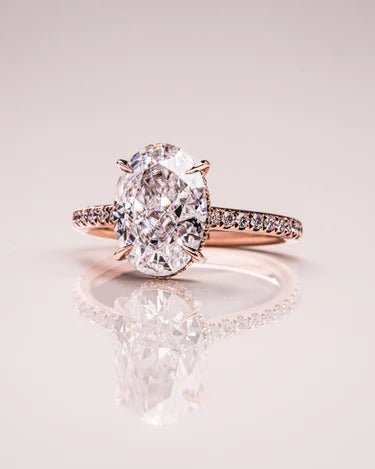
| Rose gold | Pink cast into the stone; very distinctive |
| Two-tone | White head, warm band — both at once |
The last row is the answer for most people who cannot decide. A white head with a yellow or rose shank keeps the stone reading neutral where it matters — against the metal touching it — while the warm band does the visual work on the hand. It is also the more durable build, since white metal prongs wear better.
The setting decides how much warmth transfers
How much colour the metal throws into the stone depends on how much metal is near it.
- Bezel — the most contact, so the most warmth. A rose gold bezel visibly tints the stone at the edges. Deliberate and lovely, but see it in video first.
- Basket or cathedral — moderate. Metal below and around the pavilion.
- Peg head or open gallery — the least metal near the stone, so the least colour transfer and the most light in.
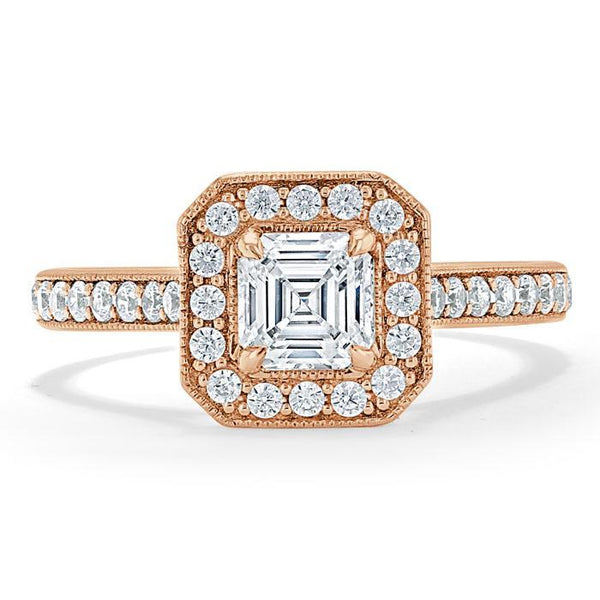
- Halo in a warm metal — twenty to forty small brilliants each reflecting warmth, which softens the overall effect more than a plain setting would.
Practical differences between the golds
14K is harder than 18K and resists deformation better, which matters most on the shank. 18K is warmer in colour and softer — fine at 2 mm thickness, less so thin.
Rose gold has the highest copper content, which is what makes it pink. That has one consequence worth knowing: copper is what reacts with sweat to leave a green mark on skin, so rose gold does it most, particularly in heat and humidity. It is harmless, it washes off, and it is the alloy rather than the stone — moissanite is chemically inert.
And both are lower maintenance than white gold, which is a plated alloy needing replating every one to two years for as long as it is worn. Choosing warm gold removes that recurring cost entirely.
Choosing without seeing it in person
- Ask for rotating video in ordinary indoor light, not a lightbox — warmth transfer and fire both show completely differently under studio lighting.
- Ask to see the same design in two metals if the workshop has both. Most do, and the comparison settles it in seconds.
- Say what you want the stone to do. “I like the size but not the rainbow” is an actionable brief, and warm metal is part of the answer.
- Specify the fineness number, not the colour word — 585 or 750. Rose and yellow recipes vary between workshops, so “rose gold” alone is not a specification.
- Consider two-tone before compromising in either direction.
One thing this does not change
Metal colour has no effect on durability, cleaning or how the stone wears. Moissanite is chemically inert, so chlorine, perfume, sunscreen and cosmetics affect only the metal — and the reason a stone in any setting goes dull is a film on the pavilion, cleared in two minutes with warm soapy water and a soft brush from underneath.
If anything, warm gold is more forgiving day to day: no plating to wear through, no white surface showing a warm underlayer, and marks that blend into a brushed finish rather than standing out against a mirror one.
Keep reading
Frequently asked questions
Does yellow gold make moissanite look less sparkly?
It softens the rainbow flash rather than the brightness. Warm reflections from the setting compete with the dispersed spectral colour, so the same stone reads noticeably calmer in yellow gold than in white gold or platinum. It is the cheapest way to reduce moissanite’s fire without changing the stone.
Will a warm setting make the stone look yellow?
It picks up a faint warmth, which most people find flattering rather than a flaw. How much depends on the setting: a bezel has the most metal contact and transfers the most, while a peg head or open gallery transfers the least. A white head on a warm shank avoids it entirely.
Is rose gold a good choice for moissanite?
It gives the most distinctive result — a pink cast into the stone and the softest fire of any metal — so see it in rotating video before committing. Rose gold also has the highest copper content, which is what can leave a harmless green mark on skin in heat and humidity.
Which metal is lower maintenance?
Yellow and rose gold, by a clear margin. White gold is a plated alloy that needs rhodium replating every one to two years for as long as it is worn, while warm golds need none. 14K also resists deformation better than 18K, which matters most on the shank.
Ask to see the same design in two metals.
Rotating video, ordinary indoor light. The comparison settles the question in about ten seconds.
Leave a comment