Moissanite 101
How Moissanite Is Cut, and Why It Is Harder to Get Right
Different optics mean different angles. A cutter who treats it like diamond produces a worse stone.
Written by the Mapple Gems workshop, Surat · Updated 6 September 2026
Short answer
Moissanite has a higher refractive index (about 2.65–2.69 vs diamond’s 2.42) and is doubly refractive, so light behaves differently inside it. Proportions optimised for diamond are not optimal here, and the doubling has to be managed by orienting the stone along its optic axis during cutting — get that wrong and the stone looks slightly soft even when the polish is perfect. It is also physically hard: at Mohs 9.25 it takes longer to cut than almost anything except diamond.
Cutting is the part of moissanite nobody discusses, and it is where the difference between two apparently identical stones actually lives — because no laboratory grades it, so nothing on paper distinguishes careful work from careless.
Why diamond proportions do not transfer
A cut is a set of angles designed to bounce light back to the eye rather than let it escape through the bottom. The correct angles depend on the material’s refractive index — how sharply it bends light.
Diamond sits at 2.42. Moissanite is higher, at roughly 2.65–2.69. That difference changes the critical angle at which light is internally reflected rather than lost, which means the ideal pavilion angles differ.
A cutter who simply applies a standard diamond template to silicon carbide gets a stone that works, but not one that works as well as it could. Well-cut moissanite is cut for moissanite.
The optic axis problem, which is unique to this material. Diamond is singly refractive: light passes through as one ray. Moissanite is doubly refractive — light splits into two rays travelling at slightly different speeds, which is exactly how a jeweller identifies it under a loupe. That doubling is unavoidable, but it can be minimised: silicon carbide has an optic axis along which the effect is least, and a careful cutter orients the rough so the table is aligned to it. Cut off-axis to save weight from an awkward piece of rough and the doubling becomes more visible from the top, which reads as a faint softness or blurring in the facet pattern. It is not something a buyer can see named anywhere — it just shows up as one stone looking crisper than another.
The physical difficulty
At Mohs 9.25, moissanite is harder than sapphire and second only to diamond among stones in common use. Practically, that means it is cut and polished with diamond tooling, and it takes noticeably longer than corundum or quartz.
Two consequences follow. Cutting labour is a real proportion of the finished cost, unlike with cheaper simulants. And a cutter under time pressure is tempted to stop polishing sooner — which shows up as slightly rounded facet junctions rather than crisp meeting points.
What good cutting looks like
| Look for | What it means |
|---|---|
| Crisp facet junctions | Polishing was finished properly, not stopped early |
| A sharp, defined pattern from the top | Cut on-axis; doubling minimised |
| No permanently dark zone | Pavilion angles correct for the material |
| Symmetrical outline | Cut to shape rather than to save weight |
| Dimensions at or just under standard for the DEW | Not spread shallow to look bigger |
All five need video, rotating, in ordinary indoor light. A still cannot show four of them.
Why faceting style is a separate decision
Do not confuse how well a stone is cut with how it is styled. Both a crushed-ice cushion and a chunky antique cushion can be beautifully cut; they simply distribute moissanite’s strong dispersion differently.
Many small facets scatter the fire into rainbow flashes. Few large facets return broad clean flashes with less colour separation. That is a preference, and it is the single biggest lever on how obviously moissanite reads as moissanite.
Quality and style are independent: you can have a badly cut emerald and a superbly cut crushed-ice round, or the reverse.
The hearts-and-arrows question
Some moissanite is sold as precision cut with a hearts-and-arrows pattern visible under a special viewer. Where genuine, it indicates careful, symmetrical work — the pattern only appears when facets are aligned precisely.
Two caveats worth holding. It is not a graded standard in moissanite the way it is loosely used in diamond, so it is a claim rather than a certification. And a stone can be beautifully cut without it, particularly in fancy shapes where the pattern does not apply at all.
Treat it as evidence of care rather than as proof, and still ask for video.
What to ask
- Video of the specific stone, rotating, in ordinary light rather than a lightbox.
- Its millimetre dimensions, to check against the standard for that DEW.
- The faceting style — brilliant or step, and on a cushion, crushed ice or chunky.
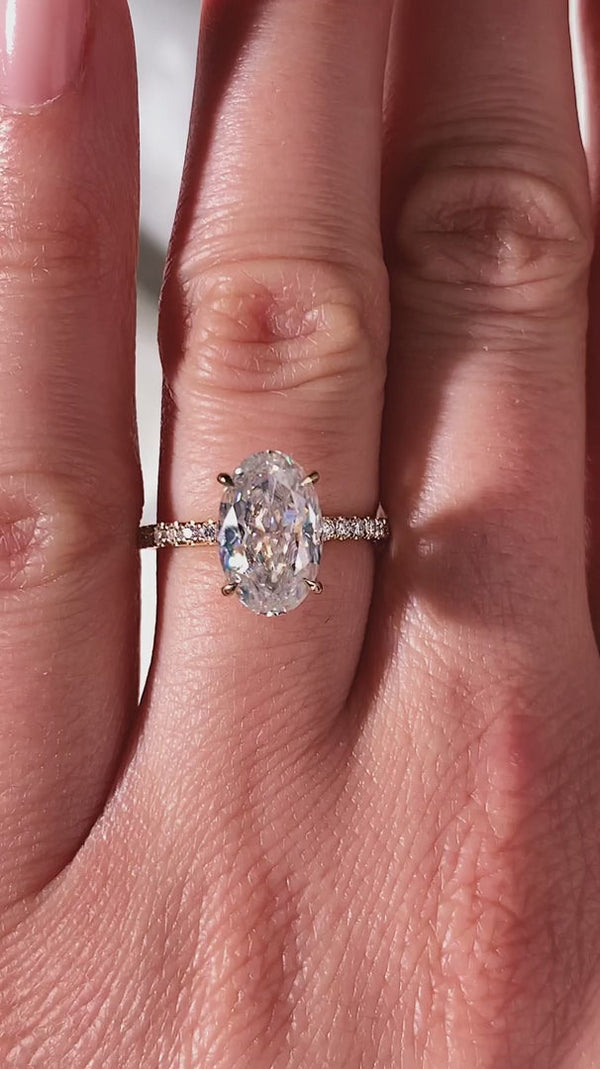
- A straight-on photograph of the stone alone, to judge outline symmetry.
- Whether you can see it before it is set — several of these checks get harder afterwards.
Keep reading
Frequently asked questions
Is moissanite cut differently from diamond?
It should be. Moissanite’s refractive index is about 2.65–2.69 against diamond’s 2.42, which changes the critical angle for internal reflection and therefore the ideal pavilion angles. A diamond template applied to silicon carbide produces a stone that works, but not one that performs as well as it could.
What is the optic axis in moissanite cutting?
Moissanite is doubly refractive, meaning light splits into two rays, and there is an axis along which that doubling is least visible. A careful cutter orients the rough so the table aligns to it. Cutting off-axis to save weight makes the doubling more visible from the top, which reads as a faint softness in the facet pattern.
Is hearts and arrows moissanite worth paying more for?
Where genuine, the pattern indicates careful symmetrical work, since it only appears when facets are precisely aligned. But it is not a graded standard in moissanite, so it is a claim rather than a certification, and a stone can be beautifully cut without it — particularly in fancy shapes, where the pattern does not apply. Ask for video regardless.
Why does one moissanite look crisper than another?
Usually orientation and finishing. A stone cut off its optic axis shows more of the doubling effect from the top, which blurs the facet pattern slightly, and polishing stopped early leaves rounded rather than crisp facet junctions. Neither appears on any document, which is why video is the only assessment available.
Ask to see the stone before it is set.
Rotating, in ordinary light, straight on. Nothing on paper will tell you what that thirty seconds will.
Leave a comment