Oval diamonds
The 2 Carat Oval
Two carats has quietly become the ordinary size. Here is what it measures, what changes in the ring around it, and the one buying decision that saves the most.
Written by the Mapple Gems workshop, Surat · Updated 21 August 2026
Short answer
A 2ct oval measures roughly 9.7 × 7.0 mm at a 1.40 ratio — noticeably longer than a 2ct round at about 8.1mm across. At this weight, move to six prongs, keep the shank at 1.8mm or more, and consider buying at 1.90ct instead: the stone measures almost identically but sits below a price threshold.
The average centre stone in a new engagement ring has climbed towards 1.9 carats, and lab grown diamonds are the reason. Prices per carat fell sharply between 2020 and 2024 and have since settled near production cost, which moved two carats from an unusual purchase to a fairly standard one.
That creates a specific question that barely existed five years ago: what actually changes when you put two carats of oval on a hand?
How big it really is
Carat is a unit of weight, not size. An oval spreads that weight into face-up area rather than depth, which is why an oval looks larger than a round of the same carat. Approximate face-up dimensions at 2ct, by ratio:
| Shape and ratio | Approx. face-up size at 2ct | Reads as |
|---|---|---|
| Round brilliant | 8.1 mm diameter | Compact, wide across the finger |
| Oval at 1.30 | 9.3 × 7.2 mm | Full and generous |
| Oval at 1.40 | 9.7 × 7.0 mm | The classic oval |
| Oval at 1.50 | 10.2 × 6.8 mm | Visibly elongated |
| Oval at 1.60 | 10.6 × 6.6 mm | Long and narrow |
Two things to take from that. The oval gains 1.5–2.5mm of length over a round at the same weight. And as the ratio rises, width falls — the stone gets longer and covers less of the finger, which is the opposite of what most people assume they are buying.
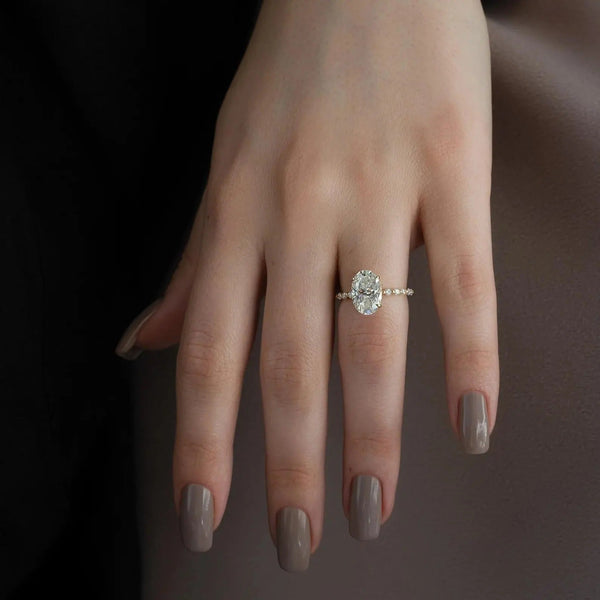
Apparent size is also a ratio, not an absolute. A 9.7mm oval on a size 4 finger reads roughly the way a 12mm stone would on a size 7. Before settling on two carats, hold a paper cut-out at the actual millimetres against the actual hand. It takes five minutes and prevents the commonest size regret.
The just-under trick
This is the single most useful thing on this page.
Prices step up at round carat figures — 0.50, 0.70, 1.00, 1.50, 2.00. Those thresholds exist because of how stones are bought and sold, not because of anything visible. Sizes, meanwhile, rise smoothly and continuously.
So a 1.90ct oval and a 2.00ct oval at the same ratio differ by roughly two tenths of a millimetre in length. Nobody has ever detected that difference on a hand. But the 1.90 sits below a pricing threshold and the 2.00 sits above it.
The same works at 0.90 instead of 1.00, at 1.40 instead of 1.50, and at 2.90 instead of 3.00. It is the cleanest saving available in diamond buying, it costs you nothing visible, and it is available simply by asking for it.
The one honest caveat: some people want to be able to say "two carats". If that matters to you, it matters, and no millimetre argument changes it. Just make the trade knowingly.
From our bench in Surat
Most disappointments with large stones are not stone problems. They are setting problems. At two carats an oval is heavy enough that the ring around it starts doing real structural work, and a head or shank drawn for a one carat centre does not simply scale up — it carries roughly twice the mass on the same geometry.
The uncomfortable part for us to say: the delicate, thin-shanked designs that photograph best are the ones we most often have to talk customers out of at this weight. Under about 1.8mm at the base, a shank carrying a 2ct oval goes out of round within a few years, and when the shank deforms the setting above it stops sitting square. We will still make it thin if you insist. We would rather you knew first.
What changes in the ring at two carats
- Six prongs rather than four. More mass on the same contact points, and enough length in the outline that both tips want covering.
- Shank at 1.8mm minimum, 2mm preferably. Width is cosmetic; thickness is structural, and almost no listing states it.
- A euro shank becomes close to essential. A heavier head turns on the finger more readily, and a flattened underside stops it.
- The bow-tie is more visible. There is simply more table area to see it through, so the video test matters more here than at one carat.
- Profile height needs deciding deliberately. A large oval set high is a large oval that catches on everything.
- The contoured band is effectively mandatory. Order it with the ring, drawn from the same file.
Colour and clarity at this weight
Two carats sits below the point where you need to step up grades. Above roughly 3ct both colour and clarity want raising a notch, because there is more stone for anything to show through. At 2ct, ordinary guidance holds: H–I in yellow or rose gold, G or better in white gold or platinum.
On clarity, position beats grade. Open the plot diagram on the report — red marks internal inclusions, green marks surface features. The two questions are whether anything sits under the table and whether it is visible without magnification. A well-placed SI1 outperforms a badly-placed VS2 and costs less. And a prong can be oriented to sit over a girdle inclusion, which is a free request almost nobody makes.
One thing no report will tell you at any weight: cut. No laboratory grades cut on a fancy shape, so on the specification that most determines whether your 2ct oval looks bright or flat, the document is silent and you are the grader.
Keep reading
Lab grown diamond size chart: mm by carat and shape
Frequently asked questions
How many millimetres is a 2 carat oval diamond?
Roughly 9.7 × 7.0 mm at a 1.40 length-to-width ratio. A longer 1.50 ratio runs about 10.2 × 6.8 mm, and a fuller 1.30 about 9.3 × 7.2 mm. For comparison, a 2ct round brilliant is about 8.1mm across.
Is a 2 carat oval too big for everyday wear?
Not inherently — it is a setting question, not a size one. A 2ct oval set low, in a bezel or a low-profile head with six prongs and a 1.8mm shank, wears comfortably every day. The same stone set high on a thin band does not.
Is 1.90ct really cheaper than 2.00ct?
Yes, and by more than the weight difference suggests, because round carat figures are pricing thresholds while physical size rises smoothly. The two stones differ by roughly two tenths of a millimetre in length — not detectable on a hand.
What colour grade should a 2 carat oval be?
H–I in yellow or rose gold, G or better in white gold or platinum. Two carats sits below the point where grades need stepping up; that begins above roughly three carats, where there is more stone for colour to accumulate through.
Does a 2 carat oval get a cut grade on its report?
No. No laboratory grades cut on any fancy shape — cut grades exist only for round brilliants. Polish and symmetry are graded but are not substitutes, so cut quality has to be judged from a rotating video in ordinary light.
Ask us to quote 1.90 as well as 2.00
Everything is made to order in our Surat workshop, so weight, ratio, prong count and shank thickness are all still open before casting.
Leave a comment