Shape comparison
Oval or Emerald Cut?
A mirror or a window. The choice between these two decides which grades you have to buy — and the difference is worth real money.
Written by the Mapple Gems workshop, Surat · Updated 22 August 2026
Short answer
An oval is a brilliant cut — many facets returning scattered light, which hides tint and inclusions. An emerald is a step cut — long parallel facets acting as a window into the stone, which hides nothing. Expect to buy one grade higher on both colour and clarity for an emerald, and expect it to face up smaller per carat.
These two shapes are not variations on a theme. They are opposite philosophies of what a diamond should do with light, and choosing between them changes your entire specification — not just the outline.
Brilliant versus step cut
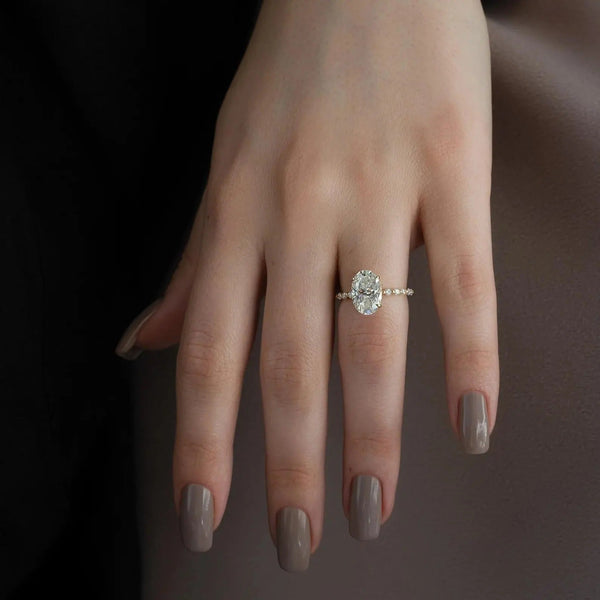
An oval is a brilliant cut. Its pavilion is covered in many triangular and kite-shaped facets angled to bounce light back to the eye from every direction at once. The result is scattered, busy, high-contrast sparkle. That visual noise is doing a second job people rarely notice: it camouflages anything you would rather not see.
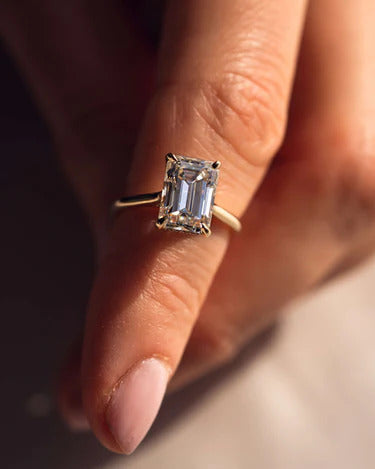
An emerald is a step cut. Its facets are long, parallel and arranged in tiers like steps, running the length of the stone. Instead of scattering light it produces broad flashes and a hall-of-mirrors depth, and instead of hiding the interior it presents it. You are looking into the stone rather than at its surface.
Everything else follows from that one difference.
What changes in your specification
| Oval (brilliant) | Emerald (step cut) | |
|---|---|---|
| Approx. size at 1ct | 7.7 × 5.5 mm | 7.0 × 5.0 mm |
| Clarity to buy | Standard — position matters more than grade | One grade higher |
| Colour to buy | H–I in warm metal, G+ in white | One grade higher in any metal |
| Bow-tie | Always present | None |
| Prong requirement | At the shoulders, not the tips | One over every corner — four minimum |
| Cut grade on the report | None | None |
| How it ages as a style | Has never really dated | Has never really dated |
The two grade rows are where the money moves. An emerald asks you to spend upward on colour and clarity and gives you less face-up size per carat in return. That is not a bad deal — it buys a completely different look — but it is a real cost and it is rarely stated when the shape is recommended.
Where each one is more forgiving
The oval forgives the interior. Scattered brilliance means a well-placed inclusion often disappears entirely. Open the plot diagram on the report — red marks internal features, green marks surface ones — and the two questions are whether anything sits under the table and whether it is visible unmagnified. On an oval, a well-placed SI1 routinely outperforms a badly-placed VS2 and costs less. A prong can even be oriented to sit over a girdle inclusion, which is a free request almost nobody makes.
The emerald forgives the outline. Its long straight sides and cropped corners make it structurally calm: no thin tapered tips, no bow-tie, and no ambiguity about symmetry. What it will not forgive is a feather or a crystal anywhere near the table, because there is nothing to break up your view of it. On an emerald, clarity is not a number to optimise — it is the thing you are looking at.
From our bench in Surat
There is one warning worth giving that applies to emeralds and not to ovals. A step cut shows the quality of the cutting with nowhere to hide. If the parallel facets are not truly parallel, or the tiers are not evenly spaced, the hall-of-mirrors effect breaks and the stone looks slightly wrong in a way most people cannot name.
Since no laboratory grades cut on either shape, that is a judgement we make and you inherit. Ask us for a straight-down video of an emerald with the table filling the frame — the facet lines should run dead parallel and the tiers should step evenly. On an oval, ask for the opposite: a tilting handheld video, in an ordinary room, to see how the bow-tie behaves.
Setting the two
An emerald wants a prong over each of its four corners, because a cropped corner is where a step cut is thinnest. Beyond that it is one of the easier stones to set: it sits stably, it takes a straight wedding band more readily than an oval, and it looks completely at home in a bezel.
An oval wants prongs at the shoulders rather than the tips, and usually a contoured band. It also benefits from an open gallery more than an emerald does, since light entering from beneath reduces how much you notice the bow-tie.
One shared piece of advice: neither shape should be bought from still photographs. A lightbox flatters an oval by hiding its bow-tie and flatters an emerald by lighting facets that would look flat in a room.
Which to choose
- Oval for maximum face-up size per carat, for the flexibility to drop a colour or clarity grade, and for scattered lively sparkle.
- Emerald for a calm, architectural look, broad flashes rather than glitter, and a shape with no bow-tie to judge.
- Emerald also if you dislike busy sparkle — this is a genuine preference and worth naming rather than treating as a compromise.
- Oval if budget is tight, because the grade savings it permits are real and the emerald's requirements run the other way.
Keep reading
Frequently asked questions
Does an emerald cut sparkle less than an oval?
It sparkles differently rather than less. An oval scatters light into many small flashes; an emerald returns broad flashes and depth through long parallel facets. If you want glitter, the oval delivers it; if you want calm, the emerald does.
Why do emerald cuts need a higher clarity grade?
Because a step cut is a window into the stone rather than a mirror on its surface. There is no scattered brilliance to break up your view, so inclusions that would vanish in an oval remain visible. Plan on one grade higher for both clarity and colour.
Which looks bigger, an oval or an emerald?
The oval. At 1ct an oval faces up around 7.7 × 5.5 mm against an emerald's 7.0 × 5.0 mm, because step cuts carry more weight below the girdle. The oval also has a bow-tie, which the emerald does not.
Is an emerald cut more fragile?
Less so than most fancy shapes, because its corners are cropped rather than pointed. Each corner still needs its own prong, since that is where a step cut is thinnest. An oval's tapered tips are comparably vulnerable and need cover at the ends.
How do I judge cutting quality on an emerald?
Ask for a straight-down video with the table filling the frame. The parallel facet lines should run dead straight and the tiers should step evenly. Uneven spacing breaks the hall-of-mirrors effect, and no report will flag it because no laboratory grades cut on fancy shapes.
Different shape, different specification
Made to order in our Surat workshop, so the grades, the prong build and the band are all chosen for the shape rather than inherited from a template.
Leave a comment