Oval diamonds
Elongated Ovals: Should You Buy One?
The most requested lab grown shape of 2026 — and a word with no agreed meaning behind it.
Written by the Mapple Gems workshop, Surat · Updated 21 August 2026
Short answer
"Elongated" is a style label, not a measurement — it is applied to anything from about 1.40 upward. A genuinely elongated oval sits around 1.50 to 1.60. It lengthens the finger and reads modern, but it is narrower across the finger, more prone to a wide bow-tie, and needs prong cover at both tips. Judge it by ratio and video, never by the word.
If you have looked at oval engagement rings this year, you have read the word "elongated" a hundred times. It is doing an enormous amount of work in the market and almost none of it is precise.
The shape is genuinely having a moment. Lab grown diamonds now account for the majority of new engagement ring centre stones, average centre weights have climbed towards 2ct, and the oval has pulled level with the round brilliant as the most chosen shape. Within that, buyers are asking for longer and longer outlines. The question worth answering is where that stops being a good idea.
There is no definition
No laboratory certifies an oval as elongated. No trade body sets a threshold. The word appears in listings because it sells, and it is attached to stones that a buyer looking for real elongation would find ordinary.
In practice the market uses it roughly like this:
- 1.30–1.40 — a classic oval. Frequently sold as "elongated" anyway.
- 1.40–1.50 — slightly long. This is what most "elongated" listings actually are.
- 1.50–1.60 — genuinely elongated, and visibly so on the hand.
- 1.60+ — approaching a moval, the oval-marquise hybrid with slightly pointed ends.
Since the word is unreliable, the only defence is the number. Take the measurements line from the report, divide length by width, and you have it in ten seconds. Do not accept an adjective in place of arithmetic.
What you gain
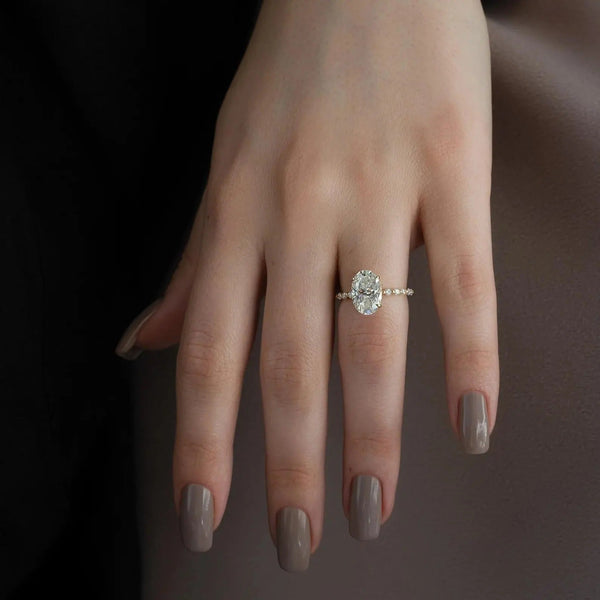
Finger-lengthening. This is real and it is the honest reason to choose the look. A long stone running along the finger draws the eye along its axis, which reads as a longer, slimmer hand. It is the strongest effect any diamond shape has on the appearance of the hand.
Face-up length per carat. Carat is weight, not size. An oval already spreads that weight into the face rather than the depth, and a longer oval spreads it further. A 1ct round measures roughly 6.5mm across; a 1ct oval at 1.55 runs about 8.7mm long.
A distinctly modern outline. The elongated oval reads as a 2020s choice in the way a princess cut reads as a 2000s one. Whether that is a benefit depends on how you feel about the next paragraph.
What you give up
| Trade-off | Why it happens | What to do about it |
|---|---|---|
| Narrower across the finger | Weight is fixed, so length is bought with width | If you want apparent bulk, buy width instead |
| Wider bow-tie | Pavilion facets stretch further to fill the outline | Handheld video in ordinary light, before buying |
| More exposed tips | The girdle runs thinner as the ends taper | Six prongs, or a bezel; never leave a tip uncovered |
| Contoured band effectively required | The stone occupies the space a straight band wants | Order the band with the ring |
| Harder to upgrade later | A head is built to one outline, not one carat figure | Buy the structure for the shape you will keep |
None of these are reasons not to buy an elongated oval. They are reasons to buy one deliberately rather than because a listing used a flattering adjective.
From our bench in Surat
Here is the pattern we see. A customer sends an inspiration image of an elongated oval, we measure the ratio in the photograph, and it comes back around 1.42. They have not actually fallen for elongation. They have fallen for a particular photograph — usually shot from slightly along the finger, which exaggerates length, on a hand smaller than average, which exaggerates size.
So the concession worth making out loud: a good part of what people are responding to in "elongated oval" content is camera angle and hand size, neither of which comes with the stone. Before committing to a long ratio, ask for the stone photographed straight down on a plain background. Sometimes the answer is still 1.55. Often it is 1.40, and the ring is better for it.
The trend question
Shapes divide into two groups. Round, oval and emerald have never really dated. Pear, princess, marquise and heart move in cycles, going in and out over roughly generational spans.
The oval sits firmly in the first group, which is a genuine argument for it. But an oval at 1.60 is a different proposition from an oval at 1.35 — the further you push the outline toward a moval, the more you are buying into a specific current look rather than the shape's long record.
Worth remembering too: the setting dates faster than the shape. A 1.45 oval in a plain four-prong solitaire will look unremarkable in thirty years. The same stone in whatever fine-detail head is fashionable this season will not. If longevity matters, spend the conservatism on the setting rather than on the ratio.
Who it genuinely suits
- Shorter fingers, where the lengthening effect does the most work.
- Buyers who have seen the specific stone on video and know its bow-tie.
- Anyone ordering the wedding band at the same time.
- Anyone who wants a modern outline and knows they want that, not just size.
And who it suits less: anyone chasing apparent size on a budget, who will get more from width; anyone whose ring must fit a straight band; and anyone buying without seeing the stone move, because ratio is the one oval specification where the risk rises with the number.
Keep reading
Oval length-to-width ratio: how to calculate and choose yours
Frequently asked questions
What ratio counts as an elongated oval?
There is no official threshold. In practice a genuinely elongated oval sits around 1.50 to 1.60, while most stones marketed as elongated measure closer to 1.40–1.45. Calculate it yourself by dividing the length by the width on the report's measurements line.
Do elongated ovals look bigger?
They look longer. Because carat weight is fixed, extra length comes at the cost of width, so the stone actually covers less of the finger as the ratio rises. If apparent size is the goal, a lower ratio with more width usually delivers it better.
Are elongated ovals more fragile?
The stone itself is as hard as any other diamond, but the tapered ends have a thinner girdle and are more exposed to knocks. That makes it a setting question rather than a stone question: cover both tips with prongs, or choose a bezel.
What is a moval?
A hybrid between an oval and a marquise, with an oval body and slightly drawn-out ends. It typically appears above a ratio of about 1.60. It is a deliberate stylistic choice rather than a default, and it needs the same tip protection a marquise does.
Will an elongated oval date?
The oval as a shape has a long record and sits alongside round and emerald as one that has not really dated. A very long ratio is more tied to the current moment. In either case the setting dates faster than the stone, so a simple head is the better place to be conservative.
Tell us the ratio, and we will build to it
Every piece is made to order in our own workshop in Surat, so outline, prong cover and band fit are all decided before casting.
Leave a comment