Lab Grown Diamonds
Melee: What You Are Actually Buying in a Pavé Band
The small stones are never individually certified. Here is what to ask for instead.
Written by the Mapple Gems workshop, Surat · Updated 5 September 2026
Short answer
Melee — small stones under roughly 0.2 ct — is never individually graded, in any material, anywhere. It is bought and sold by the parcel, to a stated colour and clarity range, a size range in millimetres, and a total weight. So the right question is not “is it certified” but “what is the parcel specification, and are the stones lab grown or moissanite?” The second half of that matters, because mixed-material accents are common and frequently undisclosed.
Centre stones get all the attention and all the paperwork. The forty small stones around them get a line saying “pavé band”. Since those stones are a real part of what you pay for and a real part of what needs maintaining, they deserve a few specific questions.
Why melee is never certified
Grading a stone individually costs money and takes time, and the fee would exceed the value of a 1.3 mm stone many times over. Laboratories therefore do not offer it below a practical threshold, and no seller anywhere provides individual reports for pavé stones.
Instead the trade works in parcels: a quantity of stones sorted to a stated size range and quality band, sold by total weight. That is a legitimate and universal system rather than a shortcut — but it means the specification lives at the parcel level, and you have to ask for it.
| Ask for | A good answer looks like |
|---|---|
| Material | “Lab grown diamond” or “moissanite” — named, not implied |
| Colour range | “F–G” or “G–H” |
| Clarity range | “VS” or “VS–SI” |
| Individual size | “1.3 mm” — a millimetre figure, not just CTTW |
| Stone count | “18, half coverage” |
| Setting style | “Shared-prong pavé” or “bezel-set” |
Mixed-material accents are common, and often not mentioned. A ring can legitimately have a lab grown diamond centre and moissanite accents — at 1.3 mm the two are visually indistinguishable, and it reduces cost with no visible compromise. We think that is a perfectly good build. What is not good is failing to say so. If a listing describes a “lab grown diamond ring” and the accents are moissanite, that should appear in the description, not emerge later at an appraisal. Ask what the accent stones are, specifically. An honest seller answers immediately and explains why; a vague answer tells you what you need to know.
Why the colour range matters more than you would expect
Accent stones sit directly against the centre stone, and adjacency is unforgiving. A G-colour centre surrounded by I-colour melee reads as a warm halo around a white stone, and once seen it cannot be unseen.
The practical rule: match the melee range to the centre, or go one step whiter. Going one step warmer to save money is where pavé rings visibly go wrong, and the saving is small because melee is inexpensive anyway.
This is also an argument for moissanite accents. Grown material is consistent, so a parcel matches itself easily, whereas matching mined melee for colour is a sorting exercise with a cost attached.
Size consistency, and what uneven melee looks like
Within a parcel, stones vary slightly. In a well-made row that variation is invisible because the setter selects and places them so the line reads even. In a poorly made one, you see it — the row looks slightly wavy, or one stone sits proud.
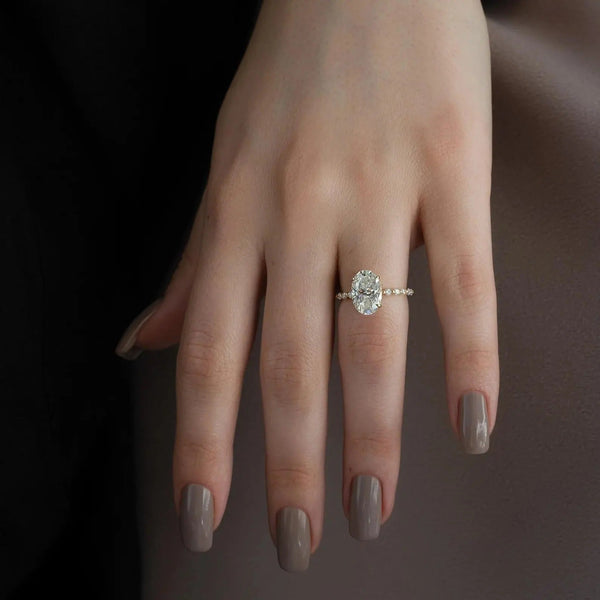
This is a setting-quality issue rather than a stone-quality one, and it is visible in a straight-down photograph in good light. Ask for one, and look at the row rather than the centre.
Replacing one later
Worth knowing before you need it.
- Replacement is routine and inexpensive — melee comes in standard millimetre sizes, so matching a 1.3 mm stone is straightforward.
- Matching the colour is easier with grown material, for the same consistency reason as above.
- Keep the specification with your invoice. If you know the size and range, a replacement matches; without it, a jeweller is estimating.
- Replace promptly. A gap leaves the neighbouring shared prongs exposed, and the next loss comes faster.
How much of the price is melee?
Less than people assume, and this is the useful takeaway. The stones themselves are inexpensive; the cost of a pavé band is overwhelmingly labour, because each stone is a separate setting operation done by hand.
Two consequences worth acting on. First, upgrading the melee colour range costs very little — do it. Second, reducing the stone count saves real money, which is why half pavé is meaningfully cheaper than full and looks identical from above.
Keep reading
Frequently asked questions
Are pavé stones certified?
No — melee under roughly 0.2 ct is never individually graded in any material, because the fee would exceed the stone’s value many times over. The trade sells it by the parcel to a stated colour and clarity range, size range and total weight. Ask for that parcel specification rather than a certificate.
Can accent stones be a different material from the centre?
Yes, and it is common — a lab grown diamond centre with moissanite accents is a legitimate build, since at 1.3 mm the two are visually indistinguishable. What matters is disclosure. Ask specifically what the accent stones are; it should be stated in the description rather than emerging later at an appraisal.
What colour should accent stones be?
Matched to the centre stone or one step whiter. Accents sit directly against the centre and adjacency is unforgiving — a G centre surrounded by I melee reads as a warm halo around a white stone. Upgrading the melee range costs very little, since the stones are cheap and the cost of a pavé band is mostly labour.
Can a lost pavé stone be replaced?
Yes, routinely and inexpensively, because melee comes in standard millimetre sizes. Keep the parcel specification with your invoice so a replacement matches rather than being estimated, and have it done promptly — a gap leaves the neighbouring shared prongs exposed and the next loss comes faster.
Ask us what the accent stones are.
Material, colour and clarity range, individual millimetre size and count — we will give you all five in writing.
Leave a comment