Customer Favourite
Oval Moissanite Ring with Alternating Marquise and Round Accents
Separate points of light with polished metal between them. Why spaced accents read differently from pavé, and what that means for owning the ring.
Written by the Mapple Gems workshop, Surat · Updated 13 October 2026
Short answer: This ring sets an oval moissanite in four claws, low on a slim band of individually set accents that alternate marquise, round, marquise, with polished metal between each one. The two largest marquises sit nearest the centre, point outward. It is made to order in 925 silver or solid 10K, 14K or 18K gold, from 2 to 5 carats.
This band is not pavé. Each accent stands on its own, separated from the next by a short run of polished metal, and the shapes alternate as they go. Instead of one continuous line of sparkle, you see distinct points of light — lighter, more graphic, and showing off the shape of each stone. Our latest order was a 3 carat oval in 14K white gold.

Spaced accents compared with pavé
| Continuous pavé | Spaced, alternating accents | |
|---|---|---|
| Look | One bright line | Separate points of light |
| Stone shapes | Merge together | Each shape visible |
| Feel on the hand | Glamorous | Light, delicate, vintage |
| Repairs | Beads often shared between stones | Each stone set on its own, simpler to reset |
Because each accent is set independently, a single loose stone does not disturb its neighbours, and a jeweller can reset it on its own. Marquise accents have points, and those points should sit under their prongs — a detail worth checking on the CAD preview.
The low-set oval
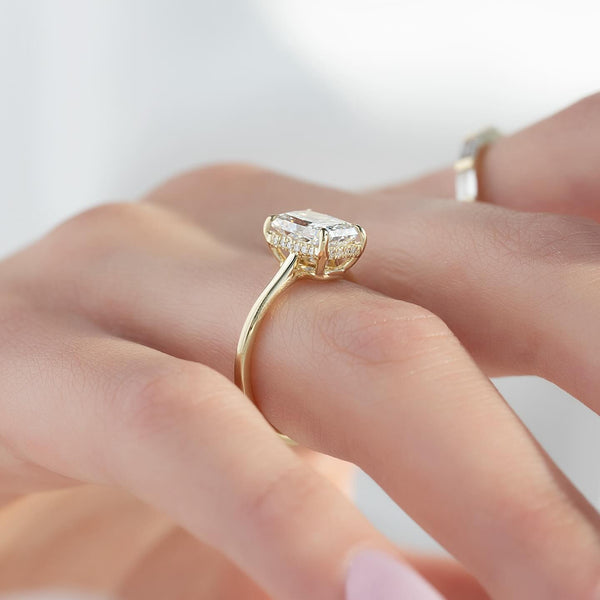
The oval sits low on this ring, which keeps the profile close to the finger and less likely to catch. Moissanite is Mohs 9.25, hard enough for daily wear, and its fire (dispersion 0.104) is framed rather than overwhelmed by the spaced accents: tiny stones look bright and white, while the centre carries the colour.
From the workshop
Our latest customer chose a 3 carat oval in 14K white gold, and it suits this band well: white metal makes each point of light crisp against the polished spaces between. White gold’s brightness comes from rhodium plating, though, and on a band like this one the polished spaces show wear first, because they are smooth metal that touches everything. When they start to look slightly warmer than the settings, after one to two years, it is time to re-plate. Ask the jeweller to check every accent while the ring is on the bench — it costs little extra and catches a thinning prong early.
Before you order: a short checklist
- Ask for the oval’s millimetres and do a paper test.
- Check that each marquise point sits under a prong.
- Ask for the band thickness at the base: 1.8 mm or more.
- Choose white metal for crisp contrast, or yellow and rose for warmth.
- Get your size right first; accents along the band limit resizing.
Keep reading
Frequently asked questions
Is this band pavé?
No. Each accent is set on its own with polished metal between them, alternating marquise and round shapes.
Are spaced accents easier to repair than pavé?
Usually yes. Each stone is held independently, so one can be tightened or replaced without disturbing its neighbours.
Why are the biggest marquises next to the centre?
Set point outward, they lead the eye along the band and into the oval, framing it.
Does the oval sit high on this ring?
No, it is set low, which keeps the profile close to the finger and less likely to catch on clothing.
How often does white gold need re-plating?
Typically every one to two years, depending on wear. Yellow and rose gold never need it.
The oval alternating marquise ring, made to order in Surat
2 to 5 carats, 925 silver to solid 18K gold, CAD preview before production.
See the ring All engagement rings
Leave a comment