Statement Rings
Hidden Halo Marquise Moissanite Rings in 14K Gold
What changes when the centre stone reaches four carats — and what nobody tells you before it arrives.
The short answer: A four-carat marquise moissanite covers more finger than almost any other stone of the same weight — it runs roughly 15 to 17 mm along the finger, which on many hands reaches close to knuckle to knuckle. A hidden halo adds brightness at the girdle and lifts the stone; that lift is the trade-off, because a marquise already has two of the most fragile points in gemstone cutting. 14K gold is the right karat for this ring: it is harder than 18K and this is a setting that will take knocks.
This particular combination — marquise shape, hidden halo, large centre, 14K gold — has become one of the most specific things people search for in the whole engagement ring category. That specificity is a good sign: it means the buyer knows exactly what they want. What most of them have not yet seen is how the four choices interact once they are built into a single ring.
If you are still deciding on the shape or the halo in isolation, start with marquise cut engagement rings and what is a hidden halo. This guide assumes you have chosen both and covers what happens when you combine them at scale.

How much finger four carats of marquise actually covers
The marquise has the largest face-up spread per carat of any common shape. All of its weight is pushed outwards into a long, narrow footprint, with very little hidden in depth. That is why it was cut this way in the first place.
| Centre weight | Approximate length | How it reads on the hand |
|---|---|---|
| 1.5 ct marquise | ~11–12 mm | Elegant, everyday-wearable |
| 2.5 ct marquise | ~13–14 mm | Clearly a statement, still practical |
| 4 ct marquise | ~15–17 mm | Dominates the hand; near knuckle-to-knuckle on slimmer fingers |
Measure the gap between your knuckles before you commit to four carats in this shape. A stone that bridges that gap will catch on gloves, pockets, hair and jumper sleeves in a way a compact round of the same weight simply does not. Plenty of people want exactly that presence — but it should be a decision, not a surprise.
The two points: the real reason the setting matters
A marquise has two tips, each formed where the curved sides converge to almost nothing. They are the thinnest structural feature in any mainstream cut, and they are the first thing to chip if the ring meets a door frame at the wrong angle. Moissanite is a very hard material — it sits just below diamond on the Mohs scale — but hardness resists scratching, not impact. A sharp knock on an unprotected point is the failure mode that matters.
Practical protection, in order of effectiveness:
- V-prongs over both tips. A V-shaped prong cups each point rather than gripping across it. On a marquise this is not optional styling — treat it as the minimum specification.
- Half-bezel at the ends. Metal wrapping each tip, open along the sides. The most protective option that still lets light in from the flanks.
- Six prongs total. Two V-prongs at the points plus four along the sides distributes the load and reduces the chance of the stone rocking in the setting over time.
What a hidden halo does — and the trade-off at this size
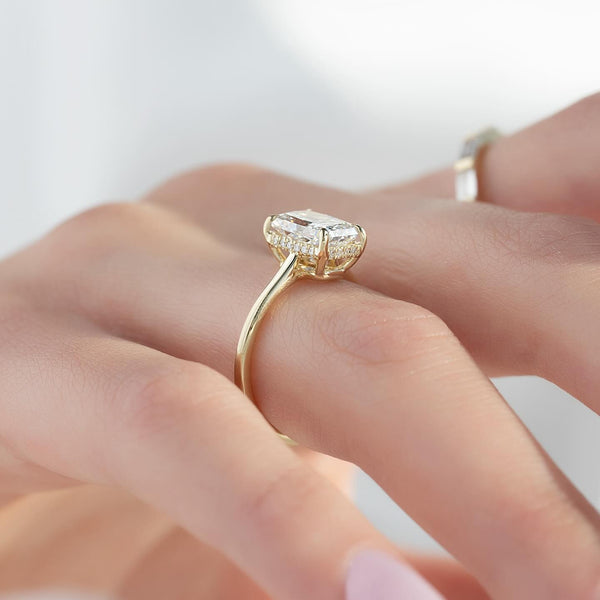
A hidden halo is a ring of small stones set into the side of the head, beneath the centre stone and invisible when the ring is viewed from above. Its job is to add brightness where the stone meets the metal and to give the profile a decorated look from the side.
Two things it does that are worth knowing before you specify one on a large marquise:
1. It raises the stone
The halo occupies vertical space between the band and the girdle, so the centre stone sits higher than it would in a plain head. A higher setting means a longer lever arm — the same knock applies more force at the join. On a 15 mm marquise that already protrudes over the sides of the finger, added height compounds the snag risk rather than offsetting it.
2. It changes what you see from the side
This is the reason people ask for it. Viewed straight down, nothing changes. Viewed from the side — which is how the wearer sees their own hand most of the time — the hidden halo turns a plain metal head into a band of light. It is genuinely the angle it was designed for.
The compromise most buyers land on: hidden halo, V-prongs over both tips, and a deliberately low-profile head. You keep the side-on brightness, and you give back most of the height the halo would otherwise add. Ask for it in those words when you brief the ring.
Fire at four carats: what large moissanite really looks like
Moissanite is not a diamond and is never sold as one — it is a separate mineral, silicon carbide, with its own optical properties. The most important of those is dispersion: its ability to split white light into spectral colours is more than double that of diamond.
Dispersion scales with size. At one carat the extra fire reads as liveliness. At four carats, in a shape with long, broad facets like a marquise, it becomes the dominant visual characteristic — flashes of clear red, blue and green rather than the mostly-white sparkle of a diamond. Under directional light, especially spotlights and sunlight, this is very visible.
Whether that is a feature or a problem depends entirely on what you want:
- If you want a large stone with maximum visual drama for the money, this is the effect you are buying and you will love it.
- If your goal is for the ring to be indistinguishable from a mined diamond at close range, size works against you. A smaller moissanite is a far more convincing lookalike than a large one, and a lab grown diamond is the honest answer to that brief.
Metal choice interacts with this. Moissanite's higher dispersion means a warm metal visibly warms the stone; in 14K yellow gold a large marquise reads noticeably warmer and more golden than the same stone in white metal. If you want the gold band but the cooler stone, specify a white gold head on a yellow gold shank — a standard request and the usual fix.
Band width: the proportion nobody plans
There is a real tension here. A narrow band makes a centre stone look larger by contrast — that is why so many large-stone rings sit on thin shanks. But a four-carat marquise is heavy and long, and a very thin band under a large head is the classic recipe for a shank that goes out of round and prongs that loosen.
The workable range for a stone this size is a band around 1.8 to 2.2 mm: still slim enough to flatter the stone, substantial enough to carry it. Below about 1.5 mm under a four-carat head, expect to be resetting it sooner than you would like. See ring band profiles explained for how profile shape affects both comfort and strength.
Why 14K rather than 18K for this ring
| 14K gold | 18K gold | |
|---|---|---|
| Gold content | 58.3% | 75% |
| Hardness | Harder — resists knocks and prong wear better | Softer — prongs deform more easily |
| Colour | Slightly lighter yellow | Richer, warmer yellow |
| Best for | Large centre stones, points to protect, daily wear | Colour-critical pieces, less exposed settings |
For a ring whose entire structural risk sits in two thin prongs holding two thin points, the harder alloy is the correct choice. That is why 14K appears in the search phrase this article is answering — buyers have worked it out already.
Keep reading
Frequently asked questions
How big is a 4 carat marquise moissanite ring on the hand?
A four-carat marquise typically measures around 15 to 17 mm along its long axis. Because the marquise is set north-to-south, that length runs along the finger, and on slimmer hands it can reach close to knuckle-to-knuckle. It is the largest face-up presence available at that carat weight of any common shape.
Does a hidden halo make a ring sit higher?
Yes. The halo occupies vertical space between the band and the girdle of the centre stone, so the stone sits higher than it would in a plain head. On a large marquise this adds to snag risk, so ask specifically for a low-profile hidden halo head, which keeps the side-on brightness while giving back most of the added height.
Do marquise rings chip easily?
The two points are the most fragile feature of the shape. Moissanite is very hard, but hardness resists scratching rather than impact, so an unprotected tip can chip on a sharp knock. V-prongs cupping each point, or a half-bezel wrapping the ends, remove most of that risk. Treat V-prongs as the minimum specification on any marquise.
Is 14K or 18K gold better for a large moissanite ring?
14K. It contains less pure gold and is therefore a harder alloy, so prongs hold their shape better and the shank resists deforming under a heavy head. 18K has a richer colour but is softer, which matters more when the setting is carrying a large stone with vulnerable points.
Does a large moissanite look different from a diamond?
At larger sizes, yes, and more so than at small ones. Moissanite disperses light into spectral colours more than twice as strongly as diamond, and that effect scales with the size of the facets. A four-carat moissanite throws pronounced coloured fire under directional light. If a diamond-indistinguishable look is the goal, a lab grown diamond is the better answer; if maximum visual drama for the money is the goal, moissanite at this size delivers it.
How wide should the band be under a 4 carat centre stone?
Around 1.8 to 2.2 mm. Thinner bands flatter a large stone by contrast but a very slim shank under a heavy head tends to go out of round and loosen the prongs over time. Below about 1.5 mm with a four-carat centre, expect earlier maintenance.
Marquise moissanite rings, built to your specification
Choose your carat, prong style, halo height and metal — 925 sterling silver or solid 10K, 14K and 18K gold. Handcrafted to order in Surat.
Shop marquise moissanite rings
Leave a comment