Marquise
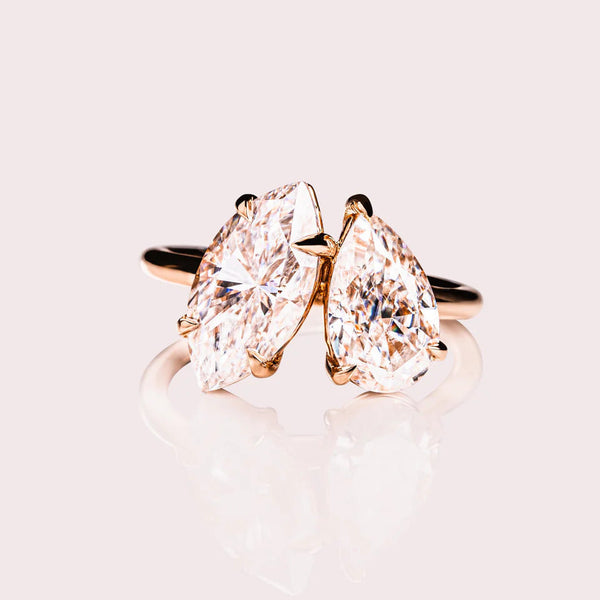
The East-West Marquise
Turning the longest shape in jewellery sideways solves one problem, creates another, and changes what the ring is for.
Written by the Mapple Gems workshop, Surat · Updated 23 August 2026
Short answer
An east-west marquise lies across the finger rather than along it. It often takes a straight wedding band, sits lower, and reads as a deliberate design rather than a traditional solitaire. The cost: both points now aim outward at the neighbouring fingers, so V-prongs stop being advisable and become non-negotiable.
Almost every marquise engagement ring ever made points up the finger. Turning it ninety degrees is a genuinely different object, and on this shape more than any other the consequences are structural rather than stylistic.
What changes
| North-south (standard) | East-west | |
|---|---|---|
| Visual effect | Maximum finger-lengthening | Width and presence; a bar across the hand |
| Straight wedding band | Contour effectively certain | Often fits straight |
| Finger-span limit at 4ct | 15–16mm may exceed the knuckle gap | Not an issue — length runs across |
| Where the points aim | Up and down the finger | Outward, at the neighbouring fingers |
| Bow-tie | Across the finger | Along it — same band, rotated |
| If the ring turns | Obvious | Very obvious — euro shank essential |
Two real advantages
The band problem largely disappears. A north-south marquise occupies exactly the space a straight wedding band wants to sit in, which is why a contoured band is effectively mandatory. Turn the stone and the setting spans the band instead of blocking it. That matters more than it sounds: a contour is cut to one specific ring, is not really wearable alone, and cannot be matched or replaced elsewhere. A straight band is a piece of jewellery in its own right.
The finger-span limit goes away. At four carats a marquise runs 15–16mm, which on many hands is longer than the flat span between the knuckle joints — so a north-south stone sits over the joints and the ring rocks slightly as the finger bends. Set east-west, that length runs across the finger where there is no joint to bridge. For anyone who wants a large marquise and has short finger segments, this is the answer to a problem they may not have known they had.
The cost, and it is specific to this shape
An east-west oval turns two soft, rounded tips outward. An east-west marquise turns two points outward — toward the neighbouring fingers, and toward whatever the side of the hand brushes against all day.
That changes the V-prong from a strong recommendation into a hard requirement. Both ends, properly capped, with no exceptions and no decorative substitutes. And it makes the two-yearly bench check less optional than usual, because those prongs are now in the line of fire in a way they were not before.
Worth noting too: the points can catch on an adjacent finger, particularly at larger sizes. A slightly lower ratio — 1.80 rather than 2.05 — gives blunter, better-protected tips and is worth considering specifically for this orientation.
From our bench in Surat
A caution about the label rather than the ring, and it applies to our own catalogue as much as anyone's. "East-west" has become a fashionable phrase and it gets attached loosely — to rings that are horizontally set, to rings that merely look wide, and occasionally to nothing in particular. We have been auditing our listings for exactly this.
So do not buy the phrase, buy the picture. A genuine east-west marquise, viewed straight down with the band running vertically, has its long axis crossing the band at ninety degrees and a point at each side. If a listing says east-west and the image does not show that, the description is wrong — ours included, and we would rather hear about it.
The myth, and the longevity question
People expect east-west to reduce the bow-tie. It does not. The dark band is created inside the pavilion by facets stretched along the stone's long axis, so rotating the stone rotates the pattern with it — it now runs along the finger instead of across. Every diagnostic still applies: judge it on a handheld video in ordinary room light, and note that the marquise typically shows the strongest bow-tie of any shape.
On longevity, two things are true at once. The marquise as a shape is cyclical, moving in and out of fashion over generational spans, and the east-west orientation is a current design language. Together that is a distinctly 2020s ring.
The reassurance is that orientation lives in the head, not the stone. A new head built north-south around the same marquise is ordinary bench work, which makes this one of the more reversible decisions in ring design — far more reversible than profile height or gallery architecture, both of which are fixed at casting.
What to specify
- A straight-down render confirming the long axis crosses the band at ninety degrees.
- V-prongs on both points. Non-negotiable in this orientation.
- Consider a lower ratio, around 1.80, for blunter and better-protected tips.
- Euro shank, so the ring does not end up sitting diagonally.
- Total width across the setting, in millimetres — this is now the finger-width figure.
- Straight-edge test on the side elevation to confirm the straight-band advantage.
- Low profile, so the outward-facing points sit closer to the hand.
Keep reading
East-west oval rings: what turning the stone changes
Frequently asked questions
Does an east-west marquise take a straight wedding band?
Often yes, and it is the strongest practical argument for the orientation. The stone spans the band rather than occupying the space it needs. Confirm with a straight edge against the CAD side elevation, since a raised head can still create a gap.
Are the points more exposed set east-west?
Yes. They now aim outward at the neighbouring fingers and at whatever the side of the hand contacts, rather than along the finger. V-prongs on both points move from strongly advisable to mandatory, and a lower ratio around 1.80 gives blunter tips.
Does east-west setting hide the bow-tie?
No. The dark band is created inside the pavilion along the stone's long axis, so it rotates with the stone and simply runs along the finger instead of across it. Only a full halo genuinely masks a bow-tie.
Is east-west better for a large marquise?
It solves one real problem at size. A 4ct marquise runs 15–16mm, which on many hands exceeds the flat span between the knuckle joints when set north-south. Turned sideways that length runs across the finger with no joint to bridge.
Can an east-west ring be reset north-south later?
Yes. Orientation lives in the head rather than the stone, so a new head built north-south around the same marquise is ordinary bench work. That makes it far more reversible than profile height or gallery architecture, which are fixed at casting.
Buy the picture, not the phrase
Made to order in our Surat workshop — ask for the straight-down render before casting and you will know exactly what you are getting.
Leave a comment