Moissanite 101
Buying Moissanite for the First Time
Everything that actually matters, in the order it matters — including the parts that count against it.
Written by the Mapple Gems workshop, Surat · Updated 29 September 2026
Short answer
Moissanite is silicon carbide, a different mineral from diamond that happens to look similar — Mohs 9.25 against 10, and it disperses light more (0.104 vs 0.044), which is why large stones show rainbow flashes and small ones do not. Compare by millimetres, never carats, since it is sold by diamond equivalent weight. No laboratory grades it, so rotating video in ordinary light is your only quality evidence. And judge the ring as hard as the stone: gram weight and shank thickness decide whether it lasts.
If you are looking at moissanite for the first time, here is the whole picture in one page — what it is, where it is strongest, where it is weakest, and what to ask before spending anything.
What it is
Silicon carbide, discovered by Henri Moissan in 1893 in crystals from the Canyon Diablo meteorite crater in Arizona — and initially mistaken for diamond, which tells you most of what you need to know about the resemblance. Natural moissanite is vanishingly rare, so every jewellery stone is laboratory grown, and gem-quality growth only became possible in the 1990s.
That history explains several things: there are no antique moissanite pieces, there is no mined supply chain, and there is no legacy pricing structure — which is a large part of why it costs what it does.
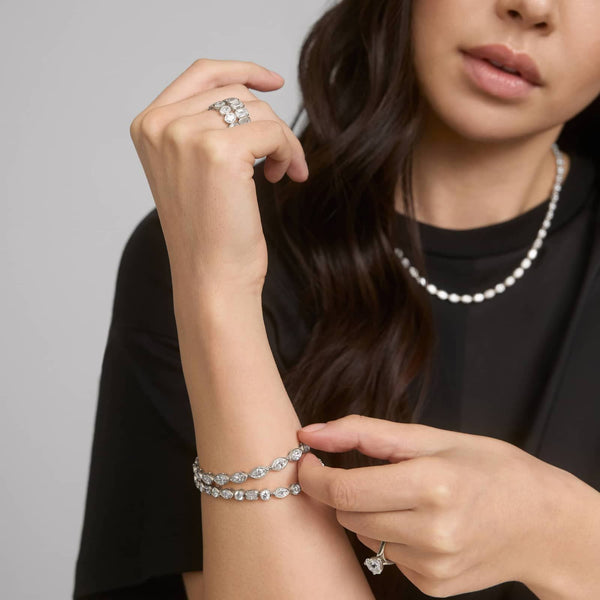
The single most useful thing to understand: moissanite behaves differently at different sizes, and it runs the opposite way to what people expect. Dispersion — the splitting of light into spectral colour — needs depth to develop. A 3 mm stone has barely two millimetres of pavilion for light to travel through, so the effect never builds and the stone reads as clean white sparkle, indistinguishable from a small diamond in wear. A 9 mm stone has plenty of depth, and the rainbow flashes become obvious. So a larger moissanite is LESS discreet, not more impressive — the inverse of how people assume it works. Two consequences follow, and they are the whole strategy. Moissanite is at its strongest in many-small-stone pieces — tennis bracelets, eternity bands, pavé, studs, flush-set men’s rings — where the visual difference is smallest and the saving multiplies across forty or sixty stones. And in a large solitaire, the difference is at its most visible and the saving applies to a single stone. Neither is a reason to buy or avoid it; both are reasons to buy it deliberately.
Compare in millimetres, not carats
Moissanite is about 15% less dense than diamond, so it is sold by diamond equivalent weight — the carat figure describes the size a diamond of those dimensions would be, not what the stone weighs. A 6.5 mm “1 carat” moissanite weighs around 0.88 ct on a scale.
That is not a deception; it is how the material is sold, so that sizes are comparable. But it makes millimetres the only honest comparison between two stones, two sellers, or a moissanite and a diamond. Ask for the measured dimensions every time.
One check that comes free with it: a stone measuring larger than standard for its stated weight has been cut shallow to spread the size — more face, less light returned, and often a flat, lifeless centre. It is a warning rather than a bargain.
Nobody grades it — so you do
No laboratory grades moissanite for cut, colour or clarity. The “D–E–F” and “VVS” on listings are seller assessments, not comparable between sellers, and there is no report to verify. That has one important consequence in both directions: a higher price is not evidence of a better stone, because there is no independent anchor.
What replaces grading is rotating video in ordinary indoor light — not a lightbox, which flatters every stone equally. Four things to look for:
- No permanently dark zone as the stone turns.
- Crisp facet junctions where lines meet at a point.
- A symmetrical outline when you halve it mentally.
- A table that is not oversized relative to the stone.
Where it holds up, and where it does not
| Question | Honest answer |
|---|---|
| Does it scratch? | Mohs 9.25 — practically, no |
| Does it cloud or fade? | No — it is chemically inert |
| Can it chip? | At points and thin girdles — a setting question |
| Can a jeweller tell? | Yes — doubled facet edges under a loupe |
| Does it resell? | Effectively not — buy it to wear |
| Is it a diamond? | No — a different mineral entirely |
The last two are the honest limits. Moissanite has no resale market to speak of, and anyone who examines it with a loupe can identify it — because it is doubly refractive where diamond is not, so back facet edges appear doubled. If either of those matters to you, that is a legitimate reason to choose something else.
Judge the ring as hard as the stone
Most disappointment with moissanite jewellery is not about the stone at all. Ask for these regardless of material:
- Metal and karat, solid or plated. If “gold” needs a preposition — over, filled, plated, vermeil — it is not solid.
- Finished gram weight. Gold trades publicly, so this makes the metal component verifiable.
- Shank width AND thickness. 1.8 mm minimum for daily wear; thickness is the structural story and almost no listing states it.
- A prong over every point and corner.
- Production and transit days separately. A checkout estimate is transit only.
Two levers most first-time buyers do not know about
Warm metal calms the fire. A yellow or rose setting reflects into the pavilion and competes with the dispersed colour, so the same stone reads noticeably calmer than it does in white gold or platinum. If you like the size but not the rainbow, changing the metal is free.
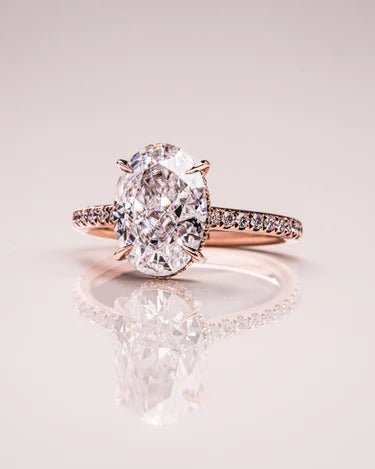
Shape changes it too. Most to least fire: round and crushed-ice cushion, then oval, pear and marquise, then radiant and princess, then Asscher and emerald. A step cut at a 1.40–1.50 ratio gives length and presence with the least rainbow of any option.
Keep reading
Frequently asked questions
What is moissanite?
Silicon carbide — a different mineral from diamond that happens to look similar. Discovered by Henri Moissan in 1893 in meteorite crystals and initially mistaken for diamond. Natural moissanite is vanishingly rare, so every jewellery stone is laboratory grown.
Can people tell moissanite from diamond?
Under a loupe, yes — moissanite is doubly refractive, so back facet edges appear doubled. By eye it depends on size: below about 3 mm the extra dispersion never develops and it is indistinguishable, while above roughly 7 mm the rainbow flashes become noticeable.
Why is moissanite sold by millimetres?
Because it is about 15% less dense than diamond, so carat figures are diamond equivalent weight rather than actual weight — a 6.5 mm “1 carat” stone weighs around 0.88 ct. Millimetres are the only honest comparison between two stones or two sellers.
Is moissanite graded like a diamond?
No laboratory grades it for cut, colour or clarity, so listed D–E–F and VVS claims are seller assessments and are not comparable between sellers. That also means a higher price is not evidence of a better stone. Rotating video in ordinary light is the only real quality evidence.
Ask us for millimetres, gram weight and video.
Ask everyone else the same three things. It is the fastest way to find out who is describing a ring and who is describing a photograph.
Leave a comment