Moissanite 101
Cocktail and Right-Hand Rings: Where Fire Is the Point
Every argument against large moissanite disappears the moment the ring is not pretending to be anything.
Written by the Mapple Gems workshop, Surat · Updated 27 September 2026
Short answer
The usual reservation about large moissanite is that its dispersion becomes conspicuous above about 7 mm. On a cocktail ring that is the desired effect, not a drawback — so this is the one category where you should size up and choose the most dispersive shapes: round, crushed-ice cushion, oval. It is also where the economics are most persuasive, since a 10–12 mm stone is affordable in a way no equivalent is. Build it for occasional wear: comfort matters more than durability here.
Most moissanite advice is written for engagement rings, where the aim is usually discretion. A cocktail ring inverts every one of those assumptions, and it is the piece the material was arguably best suited to all along.
The size inversion that works against moissanite everywhere else works entirely in its favour here. Moissanite disperses light at 0.104 against diamond’s 0.044, and dispersion builds with depth — so a small stone reads as clean white sparkle while a large one throws visible spectral colour. That is why we tell engagement ring buyers that a larger moissanite is less discreet, which is a counter-intuitive and genuinely useful warning. On a cocktail ring, the entire brief is to be seen. Nobody is trying to make a 12 mm stone on a right hand read as understated, and the flashes of colour are the reason to wear it. So this is the one place where the honest advice reverses: go bigger, choose a round or crushed-ice cushion, set it in white metal, and let it do the thing it does. A large moissanite is not a compromised diamond — it is a stone with a different optical character being used for what that character is good at.
Shape, by how much you want
| Shape | Effect at 10 mm+ |
|---|---|
| Round brilliant | Maximum fire — the full effect |
| Crushed-ice cushion | Scattered, glittering; very lively |
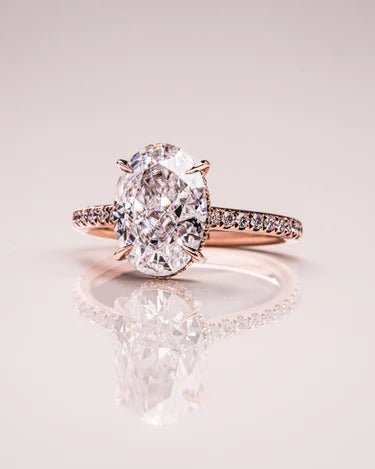
| Oval | High fire plus length on the finger |
| Radiant | Bright, a step calmer |
| Chunky antique cushion | Broad, slower flashes |
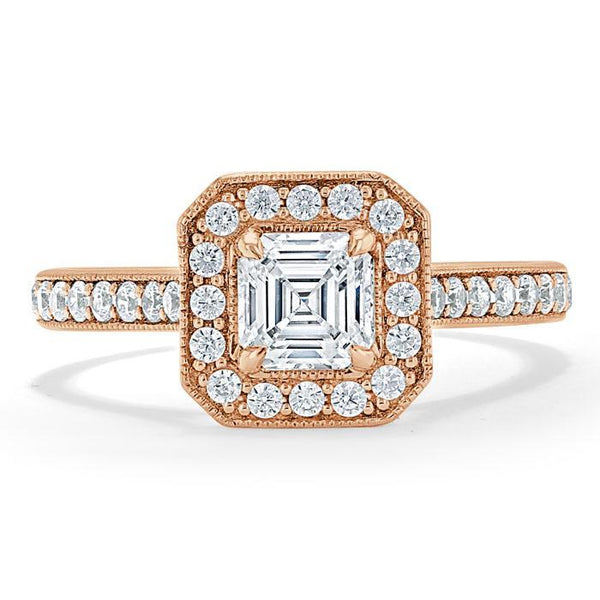
| Emerald / Asscher | Calmest — scale without rainbow |
The last row is the option for someone who wants a large statement stone and specifically not the colour flashes. A big emerald cut is dramatic through sheer scale and long broad flashes rather than dispersion — and step cuts show the least of it of any shape.
Build it for occasional wear
This is the important difference from an engagement ring, and it changes several defaults.
- Height is allowed. A high setting catches on things — which matters enormously on a ring worn 5,000 days and very little on one worn for evenings. A raised stone shows more of itself.
- Weight is the real constraint. A large stone in a substantial setting is heavy, and a heavy ring spins on the finger. Ask for a euro shank — flattened underneath — which is the anti-spin fix and needs no maintenance.
- Still 1.8 mm minimum on the shank. Occasional wear does not excuse a thin band under a heavy head; that is where these rings bend.
- Six prongs or a bezel above about 8 mm. Larger stones need more grip, not the same four.
- White metal if fire is the aim — a warm setting reflects into the stone and softens dispersion noticeably.
Cut quality matters more at this size
Everything a stone does is amplified when it is large, including its faults. No laboratory grades moissanite cut, so the checks are yours — and at 10 mm they are easy to make.
In rotating video, in ordinary indoor light: crisp facet junctions, no permanently dark zone as it turns, a symmetrical outline, and a table that is not oversized. And check the measured millimetres against the stated weight — a stone larger than standard has been cut shallow to spread, which at this size shows as a flat, lifeless centre.
One more, specific to large moissanite: because it is doubly refractive, a stone cut off its optic axis shows a faint softness from the top. It is invisible at 4 mm and detectable at 12 mm, which is one more reason to insist on video rather than stills.
Fingers and proportion
Apparent size is a ratio, not a millimetre figure — a 10 mm stone reads very differently on a size 4 hand than a size 9. For a right-hand ring, remember it will sit beside nothing, so it carries its scale alone rather than being framed by a band.
Two practical points. Size it for the right hand specifically, which is often a quarter to half size different from the left. And if it is genuinely large, check it clears the neighbouring fingers when the hand closes — the commonest complaint about big cocktail rings is not weight but that they press.
Care, briefly
Moissanite is chemically inert, so perfume, hairspray and cosmetics affect only the metal. But an occasion ring collects product film on the pavilion faster than a daily ring, because it is put on after everything else — and a film on the underside kills exactly the light return you bought the stone for.
Clean it before wearing, not after: warm soapy water and a soft brush from underneath, a week before an event rather than the night of it. And ask for an open gallery so cleaning underneath is actually possible.
Keep reading
Frequently asked questions
Is a large moissanite too flashy?
On an engagement ring it can be, since dispersion builds with depth and becomes conspicuous above about 7 mm. On a cocktail or right-hand ring that is the point rather than a drawback — nobody is trying to make a 12 mm stone read as understated.
Which shape shows the most fire in a large stone?
Round brilliant, then crushed-ice cushion and oval. Emerald and Asscher show the least, so a large step cut gives scale and long broad flashes without the colour — the option for someone who wants a statement stone but not the rainbow.
Why does my cocktail ring spin on my finger?
Weight — a large stone in a substantial setting is top-heavy and rolls. The fix is a euro shank, flattened on the underside so the ring cannot rotate; it is designed in, invisible from above and needs no maintenance. Sizing beads are the reversible retrofit.
Does a big moissanite need a different setting?
Above about 8 mm, six prongs or a bezel rather than four — larger stones need more grip. Keep the shank at 1.8 mm minimum even for occasional wear, since a heavy head on a thin band is where these rings bend, and choose white metal if fire is the aim.
This is the one place we would tell you to size up.
White metal, six prongs, a euro shank, and a stone doing exactly what it is good at.
Leave a comment