Wedding Bands
Stone-Set Wedding Bands: Which Ones Survive Daily Wear
A band takes more contact than any other ring you own. Not every setting is built for that.
Written by the Mapple Gems workshop, Surat · Updated 9 September 2026
Short answer
Ranked by durability: flush or bezel set (stones sunk level with the metal, nothing protrudes), then channel set, then shared-prong pavé, and least durable is fine micropavé on a thin shank. Two numbers decide more than the setting name: keep the shank at least 1.8 mm thick, and choose half rather than full coverage — it looks identical from above, keeps the ring resizable, and leaves the most-abraded section stone-free.
A wedding band sits at the base of the finger, under everything, taking contact from the moment it goes on. It is the ring most likely to be worn continuously for decades — and stone-set bands are where the maintenance in a jewellery box tends to concentrate.
Ranked by how they hold up
| Setting | How it holds the stone | Durability |
|---|---|---|
| Flush / gypsy | Sunk into the metal, surface level | Highest — nothing protrudes to catch |
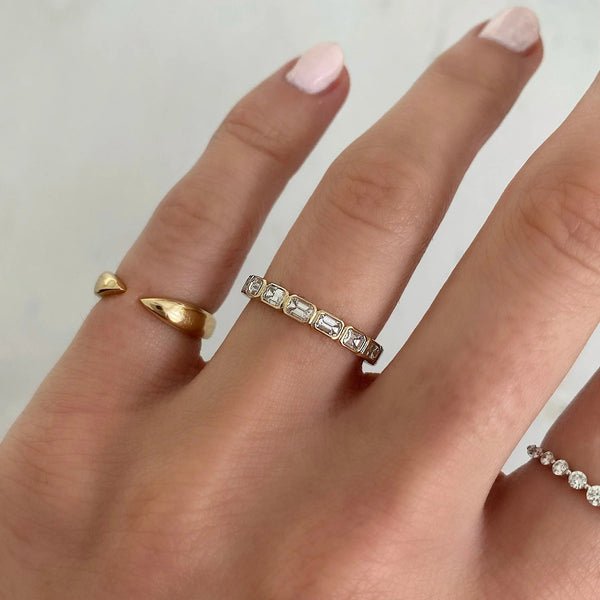
| Bezel | A continuous metal collar | Very high |
| Channel | Between two continuous walls | High, but hard to resize |
| Shared-prong pavé | Small beads shared between stones | Moderate — depends on shank thickness |
| Micropavé | Very fine beads, very small stones | Lowest for daily wear |
Shank thickness matters more than the setting name. This is the point almost every listing omits. Pavé stones are held by tiny beads of metal raised from the shank — and those beads only stay put if the metal underneath them is rigid. On a shank below about 1.8 mm, the band flexes very slightly every time you grip something, thousands of times a year. Each flex works the beads a fraction looser, and eventually a stone drops out for no apparent reason. That is why two pavé bands can look identical and behave completely differently over ten years. Ask for the thickness in millimetres, not just the width — and if a seller cannot state it, that is the answer.
Half coverage, and why it wins
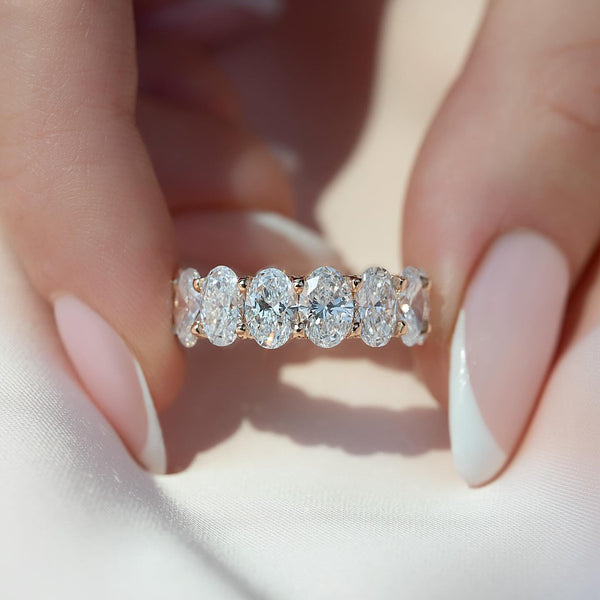
Full eternity bands are beautiful and carry three real disadvantages. They cannot be resized, because there is no plain metal to cut and nowhere safe to apply heat. They put stones on the underside of the finger, which is where all the abrasion happens. And they double the number of settings to maintain.
A three-quarter or half band looks identical on the hand — nobody sees the underside of your finger — and solves all three problems at once. Over decades, when a resize becomes necessary rather than optional, that difference is decisive.
If you want the full-eternity look and are confident about your size, the honest middle path is to buy one as an anniversary or occasion band rather than as the ring worn every day.
Where moissanite is a particularly good fit
Set stones in a band are typically 1.2–2 mm, and at that size there is far too little depth for moissanite’s extra dispersion to build. The stones read as clean white sparkle, exactly as small diamonds do.
Meanwhile the saving multiplies across twenty or forty stones rather than one, and replacing a lost stone is straightforward because the material is consistent and comes in standard millimetre sizes. On a piece where losing a stone eventually is a realistic outcome, that matters more than it does on a solitaire.
Matching the band to how you live
- Hands-on work, gloves, lifting: flush-set or plain. Nothing raised, rounded outer edge, 2 mm or thicker.
- Desk work: anything on the list, including fine pavé — but still hold the 1.8 mm floor.
- Fluctuating finger size: half coverage only. Channel and full eternity both resist resizing.
- Will you take it off for work? If yes, most of this relaxes — the exposure is a fraction of a continuously-worn ring’s.
Living with one
- Bench check every two years. Non-negotiable on a stone-set band — more so than on a solitaire, because there are more settings and each is smaller.
- Look down a pavé row in good light every few months. A missing 1.3 mm stone is easy to overlook until there are two.
- Replace a lost stone promptly. A gap leaves the neighbouring shared beads exposed, and the next loss follows faster.
- Keep the parcel specification — stone size in millimetres, colour and clarity range — so a replacement matches rather than being estimated.
- Never wear it directly against a plain band. Set stones at Mohs 9 or above abrade gold under 3. Put a plain band between two set ones.
Keep reading
Frequently asked questions
Which stone setting is most durable for a wedding band?
Flush or gypsy setting, where stones are sunk level with the metal so nothing protrudes to catch, followed by bezel and then channel. Shared-prong pavé is moderate and depends heavily on shank thickness; fine micropavé is the least durable for continuous daily wear.
Why do pavé stones fall out of wedding bands?
Usually because the shank is too thin. Pavé stones are held by tiny beads raised from the metal, and on a shank below about 1.8 mm the band flexes slightly every time you grip something. Each flex works the beads a fraction looser until a stone drops out. Ask for thickness in millimetres, not just width.
Is a half eternity band better than a full one?
For a ring worn daily, yes. It looks identical on the hand since nobody sees the underside of your finger, it can be resized, it keeps stones away from the most-abraded section, and it halves the number of settings to maintain. Full eternity works best as an anniversary or occasion band.
Is moissanite suitable for a stone-set band?
It is one of its best applications. At 1.2–2 mm there is too little depth for the extra dispersion to build, so the stones read as clean white sparkle, while the saving multiplies across twenty or forty stones. Replacement is also easy, since the material is consistent and comes in standard millimetre sizes.
Ask for thickness, not just width.
1.8 mm and up. It is the number that decides whether a pavé band still has all its stones in ten years.
Leave a comment