Engagement Rings
Pavé Settings and Everyday Wear: The Ten-Year View
Beautiful on day one. Here is what happens by year eight, and how to build one that survives it.
Written by the Mapple Gems workshop, Surat · Updated 23 August 2026
Short answer
Pavé sets many small stones in tiny shared beads of metal, so the shank reads as continuous sparkle. It is the single most effective way to add brilliance cheaply — and the setting most likely to need attention over a decade, because the beads holding the stones are the part that wears against everything you touch. Build it right and it lasts: half or three-quarter coverage, a shank of at least 1.8 mm, and a prong check every two years.
Pavé is genuinely the best value in ring design. Twenty small stones cost a fraction of one large one and add visible sparkle across the whole finger. Nothing else does that for the money.
It also accounts for most of the stone-loss repairs a workshop sees. Both things are true, and neither is a reason to avoid it — they are reasons to specify it properly.
How pavé is actually held
Each small stone sits in a seat drilled into the metal, and is held by tiny beads of metal raised from the surrounding surface with a graver. Adjacent stones frequently share beads — one bead does duty for two stones.
That sharing is what makes pavé look continuous rather than like a row of separate settings. It is also the structural weakness: lose one bead and two stones become insecure at once.
| Style | How it holds | Durability |
|---|---|---|
| Classic pavé | Shared beads | Lowest — most sparkle per pound |
| French / fishtail pavé | V-cuts under each stone | Similar, brighter, more delicate |
| Channel set | Two continuous metal walls | High — but hard to repair or resize |
| Bezel-set accents | Each stone in its own collar | Highest — reads chunkier |
| Bar set | Metal bars between stones | Good compromise, less common |
What actually goes wrong, and when
- Beads wear down. The underside and sides of a ring meet steering wheels, gym bars, shopping bags and pockets thousands of times. Beads are the highest, thinnest metal on the ring, so they flatten first.
- The shank flexes. A thin shank deforms very slightly under grip pressure, over and over. Stones sitting in a flexing surface loosen. This is why shank thickness matters more than most people expect.
- Residue builds underneath. Soap, hand cream and skin oil collect under a pavé row where a brush does not reach. The ring looks dull long before any stone is loose.
- Stones go missing quietly. A 1.2 mm stone leaves no sensation when it goes. Most people notice weeks later, in a photograph.
The specification that decides everything, and nobody asks for it. Not the number of stones — the shank thickness beneath them. A pavé shank at 1.5 mm will flex, and flexing loses stones. At 1.8 mm and above it does not, in ordinary wear. That 0.3 mm is invisible on the hand, adds a negligible amount of gold, and is the difference between a ring that needs work at year four and one that does not. Ask for the figure in writing before it is cast. We will not build a full pavé below 1.8 mm, and if a seller will not quote the number at all, that is your answer.
Coverage: how far round should it go
The most useful decision available, and the one most often made by default.
- Half pavé — stones across the top only. Visually identical from above, since nobody sees the bottom of your finger. Plain metal at the back means it resizes normally and the most-abraded part of the ring has no stones in it. This is the correct answer for most people.
- Three-quarter pavé — a short plain section at the very back. Still resizable within a limited range.
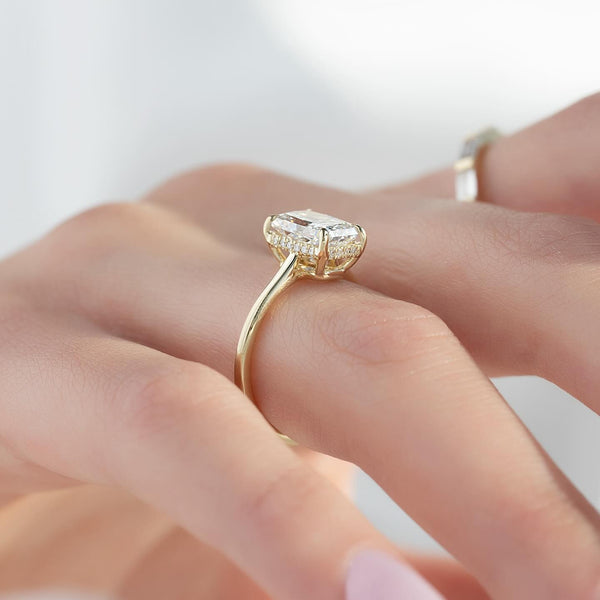
- Full pavé — stones all the way round. Beautiful off the hand. On the hand it puts stones exactly where the ring rubs against everything, and it usually cannot be resized. Choose it knowingly.
Living with pavé
None of this is difficult; it is just not obvious.
- Have the beads checked every couple of years. A jeweller sees a flattening bead long before a stone moves.
- Clean underneath, not on top. A soft brush and warm soapy water, aimed at the underside of the stone row.
- Take it off for the gym. Grip loads are the single worst thing for a pavé shank, far worse than water or chemicals.
- Photograph the ring when new, straight down, in good light. If a stone goes missing you will have something to compare against.
- If one does go, get it replaced promptly — a gap leaves the neighbouring beads exposed and the next loss comes faster.
Is it worth it?
For most people, yes — with half coverage and a proper shank. You get a substantial increase in brightness for a small increase in cost, and the maintenance is a check-up every couple of years rather than a running problem.
If you want zero maintenance, a plain shank with a larger centre stone is the honest alternative, and it is not a downgrade. It is simply a different distribution of the same money.
Keep reading
Frequently asked questions
Do pavé stones fall out?
They can, and pavé accounts for most stone-loss repairs. The cause is usually worn beads or a shank thin enough to flex under grip pressure. A shank of 1.8 mm or more, half rather than full coverage, and a bead check every couple of years reduce it to a rare event.
Is half pavé better than full pavé?
For a ring worn daily, usually yes. From above the two look identical, because nobody sees the underside of your finger. Half coverage leaves plain metal at the most-abraded part of the ring and allows normal resizing, while full pavé puts stones exactly where the ring rubs and generally cannot be resized.
How thick should a pavé band be?
At least 1.8 mm for daily wear. Below that the shank flexes slightly under grip pressure, and stones set into a flexing surface work loose over time. The difference between 1.5 mm and 1.8 mm is invisible on the hand and adds a negligible amount of metal, but it is the main factor in whether the ring needs work by year four.
Why does my pavé ring look dull?
Almost always residue underneath rather than damage. Soap, hand cream and skin oil collect beneath the stone row where a cloth cannot reach, blocking light entering from below. A soft brush and warm soapy water aimed at the underside restores it. Hand cream is the biggest single contributor.
We quote the shank thickness before we cast.
On a pavé ring it is the number that decides whether you are back at a bench in four years.
Leave a comment