Buying advice
Will People Think My Lab Diamond Is Fake?
Lab grown made two-carat rings ordinary. The worry that comes with them is social, not chemical. Here is what actually makes a ring look real across a table, and what doesn’t.
Written by the Mapple Gems workshop, Surat · Updated 10 October 2026
Short answer
No one can tell a lab grown diamond from a mined one by looking, and a standard diamond tester reads both as diamond. What makes any large ring look fake is proportion and condition: a big stone on a thin band, a tall wobbly head, a poorly cut or dirty stone. Get those right and a lab grown ring reads as exactly what it is, a diamond.
The average engagement ring centre stone is now close to two carats, and most of those stones are lab grown. That has made a very old question new again: if a ring looks big, will people assume it is costume jewellery? The honest answer is that some will, about some rings. The reasons have little to do with where the diamond came from.

What a person can and cannot see
A lab grown diamond is carbon in the same crystal structure as a mined one. It has the same hardness, the same refractive index of about 2.42 and the same way of breaking light into brightness and fire. Telling the two apart takes laboratory equipment that reads growth patterns and trace elements. A friend, a colleague or a relative across a dinner table has no way to do it.
A handheld diamond tester will not help them either. Thermal and electrical testers read a lab grown diamond as diamond, because it is one. The stones that fool or fail testers are simulants such as cubic zirconia, and moissanite on some testers, which are different materials altogether.
What actually makes a ring look fake
When people say a ring ‘looks fake’, they are reacting to signals, not testing a stone. These are the ones that matter:
| Signal | Reads as costume | Reads as fine jewellery |
|---|---|---|
| Band | Thin, bendy band under a huge stone | Band width and thickness in proportion to the stone |
| Setting height | Tall head that tips and catches | Low, stable head or bezel |
| Cut | Glassy, dark centre or a window you can see through | Even brightness across the face |
| Condition | Greasy, dull stone; scratched plating | Clean stone, solid metal with crisp edges |
| Size for the hand | Stone wider than the finger | Stone that sits within the finger width |
Notice that none of these is about origin. A mined diamond on a flimsy band looks just as suspicious as a lab grown one.
From the workshop
When a customer in Surat or abroad asks us for a very large lab grown stone, the first thing we talk about is the band, not the diamond. A heavier shank and a lower head do more to make a three-carat ring look real than any grade on the report, because the eye reads the whole ring at once. A big stone on a whisper-thin band is what looks like a fashion ring, and it is also the build most likely to bend.
Is there a size that looks too big?
It depends on the hand, not a number. As a rough guide, a stone whose width stays inside the width of the finger looks natural on almost anyone. Elongated shapes such as oval, pear and elongated radiant cover more of the finger lengthways without spilling over the sides, which is one reason they dominate large lab grown rings.
What to say if someone asks
You do not owe anyone an explanation, but if you want one, the plainest answer works best: ‘It’s a lab grown diamond.’ It is accurate, it is now the most common choice for engagement rings in the United States, and it ends the conversation more quickly than a story about price. People who ask ‘is it real?’ are usually asking ‘is it a diamond?’. It is.
- Choose a band and setting in proportion to the stone.
- Keep the head low or use a bezel for stones over two carats.
- Pick a well-cut stone; cut drives brightness more than size.
- Clean it regularly; hand cream on the back of the stone is what makes it look glassy.
- Keep the grading report; it answers the question for good.
Keep reading
Frequently asked questions
Can people tell if a diamond is lab grown?
Not by eye. Lab grown and mined diamonds share the same crystal structure and optical properties. Only laboratory instruments that read growth patterns and trace elements can separate them.
Will a lab grown diamond pass a diamond tester?
Yes. Standard thermal and electrical diamond testers read a lab grown diamond as diamond, because it is one. Testers are designed to catch simulants such as cubic zirconia.
Why do some large diamond rings look fake?
Usually because of proportion and condition: a big stone on a thin band, a tall setting, a poorly cut stone or a dirty one. Those signals apply equally to mined and lab grown diamonds.
How big is too big for a lab grown engagement ring?
There is no fixed carat limit. A stone whose width stays within the width of the finger looks natural on most hands, and elongated shapes let you go larger without spilling over the sides.
A big stone, built to look the part
IGI certified lab grown diamonds set in solid gold, with bands made in proportion to the stone. Made to order in Surat.
Browse lab grown diamond rings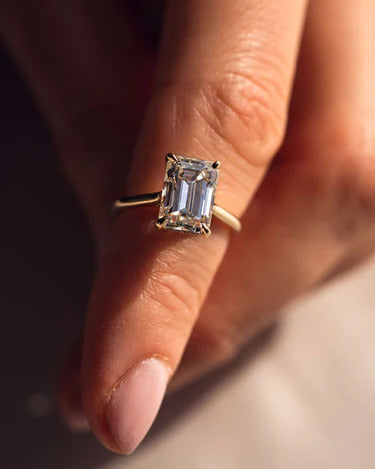
Leave a comment