Shape
When Price Stops Deciding the Shape
Half of what people believe about diamond shapes is really a fact about rough yield. Remove the price pressure and the whole ranking changes.
Written by the Mapple Gems workshop, Surat · Updated 25 August 2026
Short answer
Round brilliants cost more per carat than fancy shapes because cutting one wastes more rough, and fancy shapes are cheaper partly because they retain more weight. With an alternative, that pricing pressure largely disappears — so shape becomes a question of what suits the hand and the setting rather than what the budget allows.
Ask why someone chose an oval over a round and the answer is often "more size for the money". That is true, and it is a price fact rather than a design one. It has quietly shaped a great deal of what people believe about shapes.
Where the price differences come from
A round brilliant is the most wasteful shape to cut. Turning a rough crystal into a round means removing a large proportion of it, and what is removed is not recovered. Fancy shapes — oval, pear, marquise, cushion — follow the rough more closely and retain more of it.
So rounds carry a premium per carat, and fancy shapes are cheaper. Layer on top of that the fact that fancy shapes also spread their weight into face-up area rather than depth, and the size-per-pound gap widens further: at one carat a round is about 6.5mm across while an oval runs 7.7mm long and a marquise 10mm.
Both of those effects are about rough. Neither says anything about which shape is more beautiful, more durable or better suited to a particular hand.
What changes with an alternative
Moissanite is grown rather than mined, so "rough yield" is a manufacturing variable rather than a geological constraint. Lab grown diamond prices have also fallen steeply and settled near production cost. The per-carat premium on a round shrinks considerably in both, and moissanite's price curve rises gently with size rather than stepping at round carat figures.
The practical consequence is that the question changes. Instead of which shape gets me the most size for my budget, it becomes which shape do I actually want — which is a better question and one most people never get to ask.
Choosing on merit instead
| Shape | mm at 1ct | Cut grade? | The real reason to choose it |
|---|---|---|---|
| Round | 6.5 | Yes | The only shape whose light performance is graded for you |
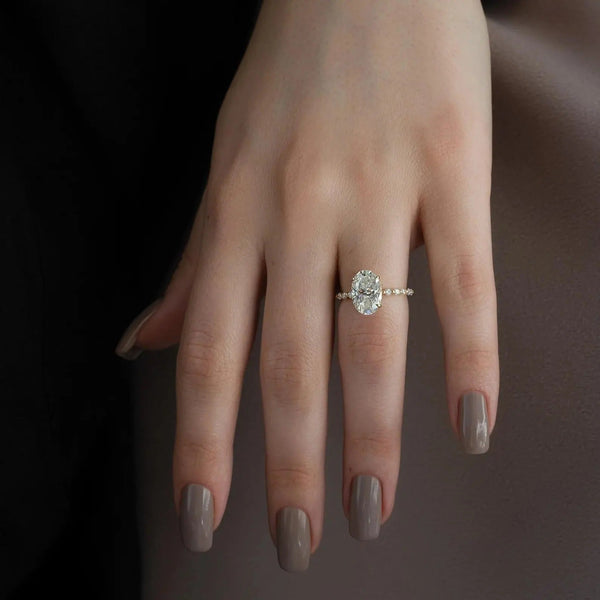
| Oval | 7.7 × 5.5 | No | Lengthens the finger; forgiving ratio window |
| Cushion | 5.9 × 5.9 | No | Softest outline; most forgiving to set and to own |
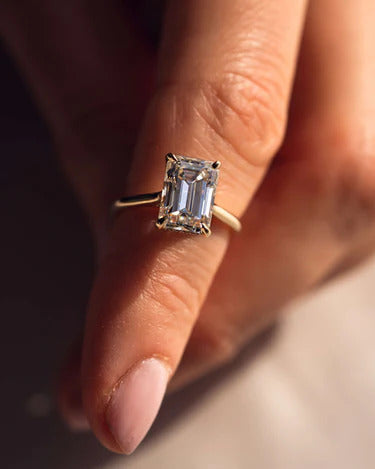
| Emerald | 7.0 × 5.0 | No | Calm broad flashes; no bow-tie; scale without rainbow |
| Pear | 8.4 × 5.5 | No | Distinctive; needs a V-prong and attention |
| Marquise | 10.0 × 5.0 | No | Largest face-up area of any shape; most demanding |
The cut-grade column deserves more weight than it usually gets. No laboratory grades cut on any fancy shape — cut grades exist only for round brilliants. So when price stops being the deciding factor, the round's genuine remaining advantage is documentary: it is the one shape where light performance comes verified rather than judged.
On everything else you are the cut grader, which means a rotating handheld video in ordinary room light is not optional.
From our bench in Surat
Here is a shape effect that has nothing to do with price and that almost nobody weighs: fancy shapes are harder to source consistently in small sizes. If you want matched pear or marquise side stones, or a halo of ovals, the melee has to be selected as a batch rather than picked individually — and matched parcels of shaped melee are genuinely harder to assemble than round.
So a shape decision is quietly also a decision about what can sit next to the stone. Round melee is available in any quantity and any size; shaped melee is not. If a design depends on matched shaped accents, ask about lead time before falling for the render.
Two things price never decided anyway
Durability is a setting question, not a shape one. Chips happen where material is thin — at points and narrow girdles. A marquise with V-prongs on both ends is not fragile; a marquise with decorative prongs along its sides is. The shape sets the requirement; the setting meets it or does not.
How a shape ages is independent of what it cost. Round, oval and emerald have never really dated. Pear, princess, marquise and heart move in cycles over generational spans. And in every case the setting dates faster than the shape — so if longevity matters, spend the conservatism on a simple head rather than on the outline.
How to choose, now that you can
- Start with the hand. Cut a paper shape at the actual millimetres and hold it against the finger it is for — apparent size is a ratio, not an absolute.
- Decide whether you want documented cut quality. If yes, that is an argument for a round and it is the strongest one left.
- Decide about fire. With a moissanite centre, a step cut gives scale with the calmest light return and a round brilliant the loudest.
- Check what the shape demands of the setting — V-prongs, tip cover, a prong per corner — and whether you will keep to a two-yearly bench check.
- Check the wedding band consequence with the straight-edge test on the CAD side elevation.
- Ask for video, whatever the shape, because on everything but a round nobody has graded the cut for you.
Keep reading
Frequently asked questions
Why do round diamonds cost more per carat?
Because cutting a round removes a large proportion of the rough crystal, and what is removed is not recovered. Fancy shapes follow the rough more closely and retain more weight, which is why they carry no equivalent premium.
Do fancy shapes look bigger than rounds?
Face-up, yes, because they spread their weight into area rather than depth. At one carat a round measures about 6.5mm across, an oval 7.7mm long and a marquise around 10mm. That is a genuine effect and separate from the price difference.
Is there any reason left to choose a round?
Yes, and it is a strong one: the round is the only shape that receives a cut grade. No laboratory grades cut on any fancy shape, so a round arrives with its light performance verified while every other shape has to be judged on video.
Are fancy shapes more fragile?
The material is identical; the exposure differs. Chips happen at points and thin girdles, so a pointed shape sets a requirement the setting must meet — V-prongs over every point. Met properly, a marquise is not a fragile ring.
Which shapes date and which do not?
Round, oval and emerald have never really dated. Pear, princess, marquise and heart move in and out over generational spans. In every case the setting dates faster than the shape, so a simple head is where to be conservative.
Choose the shape you want
Made to order in our own workshop in Surat, so the shape, the prong build and the band are all decided together rather than dictated by a price list.
Leave a comment