Engagement Rings
Why Your Ring Will Not Look Like the Photograph
Not because anything is wrong with it. Because product photography is a controlled environment and your kitchen is not.
Written by the Mapple Gems workshop, Surat · Updated 10 September 2026
Short answer
Product images are shot with directional light, at close range, at a chosen angle, from hundreds of frames — all of which flatter a stone. At home you have diffuse overhead light, a metre of distance and no retakes, so the same ring looks calmer. Three things genuinely differ: scale (macro photography enlarges everything), sparkle (directional light maximises it), and metal colour (white balance shifts it). Ask for video on a hand in ordinary indoor light and the gap mostly disappears.
This is the most common source of disappointment in online jewellery, and it is usually not a quality problem. It is a physics-and-photography problem, and knowing which parts are real and which are artefacts of the image makes ordering much less anxious.
What the photograph does to the ring
| In the image | Why | Real or artefact? |
|---|---|---|
| Looks much larger | Macro lens, close range, no scale reference | Artefact |
| Sparkles intensely | Directional point-source lighting | Real, but conditional |
| Metal reads cooler or warmer | White balance and post-processing | Artefact |
| No visible inclusions | Angle chosen from many frames | Artefact |
| No bow-tie in an oval or pear | A still cannot show a rotation effect | Artefact |
| Perfectly even pavé row | Straight-down shots hide height variation | Sometimes an artefact |
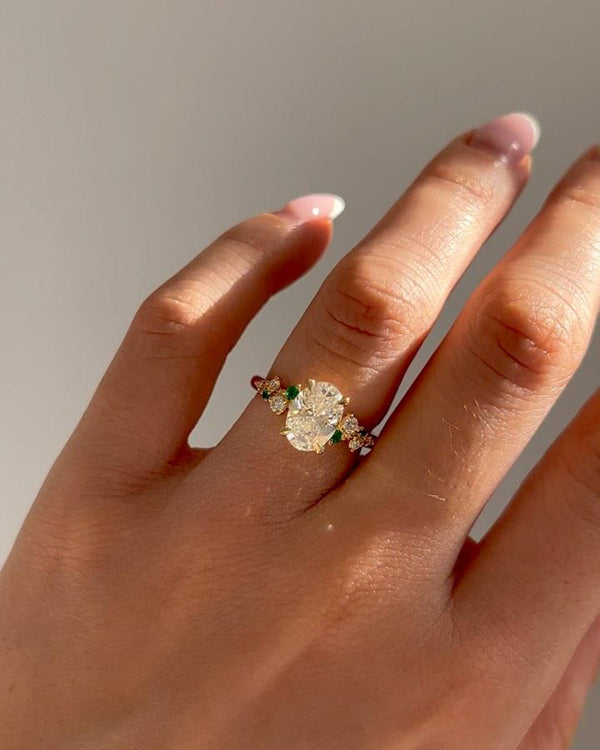
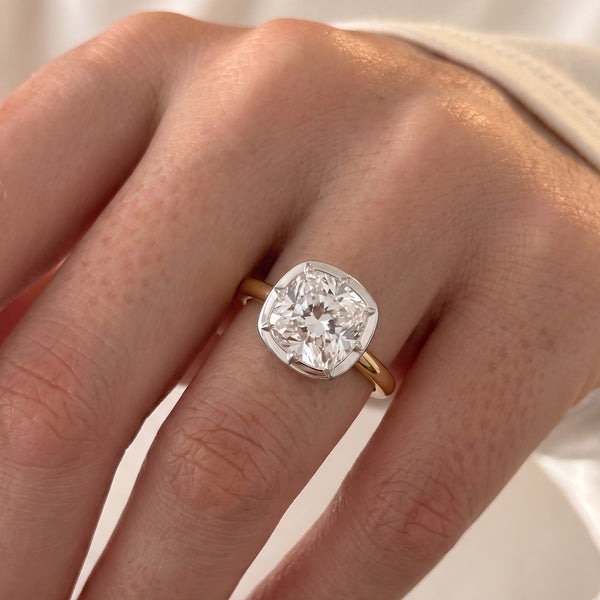
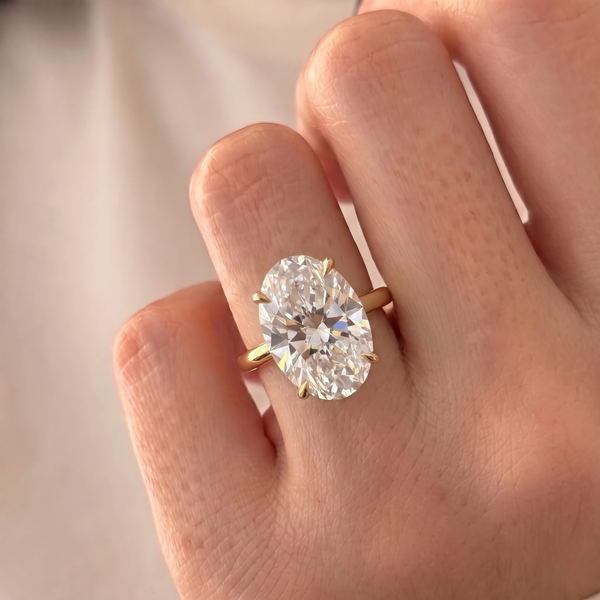
Scale is the one that causes real disappointment, and it is entirely fixable in advance. A 6.5 mm stone photographed at macro range fills a screen. On a hand it is roughly the width of a pencil. Nothing in the image is dishonest — there is simply no reference object, and your brain supplies the wrong one. The fix costs nothing: cut a 6.5 mm circle out of paper and put it on the actual finger. Do it before ordering, not after. It is cruder than any render and far more informative, and it is the single most useful five minutes in the whole process. If the paper circle looks right, the ring will look right.
Lighting: why sparkle changes room to room
Fire and brilliance depend on light hitting the stone from a defined direction. Under point sources — spotlights, LED downlights, sunlight, candles — a stone throws distinct flashes. Under diffuse light — an overcast day, a north-facing room, most offices — light arrives from everywhere at once and the flashes blend into a general glow.
Product photography and jewellery shops both use directional light deliberately. That is not deception; it is showing the stone at its best. But it means the version you saw is the maximum, not the average.
With moissanite this matters more, because its dispersion is roughly 2.4 times diamond’s — so the gap between directional and diffuse light is wider. A moissanite that looks spectacular in a lit photograph will look calm and white in an office, which many people prefer.
What to ask for instead
- Video, rotating, on a hand, in ordinary indoor light rather than a lightbox. This answers scale, sparkle and metal colour at once.
- A shot next to a known object — a coin, a fingernail, a ruler. Any reference fixes the scale problem instantly.
- The side elevation. Profile height is invisible in the top-down images everyone approves from.
- Millimetre dimensions for the stone and the total width across the setting.
- An unedited photograph, if metal colour matters — particularly for rose gold, where alloy shades genuinely vary between workshops.
Where the difference is not photography
Being fair in both directions. Some gaps are real, and these are worth checking on arrival against the written specification:
- A stone measurably smaller than stated. Check with callipers or against the report’s millimetre figures.
- A shank thinner than quoted. This is the specification most often quietly reduced, and it is measurable.
- An uneven pavé row visible in good light straight down. That is setting quality, not photography.
- Casting texture or a rough underside. Finishing that was skipped — look underneath.
Photography explains a calmer, smaller-looking ring. It does not explain a ring that fails its own written numbers.
The reasonable expectation
A well-made ring in ordinary indoor light looks quietly good rather than spectacular, and comes alive under direct light — a window, a restaurant, sunshine. That is what jewellery does, and it is why people keep glancing at their hands.
If the ring in front of you matches its written specification and looks calm indoors, it is behaving correctly. The photograph was the exception, not the rule.
Keep reading
Frequently asked questions
Why does my ring look smaller than in the photos?
Because macro photography at close range gives no scale reference, so your brain supplies the wrong one. A 6.5 mm stone fills a screen in an image and is about the width of a pencil on a hand. Cut a paper circle at the stated millimetre size and put it on the actual finger before ordering.
Why does my stone sparkle less at home than in the listing?
Because sparkle depends on light arriving from a defined direction. Product photography and jewellery shops use point sources deliberately, while most homes and offices have diffuse light where flashes blend into a general glow. The photograph showed the maximum, not the average — the stone is unchanged.
What should I ask for instead of product photos?
Rotating video on a hand in ordinary indoor light, a shot beside a known object for scale, the side elevation showing profile height, and millimetre dimensions for the stone and the total width across the setting. Between them these answer scale, sparkle, height and metal colour.
How do I know if the difference is a real problem?
Check it against the written specification. A stone measurably smaller than stated, a shank thinner than quoted, an uneven pavé row in good light, or casting texture on the underside are real issues. Photography explains a calmer, smaller-looking ring — it does not explain a ring that fails its own numbers.
Cut the paper circle first.
Tell us the millimetres and try it on the actual finger. Five minutes, and it prevents the only disappointment we cannot fix.
Leave a comment