Engagement Rings
Shank Styles: The Cheapest Way to Change How a Ring Looks
Tapered, knife-edge, cathedral, euro — four decisions that cost almost nothing and change everything.
Written by the Mapple Gems workshop, Surat · Updated 3 September 2026
Short answer
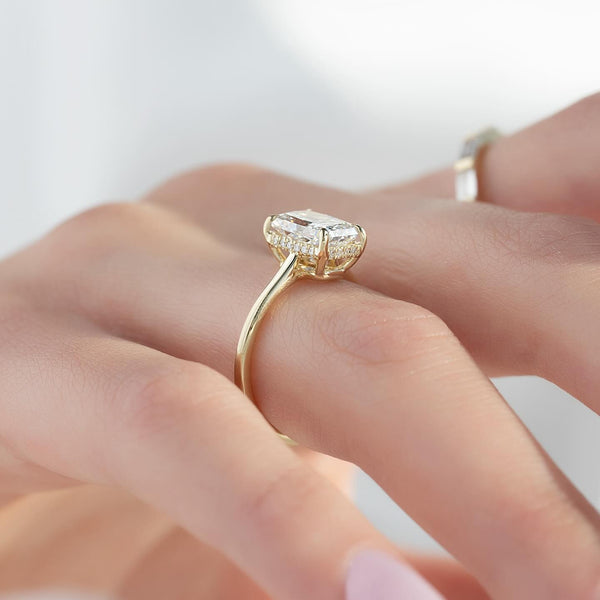
The shank is the band, and its shape is the most under-used lever in ring design. A tapered shank narrows toward the head, making the stone read larger. A knife-edge has a raised centre ridge that catches light along the finger. A cathedral sweeps upward to meet the head. A euro shank is flattened at the bottom so the ring does not spin. None of these add meaningful cost, and each changes the ring more than most people expect.
Most ring decisions are about the stone and the setting. The shank gets chosen by default — it is whatever came with the design — and yet it is the part in contact with your finger every hour of every day, and the part your eye reads the stone against.
The main styles
| Style | What it does | Trade-off |
|---|---|---|
| Straight | Even width all round; simplest to resize | None — the safe default |
| Tapered | Narrows toward the head — stone reads larger | Thin section needs adequate thickness |
| Knife-edge | Raised centre ridge; a line of light along the finger | The ridge wears flat over years |
| Cathedral | Sweeps up to support the head; elegant profile | Usually needs a contoured band |
| Euro / flat-bottom | Squared underside — resists spinning | Slightly more metal; hard to resize far |
| Twisted / crossover | Two strands wrapping the finger | Band fit is awkward; harder to clean |
| Split | Divides near the head to frame the stone | Ask for per-strand width, not combined |
The euro shank is the fix almost nobody is offered. If a ring spins, the standard advice is soldering, sizing beads or a snugger size. There is a fourth option that is better than all of them and is designed in rather than added afterwards: a euro shank, flattened along the underside instead of round. The flat face sits against the base of the finger and simply cannot rotate the way a round shank does. It is invisible from above, adds a small amount of metal, and needs no maintenance ever. If you already know your rings spin, ask for this at the design stage rather than solving it twice later.
Why a tapered shank makes a stone look bigger
Your eye judges the stone against the metal immediately beside it. Narrow that metal and the stone gains by comparison — the same effect as choosing a thinner band, concentrated exactly where it matters.
A shank tapering from, say, 2.2 mm at the back to 1.8 mm at the shoulders keeps comfort and strength where the ring is gripped, and gives the stone a narrower frame where it is seen. It costs slightly less than a straight shank of the same maximum width, because it uses less gold.
The limit is thickness rather than width: do not let the narrow section drop below about 1.8 mm on a ring worn daily, or it will bend over years.
Knife-edge, and what happens to it
A knife-edge shank rises to a ridge along its centre line, so instead of a soft curve of light you get a bright line running along the finger. It is genuinely striking and photographs beautifully.
It also wears. The ridge is the highest point on the ring, so it takes contact first, and over years it flattens into a soft rounded edge — the same mechanism that flattens milgrain. It can be re-cut, and like milgrain that removes metal, so it is not indefinite.
If you love the look, choose it knowingly: it is a detail that softens with time rather than one that stays sharp. Some people find the aged version better.
The comfort question: interior profile
Separate from the outside shape, and more important for daily comfort.
- Flat interior — the traditional profile. Fine on narrow bands; noticeable on anything above about 4 mm.
- Comfort fit — the inside is domed, so only the centre touches the finger. Slides over a knuckle far more easily and is what most people prefer once they have worn both.
- Note the sizing difference: comfort fit rings often need a half size smaller than the same size in a flat interior, because less of the band grips. Say which you are ordering when giving a size.
Which shanks resize easily
Worth knowing before choosing, because resizing is a near-certainty over decades.
- Easiest: straight and tapered plain shanks. Plenty of clean metal at the back to cut and rejoin.
- Manageable: knife-edge and cathedral — the join needs refinishing to match, which takes longer.
- Limited: euro shanks, because the flat section geometry changes with size. Fine for small adjustments.
- Difficult: twisted or crossover shanks, and anything stone-set all the way round.
What to specify
Four numbers and one word cover it: width at the back, width at the shoulders, thickness, interior profile, and the style name. That is enough for any workshop to build exactly what you pictured.
And if you are ordering a wedding band alongside, specify the shank first — the band should match its width and profile, and it is far easier to match a band to a decided shank than the reverse.
Frequently asked questions
What is a euro shank and does it stop a ring spinning?
A euro shank is flattened along its underside rather than round, so the flat face sits against the base of the finger and cannot rotate the way a round shank does. It is invisible from above, needs no maintenance, and is designed in rather than added later — a better answer to spinning than soldering or sizing beads.
Does a tapered shank make the diamond look bigger?
Yes, because your eye judges the stone against the metal immediately beside it. Narrowing the shank toward the head gives the stone a smaller frame exactly where it is seen, while keeping comfort and strength at the back. It also uses less gold, so it costs slightly less than a straight shank of the same maximum width.
What is the difference between comfort fit and flat interior?
Comfort fit has a domed inside so only the centre touches the finger, which slides over a knuckle far more easily; a flat interior contacts the whole width. Comfort fit rings often need a half size smaller than the same size with a flat interior, so state which you are ordering when giving a size.
Does a knife-edge shank wear down?
Yes. The raised centre ridge is the highest point on the ring so it takes contact first, and over years it softens into a rounded edge — the same mechanism that flattens milgrain. It can be re-cut, but that removes metal, so it is not indefinite. Choose it knowing it will soften.
Tell us if your rings spin.
We will build a euro shank instead of leaving you to solve it twice afterwards.
Leave a comment