The checklist
Twelve Luxuries That Cost Nothing Extra
Every one of these is a specification rather than an upgrade. Two of them actually reduce the price. All twelve have to be asked for before casting.
Written by the Mapple Gems workshop, Surat · Updated 26 August 2026
Short answer
A tapered shank, eased interior edges, an open gallery, a euro shank, prong orientation over an inclusion, brushed centre with polished edges, engraving in the right place, three-quarter rather than full coverage, and a weight just under a round carat figure. None costs more; two cost less. All are decided before the metal is poured.
The luxuries that actually show on a hand are mostly not upgrades. They are choices — and because they are invisible in a product photograph, they are almost never presented as options.
This is the capstone of our affordable luxury guide: the list you can hand to any maker.
The two that cost less
1. A tapered shank. A band that narrows slightly toward the head makes the centre stone read larger by contrast, sits more comfortably, and uses less metal — so it costs less. It is the only lever that improves apparent size, comfort and price simultaneously. Taper the width only; thickness stays at 1.8mm or more at the base.
2. A weight just under a round carat figure. Diamond prices step up at 0.50, 1.00, 1.50, 2.00 and 3.00 carats while physical size rises smoothly. A 0.90ct stone is about 6.2mm against 6.5mm; a 1.90ct oval is roughly two tenths of a millimetre shorter than a 2.00ct one. Nobody detects either on a hand.
The ten that cost nothing
| Ask for | What it does |
|---|---|
| 3. Eased interior edges | Sharp inner edges are the commonest reason a correctly sized band feels wrong |
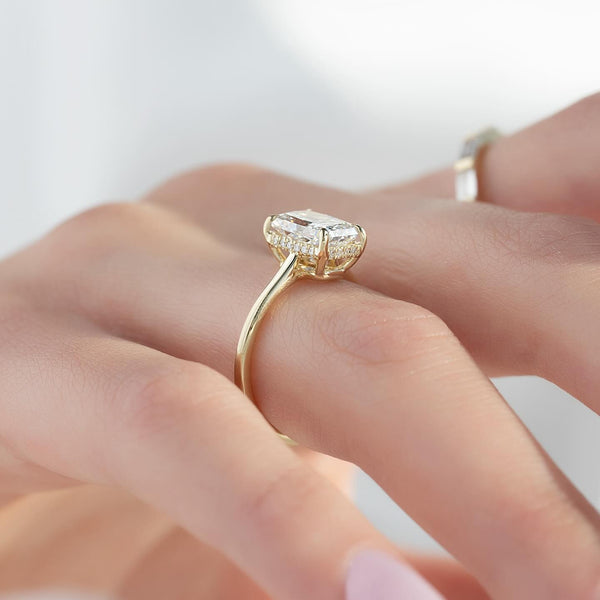
| 4. An open gallery | Light into the pavilion, and the only way the underside can be cleaned |
| 5. A euro shank | Stops a top-heavy ring turning — invisible, permanent, no maintenance |
| 6. A prong oriented over a girdle inclusion | The setter rotates the stone so a prong lands on it. Free, instant, never requested |
| 7. Prongs at the shoulders, not on tips | The girdle is thinnest at a tapered end; V-prongs over any actual point |
| 8. Brushed centre, polished edges | Grain hides the marks; polished edges give a crisp outline. Reversible |
| 9. Engraving on the upper interior | The bottom of the shank is exactly where a resize cuts |
| 10. Three-quarter rather than full coverage | Identical on the hand; stays resizable; solid metal where wear happens |
| 11. A colour grade matched to the metal | H–I reads white in warm gold; G+ only in white metals |
| 12. Clarity chosen by position | A well-placed SI1 beats a badly-placed VS2 at arm's length, and costs less |
Numbers 6 and 12 work together and are the least-used pair in jewellery buying. Open the plot diagram on the report — red marks internal inclusions, green surface ones — find anything near the girdle, and ask for a prong to sit over it. It takes the setter no additional time.
The two that do cost money, and are worth it
For honesty's sake, two things on any luxury list are genuinely more expensive and should not be presented otherwise.
Shank thickness. 1.8mm at the base, 2mm under a large stone. More metal costs more metal. It is also the single specification that decides whether a ring needs bench work in year ten or year twenty, and it is the first thing quietly cut when a price has to come down.
Bench time. A level stone row, a finished gallery, crisp edges and a smooth interior are hours, and hours are the real cost of good making. This is the craft premium, and unlike a brand premium it can be evidenced — ask for a photograph from underneath and one along the stone row in daylight.
From our bench in Surat
Every item on this list is a CAD edit, which is the tier of customisation almost nobody knows exists. Between "pick from the catalogue" and "design from scratch" sits modified — an existing design with changes made before casting. Thicker shank, lower profile, six prongs instead of four, V-prongs added, euro shank, half pavé instead of full. Most people who think they want bespoke actually want this, and it is not listed as an option on our site or on most others.
The reason it goes unoffered is not cost. It is that a configurable product is harder to merchandise than a fixed one. So it exists only if you ask — and the window closes at casting, because profile height, gallery architecture and geometry are permanent from the moment metal is poured.
How to actually use the list
Send it as one message before ordering, and ask for three things back: the written specification, the side elevation with profile height in millimetres, and confirmation of which items on the list have been applied.
Then run the straight-edge test on that side elevation — a ruler flat against the side of the ring, looking for daylight under the stone — and decide the wedding band before anything is cast.
Two closing points. Name your budget: withholding it does not produce a keener quote, it produces savings made where you cannot see them, and the invisible place is almost always the shank. And remember the inverse of this list — the six construction signals in where cheap actually shows — because knowing what to specify and knowing what to inspect are the same skill pointed in two directions.
Frequently asked questions
Which ring upgrades actually cost nothing?
Eased interior edges, an open gallery, a euro shank, prong orientation over an inclusion, prong placement away from thin tips, brushed centre with polished edges, engraving position, three-quarter coverage, and matching colour grade and clarity position to the setting. A tapered shank and a just-under-round weight actually cost less.
What is a euro shank and why ask for one?
A flattened section on the underside of the band that meets the flat underside of the finger, stopping a top-heavy ring from turning. It is invisible from above, needs no maintenance and costs almost nothing — but it has to be drawn in before casting.
Can a prong really be positioned to hide an inclusion?
Yes, if the inclusion sits on or near the girdle. The setter rotates the stone so a prong lands on that point. It costs nothing and takes no extra time on a made-to-order ring, and it is one of the least-used requests in the trade.
What is a modified ring, as opposed to custom?
An existing design with CAD edits made before casting — thicker shank, lower profile, different prong count, V-prongs added, euro shank. It sits between picking from a catalogue and designing from scratch, and it is what most people who ask for bespoke actually want.
When is it too late to ask for these?
At casting. Profile height, gallery architecture and overall geometry are fixed the moment metal is poured, and shank thickness can only be changed by reshanking afterwards. CAD approval is the decision point that matters.
Send us the list
Every item on it is a CAD edit, and everything is made to order in our own workshop in Surat — so all twelve are still open until we cast.
Leave a comment