Customer Favourite
Oval Moissanite Ball Claw Solitaire on a Hairline Band: A Buyer’s Guide
Four polished dots around an oval, on the finest band we make. Why it looks so delicate, and the one number to check before you choose it for everyday wear.
Written by the Mapple Gems workshop, Surat · Updated 13 October 2026
Short answer: This is a true solitaire: an oval moissanite set low in four claws finished as small polished balls, on a flat band about 1.4 mm wide. It is made to order in 925 silver or solid 10K, 14K or 18K gold, from 2 to 5 carats. The hairline band makes the stone look larger; for daily wear, ask that the band’s thickness be at least 1.8 mm.
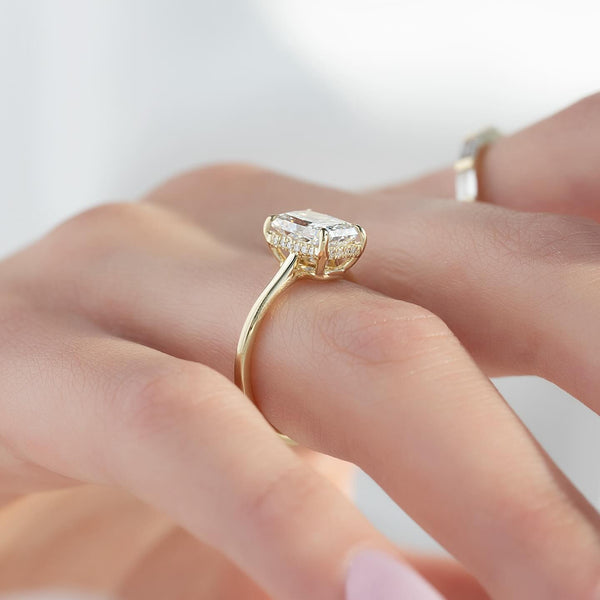
Most minimalist rings are simple. This one is reduced. The claws are rounded into small polished spheres, so from above they read as four bright dots around the outline, and the band below is about as fine as an engagement ring band gets. The whole ring is about the stone. Our latest order was a 2 carat oval in 10K yellow gold.

What ball claws are
A claw (or prong) is usually finished with a filed tab or a rounded tip. A ball claw is finished as a small sphere sitting over the edge of the stone. It is smooth to the touch, catches less on fabric than a sharp tip, and gives a soft, modern look. Like every claw, it thins slowly with wear, and a rounded ball shows that change clearly: a healthy ball is round; a worn one looks flattened.
Width and thickness on a hairline band
| Measurement | This ring | What it decides |
|---|---|---|
| Width (seen from above) | About 1.4 mm, flat | How delicate it looks |
| Thickness (inside to outside) | Ask for at least 1.8 mm | Whether it stays round for years |
A narrow band makes the stone look bigger, because more bare finger shows either side. But width is only the look. What keeps a band from bending out of round is its thickness. A band can be 1.4 mm wide and still be strong if it has enough depth. Ask for the thickness figure on the CAD preview.
From the workshop
We want to be straightforward about this ring. A 1.4 mm band is the finest we make, and on most rings we recommend at least 1.8 mm for something worn every day. That does not make this ring a poor choice — it makes it a ring for a particular wearer. It suits someone who loves a very fine look and will take the ring off for the gym, gardening and heavy lifting. Our latest customer chose 10K yellow gold, which helps: 10K is the hardest gold alloy we offer and resists bending best. With a 2 carat stone, the leverage on the band is modest too. If you want this look but use your hands hard, ask us to build the band thicker without making it wider.
Before you order: a short checklist
- Ask for the oval’s millimetres and do a paper test.
- Ask for the band’s thickness; request at least 1.8 mm for daily wear.
- Choose 10K or 14K gold for the strongest fine band.
- Consider a smaller stone if you want the band to stay fine and strong.
- Enjoy the easy part: a plain solitaire takes a straight wedding band flush.
Keep reading
Frequently asked questions
What is a ball claw setting?
A prong setting where each claw tip is finished as a small polished sphere. It looks like a bright dot and is smooth to the touch.
Is a 1.4 mm band too thin for an engagement ring?
It is fine if the band is thick enough from inside to outside. Ask for at least 1.8 mm of thickness, and take the ring off for heavy work.
Does a thin band make the stone look bigger?
Yes. More bare finger shows beside the head, so the stone looks larger by comparison.
Which gold is best for a fine band?
10K or 14K. Both are harder than 18K and resist bending better on a slim band.
How do I know if a ball claw is worn?
A healthy ball claw looks round. A worn one looks flattened on top. Have it checked if you see that change.
The oval ball claw solitaire, made to order in Surat
2 to 5 carats, 925 silver to solid 18K gold, CAD preview before production.
See the ring All engagement rings
Leave a comment