Engagement Rings
The Case for Buying a Plain Solitaire
The design with nothing added is the one that needs the least done to it for forty years.
Written by the Mapple Gems workshop, Surat · Updated 31 August 2026
Short answer
A plain solitaire has one stone, one setting and nothing to maintain. It resizes without difficulty, it takes a straight wedding band flush, it has no small stones to loosen, no milgrain to wear off and no faceting fashion to date. It also puts every pound into the stone and the metal rather than into labour. If you cannot decide, this is the choice you are least likely to regret — which is a genuine argument, not a lack of imagination.
We spend most of our time explaining halos, clusters, pavé and split shanks, because those are the decisions that need explaining. This page is the counterweight, and it is one we make regularly to customers who are about to spend money on complexity they do not want.
What a solitaire does not have
| Problem | Applies to a plain solitaire? |
|---|---|
| Small stones working loose | No stones to lose |
| Cannot be resized | Resizes easily — plain shank |
| Wedding band gap | Usually sits flush with a straight band |
| Detail wearing off | Nothing to wear off |
| Residue trapped under stones | One stone, easy to clean |
| Dating to a specific era | Minimal — the form is a century old |
Every row in that table is something we deal with at the bench, and none of it applies here. That is not a small consideration on an object you intend to wear for decades.
Where the money actually goes, and why it matters here. Setting labour scales with stone count. A halo is thirty to sixty individual settings; a pavé shank is another forty. That labour is real, skilled and correctly charged — but it is money in bench time, not in the ring’s material. A plain solitaire puts almost everything into the stone and the gold. So for the same budget, a solitaire generally gets you a noticeably larger centre stone and a heavier, better-built shank. That trade is invisible on a product page and obvious on a hand.
The counter-argument, stated fairly
A halo genuinely buys apparent size more cheaply than a bigger stone does. If maximum visual impact per pound is your goal, a halo wins and a solitaire does not.
And some people simply prefer detail. A plain solitaire is a quiet object, and if you want a ring that says something at a glance, quiet is the wrong quality.
So the honest framing is not that solitaires are better. It is that the reasons to choose complexity should be positive ones — you want the halo, you want the vintage detail — rather than a vague sense that plain is not enough.
How to make a solitaire look considered rather than default
This is where the design attention should go, and none of it costs much.
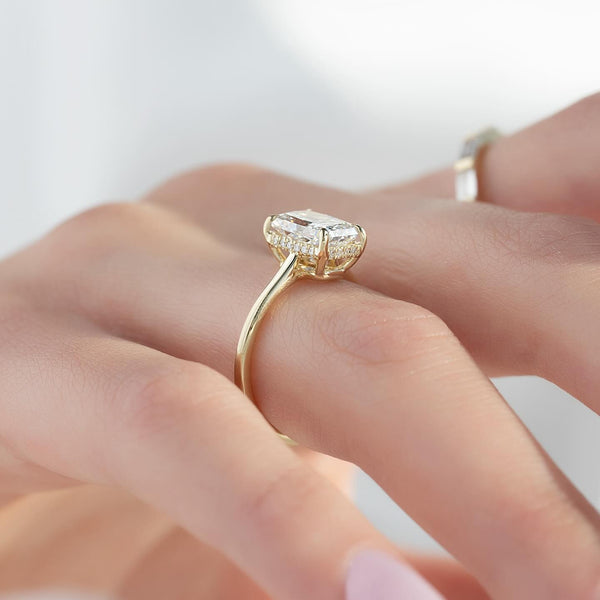
- Get the shank width right. 1.8–2.2 mm reads deliberate. Too thin looks flimsy; too thick swamps the stone. This one number does more than any decoration.
- Choose the prong count for the stone. Four below about 7 mm, six above 8 mm. It changes the outline noticeably.
- Set the profile height deliberately. A low-set solitaire feels completely different from a high-set one, and it is a free choice at the design stage.
- Consider a knife-edge or tapered shank. Still plain, but with a line rather than a tube. Costs almost nothing extra.
- Use a white head with a coloured band if the stone is large. It keeps the stone neutral and looks intentional.
For moissanite specifically
There is an additional argument here that applies to no other material.
Moissanite’s dispersion scatters more the more facets light passes through. A halo surrounds a large moissanite with dozens of small faceted stones, all doing the same thing — which amplifies exactly the effect that makes a large moissanite read as obviously not-diamond.
A plain solitaire does the opposite: one stone, one source of fire, no chorus around it. If you want a moissanite ring that reads discreet, plain is not merely acceptable — it is the better technical choice.
Keep reading
Frequently asked questions
Is a plain solitaire boring?
It is quiet, which is different. The form is a century old and does not date, it has nothing to maintain, and it puts almost the whole budget into the stone and the metal rather than into setting labour. Choose complexity because you positively want it, not from a sense that plain is not enough.
Do you get a bigger stone with a solitaire for the same budget?
Generally yes. Setting labour scales with stone count — a halo can be thirty to sixty individual settings, plus another forty for a pavé shank — and that labour is money in bench time rather than in material. A plain solitaire typically buys a noticeably larger centre stone and a heavier shank for the same spend.
How do I make a solitaire look less plain?
Attend to the proportions rather than adding decoration. A shank of 1.8–2.2 mm reads deliberate, prong count changes the outline, profile height changes the character entirely, and a knife-edge or tapered shank adds a line at almost no cost. These decisions do more than any added detail.
Is a solitaire better for moissanite?
If you want a discreet ring, yes. A halo surrounds a large moissanite with dozens of small faceted stones all producing the same strong dispersion, amplifying exactly the effect that makes a big moissanite read as obviously not-diamond. A solitaire gives one source of fire rather than a chorus around it.
Spend it on the stone and the shank.
If you are undecided, this is the version you are least likely to want changed in ten years.
Leave a comment