The complete guide
Affordable Luxury Engagement Rings
Luxury in jewellery is three separate things wearing one word. Two of them are buyable at almost any budget. The third is the one you are usually paying for.
Written by the Mapple Gems workshop, Surat · Updated 26 August 2026
Short answer
"Luxury" in jewellery covers three different things: materials, craft, and brand. Materials are commodities anyone can buy at spot price. Craft is bench time and finishing, and it costs real money but not a great deal. Brand is retail infrastructure and marketing. Affordable luxury means buying the first two properly and declining to pay for the third.
"Affordable luxury" sounds like a contradiction dressed up as a category, and in most industries it is. In jewellery it is unusually literal, because the things that make a ring genuinely good are separable from the things that make it expensive.
This guide is the index for that argument. Each section links to a fuller piece.
The three luxuries
| What you might mean by luxury | What it actually is | Buyable on a budget? |
|---|---|---|
| Materials | Gold at a public spot price; a stone from a global market | Yes — and verifiable |
| Craft | Bench hours: seats, finishing, a level stone row, eased edges | Yes — and it is the differentiator |
| Brand | Retail space, marketing, distribution margin, packaging | No — it is the thing being priced |
The first row is unusual in retail: gold trades on a public daily market, so the metal in any ring can be checked independently as grams × fineness × the day's price. Nothing else in jewellery works like that, and it means one whole component of "luxury" is a commodity with a published price.
The second row is where quality actually lives, and it is comparatively cheap. The third row is where most of a large price difference sits. Brand premium and craft premium covers the difference in full.
Where the money should go
Lab grown diamond prices fell sharply between 2020 and 2024 and settled near production cost, while gold did not fall. On many modest rings the metal and labour now cost more than the stone — which inverts the traditional advice to put everything into the centre.
The stone is also the one component that stays replaceable for the life of the ring. Profile height, gallery architecture, overall geometry and shank thickness are fixed at casting. So the strategy is to buy the structure, not the stone.
The luxuries that cost nothing extra
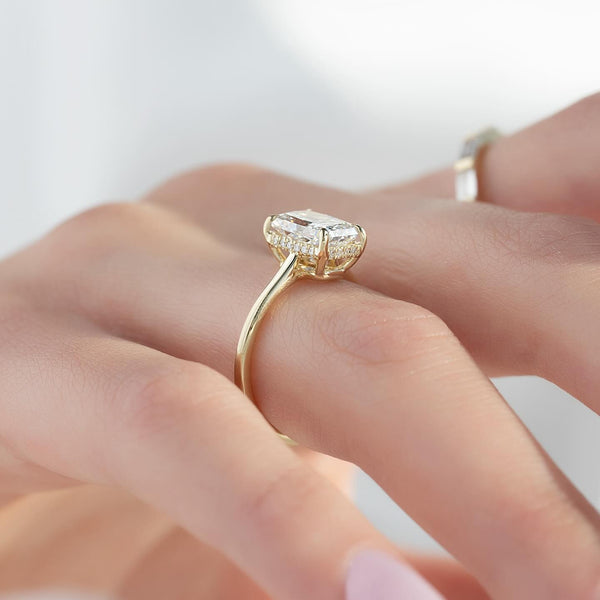
A surprising number of the details that make a ring read as expensive are specification choices rather than upgrades. A tapered shank uses less metal and costs less while making the stone look larger. Eased interior edges are a finishing decision. "Brushed centre, polished edges" is free to ask for and rarely offered.
The full list is in luxury that costs nothing extra, and its inverse — the six construction signals that give a cheap ring away — in where cheap actually shows.
Buying direct, and what it changes
Buying from the workshop that makes the piece removes distribution margin, but the more useful change is informational: the maker holds the CAD file, knows the alloy, has the melee specification, and can still change things before casting. What buying direct actually changes sets out both sides, including what a retailer genuinely gives you that a workshop does not.
Two verification tools, both free. Ask for a photograph of a piece part-finished — cast but not yet set. No reseller can produce one at any price, because nobody photographs a half-made ring for a catalogue. And ask for the written specification, the document nobody requests and the one that transfers the maker's information advantage to you.
From our bench in Surat
We should be straight about our own position, because "buy direct" is obviously self-serving when a workshop says it. Buying direct is not automatically better. A good local retailer gives you things we cannot: a piece in your hand before you commit, someone to walk into when something goes wrong, and no customs journey.
What buying direct genuinely gives you is specification control — shank thickness, profile height, prong placement, gallery, finish, all still open until we cast. That is the real argument and it is the only one we would make. And the fair criticism of us: our product pages still do not publish gram weight or shank thickness, the two numbers this entire guide tells you to demand. Ask and we will answer, but we would rather they were printed.
Luxury as duration
The version of luxury that matters most over forty years is not how a ring looked in week one. A ring is worn something like five to seven thousand days, and the underside takes nearly all the contact, so a piece immaculate from above can be a third thinner underneath.
What actually makes a ring last is unglamorous: enough metal, a two-yearly bench check, re-tipping at year six to ten, a reshank at fifteen to twenty. What "heirloom quality" would actually require takes the marketing phrase seriously and lists the specification behind it.
The checklist
- Ask for gram weight and shank thickness — 1.8mm minimum at the base.
- Ask for a photograph from underneath, and one of a piece part-finished.
- Get the written specification before you pay, not after.
- Match colour grade to metal; buy just under a round carat figure.
- Specify the free things: tapered shank, eased interior, open gallery, finish.
- Decide the wedding band before the engagement ring is cast.
- Name your budget — withholding it buys you a thinner shank, not a better price.
Frequently asked questions
What does affordable luxury actually mean in jewellery?
Buying the materials and the craft properly while declining to pay the brand premium. Materials are commodities with published prices, craft is bench time and costs real but modest money, and brand is retail infrastructure and marketing — the part that scales a price without changing the ring.
How can I verify any part of a ring's price?
The metal. Gold trades on a public daily market, so grams multiplied by fineness multiplied by the day's price gives a verifiable floor. It is the only component of a jewellery price you can check independently, which is why gram weight is the number to insist on.
Is buying direct from a workshop always cheaper and better?
Not always better. A good local retailer offers a piece in your hand before you commit, somewhere to walk into if something goes wrong, and no customs journey. What buying direct genuinely gives you is specification control — everything stays open until casting.
Where should the budget go on an affordable luxury ring?
Into structure first. The stone stays replaceable for the ring's whole life, while profile height, gallery architecture, geometry and shank thickness are fixed at casting. Since lab grown prices fell and gold did not, the metal often costs more than the stone anyway.
What is the single best question to ask a seller?
Ask for a photograph of a piece part-finished — cast but not yet set. No reseller can produce one at any price, because nobody photographs a half-made ring for a catalogue. It settles who actually makes what they sell.
Made in our own workshop in Surat
Which means the specification is still yours to set — and that we can answer every question on this page.
Leave a comment