Education
How Casting Works, and Why It Fixes Your Ring Forever
The stage nobody watches, and the one that decides which parts of a ring can ever be changed.
Written by the Mapple Gems workshop, Surat · Updated 4 October 2026
Short answer
Casting is lost-wax: a wax model of your ring is grown or carved from the CAD, encased in plaster, burned out, and the cavity filled with molten gold. Everything about the ring’s geometry is decided at that moment — profile height, shank thickness, gallery architecture, prong placement. Stones can be swapped and heads replaced for decades afterwards, but none of the geometry can. That is why CAD approval is the only real decision point, and why you should ask for the side elevation.
Casting is a five-hundred-year-old process performed with modern equipment, and it is the step that turns a set of decisions into a permanent object. Understanding it changes what you look at on a CAD render.
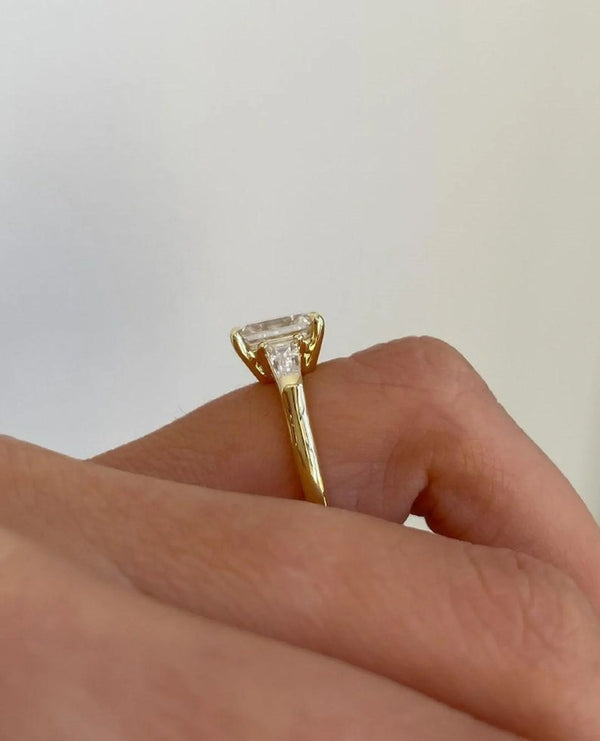
Everything that can be changed later — the stone, the head, a halo, the finish, even the shank itself — can be changed because it is a SEPARATE piece of metal. Everything cast as one body is permanent. That is the single organising fact of ring ownership and nobody explains it at the point of sale. A head is soldered on, so it can be unsoldered and replaced decades later when prongs thin past re-tipping. A shank is a band of metal, so it can be cut out and replaced. Stones sit in seats, so they lift out. But the PROFILE HEIGHT — how far the ring stands off the finger — the GALLERY ARCHITECTURE underneath, the taper, the thickness at the base and where the prongs sit relative to the stone are all one continuous casting. To change any of them you are not modifying a ring, you are making a different one. So the CAD render is not a preview, it is the decision, and it is approved from the one view — top-down — that shows none of those four things. Ask for the side elevation with the height in millimetres before anything goes to wax. It is five minutes of looking against twenty years of wearing.
The stages
- The CAD is turned into wax — grown on a resin printer or carved by hand. This is the last moment anything can be adjusted cheaply.
- The wax is attached to a sprue, a channel that will later carry metal into the cavity, and mounted in a flask.
- Investment plaster is poured around it under vacuum, so no air is trapped against the surface.
- The flask is heated and the wax burns out completely, leaving a hollow in the shape of the ring — hence “lost wax”.
- Molten gold is drawn in, usually under vacuum or centrifugal force so it reaches every fine detail.
- The flask is quenched and the plaster breaks away, leaving a rough ring on its sprue.
- The sprue is cut off and the piece goes to the bench for filing, setting and finishing — which is most of the labour.
A casting comes out rough and dull. Everything that makes it look like jewellery happens afterwards, by hand, which is why finishing is where cost differences genuinely show.
Fixed at casting, or changeable later
| Fixed forever | Changeable later |
|---|---|
| Profile height | The centre stone |
| Gallery architecture | The head (a separate component) |
| Shank taper and thickness | The finish — polished, brushed, matte |
| Prong position | Ring size, within limits |
| Total width across the setting | Side stones or a halo, added |
| Whether the gallery is open | The shank — reshanked |
Porosity, and why it matters years later
The one genuine limitation of casting. As molten metal cools it contracts, and dissolved gas can come out of solution — occasionally leaving microscopic voids inside the metal. Good casting practice minimises it: vacuum, correct temperatures, well-designed sprues.
On most of a ring it is inconsequential. It matters at the bottom of the shank, which slowly wears down over decades toward metal that was originally in the middle — porosity can then surface as tiny pits, or show as a weak spot when the ring is eventually resized or reshanked.
This is why plain bands are often formed from rolled mill stock rather than cast: rolled metal is denser, worked and uniform. For a ring with a head, gallery and detail, casting is the only practical method — the answer is a workshop that casts properly and a shank with enough metal in it.
What to ask before it goes to wax
- The side elevation, with profile height in millimetres. The single most useful request in the whole process.
- Shank thickness at the base, not at the shoulders — 1.8 mm minimum for daily wear, 2 mm for working hands.
- Is the gallery open? A closed back cannot be cleaned from underneath, and a filmed pavilion is the commonest cause of a stone looking dull.
- Is there a prong over every point and corner? Check on the render, not on trust.
- Total width across the setting, which decides whether a wedding band will sit flush.
- Can it be cast with a euro shank? Flattened underneath, invisible from above, and the anti-spin fix that costs nothing if designed in.
Why this makes made-to-order genuinely different
Everything above is open until the wax is made and closed afterwards. That window is the real advantage of ordering a piece rather than buying stock, and it is what buyers use least — most approve a render in a day because the ring looks right from above.
It is also what “modified” means as a middle tier between configured and fully bespoke: a thicker shank, a lower profile, a different prong count, V-prongs added, an open gallery, a euro shank. These are CAD edits on an existing design, they are where most of the value sits, and most people do not know they can ask.
Keep reading
Frequently asked questions
What is lost-wax casting?
A wax model of the ring is encased in plaster, then burned out to leave a hollow, which is filled with molten gold under vacuum or centrifugal force. The plaster is broken away and the rough casting goes to the bench for filing, setting and finishing — which is most of the labour.
What can be changed on a ring after it is made?
Anything that is a separate piece of metal — the stone, the head, the finish, added side stones, and the shank via a reshank. What cannot change is anything cast as one body: profile height, gallery architecture, taper, prong position and total width across the setting.
What is porosity in a cast ring?
Microscopic voids left when cooling metal contracts and dissolved gas comes out of solution. Good practice minimises it. It matters most at the bottom of the shank, which slowly wears toward metal that was originally in the middle — which is why plain bands are often formed from rolled stock instead.
What should I check on a CAD render before approving it?
Ask for the side elevation with profile height in millimetres — the top-down view people approve from shows none of the permanent decisions. Also confirm shank thickness at the base, whether the gallery is open, a prong over every point or corner, and total width across the setting.
Ask us for the side view before you approve.
Once it is wax, the geometry is decided. Before that, almost anything is an edit.


Leave a comment