Education
Reading Jewellery Reviews Properly
Star ratings tell you almost nothing about jewellery. A handful of specific sentences tell you almost everything.
Written by the Mapple Gems workshop, Surat · Updated 3 October 2026
Short answer
Ignore the average and read for time — almost every jewellery review is written within days of delivery, so it reports packaging, communication and first impressions, none of which are what fails. The reviews worth finding are the old ones, and reviews that mention repairs, resizes, replating or a stone coming loose. Sort by lowest rating, ignore the shipping complaints, and look for whether the seller answered.
Reviews are the main way people assess a jeweller they cannot visit, and jewellery is close to a worst case for the format. Knowing why makes them far more useful.
Reviews are written a week after delivery, and nothing that actually goes wrong with jewellery happens in the first week — so a five-star average measures the unboxing, not the ring. The failures that matter arrive on a schedule: rhodium wearing off white gold at year one or two, prong tips flattening around year three to five, a shank thinning noticeably by year ten, a stone coming loose because seats were cut in a hurry. A buyer writing at day seven has seen none of it. They have seen a box, a polish, and a piece that looks like the photograph — and those are genuinely worth knowing about, but they are the things every seller can get right, including one buying finished pieces from a supplier they have never met. This is why the useful signal is time, not score. A two-year-old review saying a prong was re-tipped without argument is worth fifty recent ones saying the packaging was lovely. And it is why a seller with a short review history has not yet been tested at all — not a mark against them, simply an absence of the only evidence that counts.
What reviews can and cannot tell you
| Reviews are good evidence of | Reviews cannot tell you |
|---|---|
| Communication speed | Shank thickness or gram weight |
| Whether it arrived as described | Setting quality — invisible early |
| How problems were handled | Whether they own a bench |
| Delivery reliability | How it looks in ordinary light |
| Long-term service, if old | Whether the metal is what was stated |
The right-hand column is the whole reason we say reviews are a supplement to specification questions, not a substitute. Gram weight, shank thickness in millimetres and a part-finished photograph answer things no review ever will.
How to read a review page in five minutes
- Sort by oldest. Backwards to how everyone reads them, and where the only long-term evidence lives.
- Search the reviews for “resize”, “repair”, “loose”, “replate”, “warranty”. Five words that surface the reviews that matter.
- Read the one and two-star reviews — then discard the ones about delivery timing, which are usually the carrier.
- Look at whether the seller replied, and how. A specific reply that fixed something beats a defensive one, and beats silence by a distance.
- Look for specifics. A review naming millimetres, karat or a setting type was written by someone who checked.
Signals that a review set is not what it appears
- Uniform length and vocabulary. Genuine reviews vary wildly — some two words, some three paragraphs.
- Everything praising service, nothing describing the object. Real buyers mention the specific thing they bought.
- Clusters of dates with long gaps between.
- Customer photographs that look like product photographs — lightbox lighting, plain background, no hand.
- Reviews aggregated across the whole shop rather than attached to the item, so a chain’s ratings prop up a ring.
- No negative reviews at all across hundreds. Every real business has some, and how they were answered is the useful part.
The reviews that are genuinely valuable
Four kinds, and they are worth hunting for specifically.
Old ones with an update. “Two years on, still perfect” or “needed a prong re-tipped at eighteen months” — either is informative, and the second is more so, because it shows what happens when something goes wrong.
Ones describing a problem being resolved. Nothing tells you more about a seller than a resize handled without argument.
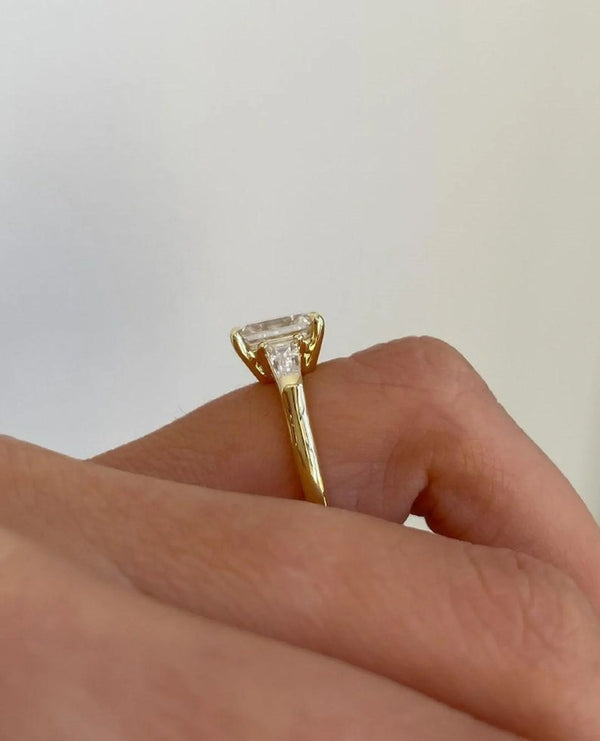
Ones with unedited photographs taken on a real hand in ordinary indoor light. That is the only view that shows how a piece actually reads — and for a moissanite it is the only way to see how the dispersion behaves outside a lightbox.
Ones that mention a specification. Somebody who wrote “the shank is a proper 2 mm” asked the question, got an answer, and checked it on arrival. That single sentence tells you the seller answers specification questions truthfully.
And write one, eventually
A small ask that would make this whole category work better. If you review a piece of jewellery, come back in a year or two and add a line. Say whether it has been re-tipped, replated, resized; whether the finish held; whether anything came loose.
Almost nobody does it, which is exactly why the long-term evidence is so thin — and it is the single review that would have helped you most when you were deciding.
Keep reading
Frequently asked questions
Why are jewellery reviews unreliable?
Because they are written within days of delivery and nothing that goes wrong with jewellery happens in the first week. Rhodium wears at year one or two, prong tips flatten at three to five, shanks thin by ten. A five-star average measures the unboxing, not the ring.
Which reviews should I actually read?
The oldest ones, and any mentioning a resize, repair, replating or a loose stone — search the review text for those words. Then read the one and two-star reviews, discard the delivery-timing complaints, and look at whether and how the seller replied.
How can I spot fake jewellery reviews?
Uniform length and vocabulary, praise for service with nothing describing the object, clusters of dates, customer photographs that look like lightbox product shots, and no negative reviews at all across hundreds. Every real business has some, and the replies are the useful part.
Should I trust a seller with few reviews?
A short history means they have not been tested yet rather than that anything is wrong. Fill the gap with specification questions instead — gram weight, shank thickness in millimetres, and a photograph of a piece cast but not yet set, which no reseller can produce.
Read our oldest reviews, not our newest.
Then ask us the specification questions reviews cannot answer — and ask everyone you are comparing us against.


Leave a comment