Education
Re-Tipping or a New Head: Fixing the Occurrence or the Cause
The cheaper repair is often the right one — and sometimes it is the one that guarantees you will be back in three years.
Written by the Mapple Gems workshop, Surat · Updated 7 October 2026
Short answer
Re-tipping adds metal back to worn prong tips — quick, inexpensive, and the right answer when the prongs are still substantial below the tip. Replacing the head is a bigger job that swaps the entire setting component, and it is the right answer when the prongs have thinned along their length, when several have been re-tipped before, or when the same stone keeps working loose. The test: is the metal below the tip still full thickness? If not, re-tipping is patching a worn part.
This decision comes up on almost every ring that reaches its second decade, and it is usually presented as a price choice when it is really a diagnosis.
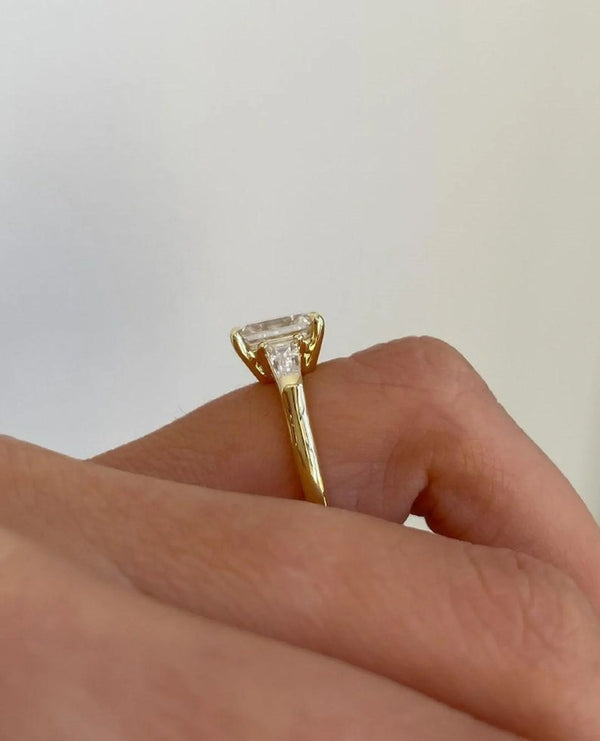
Re-tipping restores the part that holds the stone down; it does nothing about the part that holds the stone UP — and confusing the two is why some rings lose the same stone twice. A prong does two jobs. The tip is the small folded lip pressed over the girdle, retaining the stone from above — and that is what re-tipping rebuilds, with new metal added and reshaped. But the stone actually sits in a seat, a notch cut into the body of the prong, and it is the prong’s shaft that supports it from below and resists being pushed sideways. If the shaft has thinned along its length — which happens on the same schedule as everything else, from years of contact against clothing and surfaces — then a beautifully re-tipped prong is a new lip on a worn post. It will hold for a while and then flex, and the stone will loosen again. The check is simple and any bench can do it in seconds: look at the prong under magnification and compare its thickness at the tip, the middle and the base. A healthy prong tapers gently. One that is noticeably thin through the middle needs the head replaced, not re-tipped.
Which job, when
| Situation | The right repair |
|---|---|
| One or two tips flattened, shafts sound | Re-tip |
| All tips worn together | Re-tip all — they share a schedule |
| Prongs thin through the middle | New head |
| Already re-tipped twice | New head |
| Stone sits tilted | New head — the seats are uneven |
| A stone was lost | New head — fixes the cause |
The bottom row is the one worth insisting on. A stone falling out is never an isolated event — the neighbouring prongs shared the same years of wear, so replacing a single prong or re-tipping the survivors treats the occurrence and leaves the cause in place.
What each job actually involves
Re-tipping. The stone stays in place. New metal is added at the tip of each worn prong, then filed and shaped back to a rounded lip over the girdle. It is quick, and because the seats survive, nothing about how the stone sits changes. Ask for it in matching karat — a different alloy is visible in daylight even when it is not in a photograph — and on white gold expect the ring to need replating afterwards.
Replacing the head. The head is a separate component soldered onto the shank, so it is unsoldered and a new one fitted, with fresh seats cut to your specific stone. That last part matters: seats are cut to a stone’s actual girdle, not to a carat figure, so a new head is fitted rather than bought off a shelf.
The reason a head replacement is worth the extra: it keeps the shank, the engraving and the hallmarks, and it resets the clock on the part that wears fastest. It is also the moment to make an upgrade for nothing extra in labour.
Upgrades worth taking while it is apart
- A platinum head on a gold ring. Platinum displaces rather than loses metal, so platinum prongs wear better than gold ones — and a white head lets a warmer colour grade read neutral.
- Six prongs instead of four on a larger stone, or V-prongs if the shape has points or corners that were never properly covered.
- A lower profile, if the ring has always caught on things. Profile height is fixed at casting for the ring — but the head is the part that can change it.
- An open gallery, so the pavilion can finally be cleaned from underneath.
- A stone upgrade at the same time, since the seats are being cut fresh anyway.
Check the shank in the same conversation
Easy to overlook and it decides whether either repair is worth doing. A thin shank flexes on every grip, and that flex travels up into the head and works seats loose from below — so a ring that keeps loosening stones sometimes has a shank problem presenting as a head problem.
Ask for the thickness at the base in millimetres. Under about 1.5 mm means a reshank is due, and doing a reshank and a new head together is far more sensible than doing one now and the other in two years.
What to say when you hand it over
- “Do not polish.” Done by default at the end of most jobs, it removes metal every time, and on an older ring it softens hallmarks and hand-cut detail permanently.
- What the stone is, and any treatment — both jobs involve heat, and some treated stones are affected by it.
- Ask them to check every setting, not just the one that failed.
- Ask for matching karat on any added metal.
- Ask whether third-party work voids a warranty still in force — it usually does.
And afterwards: press each stone with a fingernail and look at the row straight down in daylight before you leave or before you put the ring back on. Every table should sit level.
Keep reading
Frequently asked questions
What is re-tipping a ring?
Adding new metal to worn prong tips and reshaping them back into a rounded lip over the girdle. The stone stays in place and the seats survive, so it is quick and inexpensive — but it restores only the part that holds the stone down.
When do I need a new head instead?
When the prongs have thinned through the middle rather than just at the tips, when they have been re-tipped twice already, when the stone sits tilted, or after a stone has been lost. Compare prong thickness at tip, middle and base under magnification.
Does replacing the head change the ring?
It keeps the shank, engraving and hallmarks — the head is a separate component soldered on. It is also the moment to change prong count, add V-prongs, lower the profile, open the gallery or fit a platinum head, since the seats are being cut fresh anyway.
Why do my stones keep coming loose after repairs?
Sometimes it is a shank problem presenting as a head problem — a thin shank flexes on every grip and that flex works seats loose from below. Ask for the thickness at the base; under about 1.5 mm means a reshank is due alongside any head work.
Send us a photograph of the prongs from the side.
Tip, middle and base in one image is usually enough to tell you which repair you actually need.


Leave a comment