Education
Gram Weight: The One Number That Answers Everything
Solid or hollow. How much metal comfort-fit took out. Why one ring costs twice what an identical-looking one costs. Three questions, one number.
Written by the Mapple Gems workshop, Surat · Updated 1 October 2026
Short answer
Gram weight is the finished metal weight of a piece. It is the only part of a jewellery price you can independently verify, because gold trades on a public daily market: grams multiplied by fineness multiplied by the current gold price gives you the raw metal value. It also settles solid versus hollow, which nothing visible on the outside will tell you.
Ask a jeweller for gram weight and you learn two things. You learn the number, and you learn whether they know it. Both are useful.
What the number is — and what it is not
Gram weight is the weight of the finished metal. It is not:
- The same as total weight. Some sellers quote a figure that includes the stones. On a stone-heavy piece that is a materially different number, so ask which one you are being given.
- Fixed across sizes. A ring in size 9 carries more metal than the same design in size 5. Any honest figure comes with a size attached.
- A quality grade. Heavier is not automatically better. A well-proportioned 3 g solitaire can outlast a clumsy 5 g one. What grams give you is a fact to compare with, not a verdict.
The three questions grams answer
1. Solid or hollow. Nothing on the outside of a chain, a hoop earring or a bangle tells you whether it is solid metal or formed tubing. Hollow pieces look identical, cost far less, and fail differently: tubing crushes rather than bends, splits at the seam and often cannot be repaired invisibly. Gram weight is the only reliable tell available to a buyer, and it is why the question matters most on exactly the pieces where sellers are least likely to volunteer it.
2. How much metal comfort-fit removed. A comfort-fit band is domed on the inside, which is more comfortable and takes metal out. Two 4 mm bands of the same karat can differ meaningfully in weight for that reason alone. Neither is wrong — but if you are comparing prices, you are comparing different quantities of gold.
3. Why two similar rings cost differently. Most of the time it is not margin. It is that they are not the same ring. Between two visually similar solitaires, gram weight can differ by a factor of two, and that difference lives in shank thickness, gallery substance and how much metal sits under the stone — the parts you cannot see in a top-down product photograph.
Checking the metal component yourself
Gold is a traded commodity with a published daily price, which makes this the one calculation a buyer can do without any specialist knowledge:
grams × fineness × the current gold price per gram = raw metal value
Fineness is 0.585 for 14K, 0.750 for 18K, 0.417 for 10K.
That figure is not what the ring should cost. Casting loss, bench hours, setting, finishing, stones, packaging, shipping and margin all sit on top of it, and on a modest ring they add up to considerably more than the metal. What the calculation does give you is a floor, and a sanity check: if two sellers quote very different prices for pieces with the same stated gram weight and karat, the difference is in labour, stones or margin — not in gold, and they should be able to say which.
There is a wider point here. Lab grown stone prices fell steeply between 2020 and 2024 and settled near production cost, while gold did not fall. On a great many modest rings, the metal and the labour now cost more than the stone. That inverts the old advice to put the money into the centre stone: today the shank is where skimping actually shows.
Typical finished weights from our bench
| Piece | 14K metal weight | Notes |
|---|---|---|
| Plain 2 mm court band, size 6 | about 1.8–2.5 g | Comfort-fit sits at the lower end |
| Plain 4 mm court band, size 6 | about 3.5–4.5 g | Thickness moves this more than width does |
| 6 mm court band, size 10 | about 7–9 g | Circumference × width, so larger sizes genuinely cost more |
| Solitaire, 1.8 mm tapered shank, size 6 | about 2.5–3.5 g | Excludes the centre stone |
| Halo, 1.8 mm shank, size 6 | about 3.5–4.5 g | Halo adds gallery metal as well as stones |
| Tennis bracelet, 7 in, 3 mm stones | about 8–12 g | Setting style moves this considerably |
Metal only, stones excluded, and specific to how we build. Another workshop's figures will differ — which is the point of asking.
An honest concession
Our own product pages do not currently publish finished gram weight or shank thickness, and several articles on this site tell you to ask every seller for both. That is a gap on our side, and we would rather name it than pretend otherwise: it is work in progress across a catalogue of well over a thousand pieces. In the meantime the advice stands unchanged — ask before you order, of us and of anyone else. A seller who cannot answer did not make the piece; a seller who will not answer would rather you could not compare.
How to ask, so you get a usable answer
- Ask for finished metal weight in grams, at your ring size, and confirm whether stones are included.
- Ask for shank thickness at the base in millimetres alongside it — grams and thickness together describe a ring; either alone does not.
- For a chain, hoop or bangle, ask directly: solid or hollow? Then ask for the grams, and see whether the two answers agree.
- For a comfort-fit band, ask for the weight of the same design in a standard interior, so you know what the doming removed.
- Get it in writing. A written specification is what lets any bench, anywhere, match or rebuild the piece decades later.
Keep reading
Questions people ask
What is gram weight in jewelry?
It is the weight of the finished metal in a piece, quoted in grams at a stated size. Some sellers quote a total weight that includes stones, so always confirm which figure you have been given.
How many grams should a gold ring be?
There is no correct figure, because it depends on width, thickness, size and design. As a rough orientation, a plain 2 mm 14K band in a small size is usually around two grams and a 6 mm men's band in a large size is around eight. Use grams to compare two specific pieces, not as a standard to meet.
How can I tell if a chain is solid or hollow?
Not from the outside — the pattern, the stamp and the finish all look the same. Gram weight is the practical answer: a hollow chain weighs a fraction of a solid one of the same length and pattern. Ask for the weight before you buy.
Does a heavier ring mean better quality?
Not by itself. Weight in the wrong place produces a bulky ring. What matters is where the metal sits — a shank of at least 1.8 mm at the base for daily wear, and a finished gallery underneath. Grams plus thickness together tell you something; grams alone do not.
Why do two sellers price the same ring so differently?
Usually because it is not the same ring. Gram weight between two visually similar pieces can differ by a factor of two. Beyond that, the differences are the chain of hands the piece passed through, whether import duty is included in the price, and variation inside a single grade band.
Ask us the number
We make what we sell, so the specification exists before the ring does. Ask for grams and millimetres on anything in the catalogue.
Browse fine jewelry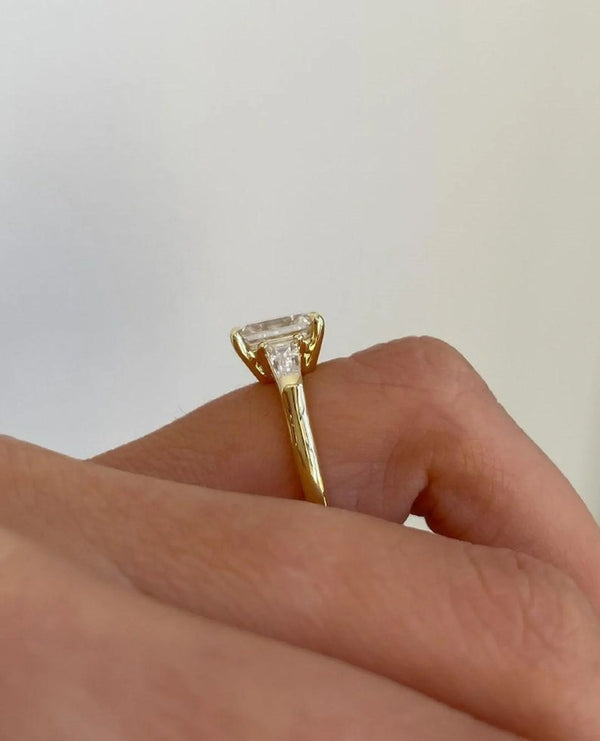


Leave a comment