Education
Who Actually Makes Your Ring
Six different jobs, six different skills — and knowing which one you need is why some questions get good answers and others do not.
Written by the Mapple Gems workshop, Surat · Updated 1 October 2026
Short answer
“Jeweller” covers at least six trades. A CAD designer models the ring; a caster turns that into metal; a goldsmith or bench jeweller builds, sizes and repairs it; a setter cuts the seats and sets the stones; a polisher finishes it; and a gemmologist or valuer assesses stones and writes valuations. Most retail “jewellers” do none of these — they sell. Knowing which trade your question belongs to is the fastest way to get a useful answer.
Customers routinely ask a retail counter a setting question, or ask a bench for a valuation, and get an unsatisfying answer from someone who is not being evasive — just not the right trade.
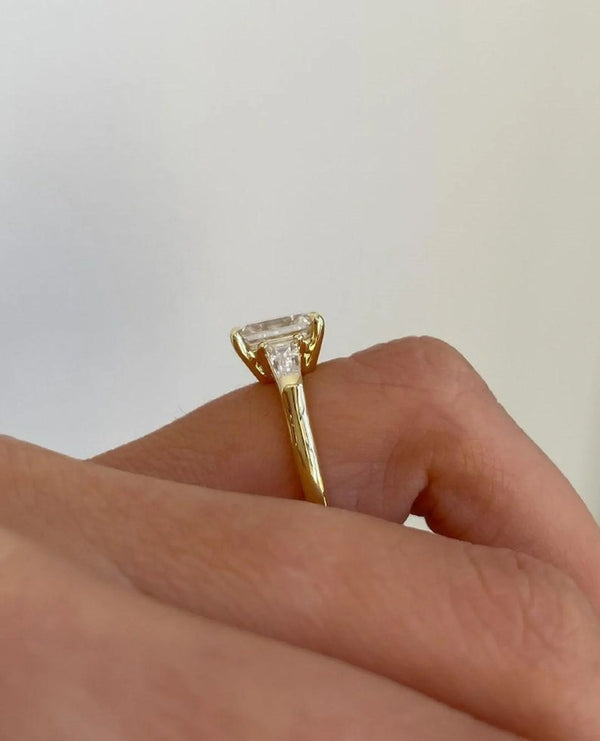
Setting is a separate trade from making, and it is the one that decides whether a ring holds its stones for forty years. People assume the goldsmith who builds the ring also sets the stones. In most workshops they do not. A setter is a specialist who does one thing: cuts a seat — a small notch — into each prong so the girdle sits inside it, supported from below and retained from above, then closes the metal over it. On pavé that is a drilled seat and hand-raised beads for every single stone, under magnification, forty times. Nearly every stone-related failure traces to this stage: uneven seat heights make a permanently tilted stone; a seat cut too shallow means the prong is gripping rather than holding; beads raised inconsistently loosen at different rates. And it is also why re-tipping is quick and cheap when prongs wear — the seats survive, so only the tips need rebuilding. So “who does your setting?” is a better question than “do you make your own jewellery?”, and a workshop will answer it immediately.
The six trades
| Who | Does | Ask them about |
|---|---|---|
| CAD designer | Models the ring digitally | Profile height, shank dimensions, edits |
| Caster | Turns the model into raw metal | Alloy, porosity, cast vs mill stock |
| Goldsmith / bench | Builds, sizes, reshanks, repairs | Resizing, reshanking, structure |
| Setter | Cuts seats, sets stones, re-tips | Prongs, pavé, loose or tilted stones |
| Polisher | Final finishing | Brushed vs polished, refinishing |
| Gemmologist / valuer | Assesses stones, writes valuations | Identification, insurance figures |
Where each question belongs
- “Can the shank be 2 mm and the profile lower?” — CAD, before casting. After casting the answer is no.
- “A stone feels loose.” — Setter. Stop wearing it until it is seen.
- “Can this be resized?” — Goldsmith, who will also tell you honestly when it cannot (full eternity, tungsten).
- “What is this old ring?” — Gemmologist or valuer, before anyone polishes it.
- “What is it worth for insurance?” — Valuer. Note that is replacement cost, not a resale price.
- “Can you make the finish brushed?” — Polisher, and it is one of the few things that can be changed at any time.
Why this tells you who you are buying from
The distinction has a practical use beyond curiosity: it is a quick way to work out whether a seller has a bench at all.
A workshop can answer trade-specific questions immediately — who does the setting, whether bands are cast or formed from mill stock, what the shank thickness is, what alloy is used. A reseller listing a supplier’s catalogue cannot, because the information sits with a bench they have never visited.
The sharpest version of the test remains asking for a photograph of a piece cast but not yet set. Nobody photographs a half-finished ring for a catalogue, so that image only exists where the work happens.
What a title does and does not guarantee
Worth being straightforward. In most countries “jeweller” is not a protected title — anyone selling jewellery can use it, and that is not dishonest, it is just how the word works.
Gemmology and valuation do have recognised qualifications, and for identification or an insurance figure it is reasonable to ask what someone holds. For bench work, qualifications matter less than evidence: ask whether work is done on site or sent out, ask them to explain the method, ask to see comparable repair work rather than a showroom of finished stock.
And start small. A clean and a prong check tells you a great deal before you trust anyone with a reshank.
Our own arrangement, stated plainly
We are a workshop in Surat, which is where a large share of the world’s stones are cut and set — including a great deal of what is sold elsewhere with a different name on the box. Design, casting, setting, finishing and quality checking all happen in one place, which is why we can answer specification questions in a message rather than a week.
It is also why we ask customers to run the same questions past everyone they are considering. The pattern of who can answer is more informative than any of the individual answers.
Keep reading
Frequently asked questions
What is the difference between a goldsmith and a setter?
A goldsmith builds, sizes, reshanks and repairs the metal; a setter is a specialist who cuts the seats into each prong and sets the stones. They are separate trades in most workshops, and nearly every stone-related failure traces to the setting stage rather than the making.
Who should I ask about a loose stone?
A setter, and stop wearing the piece until it is seen. Prongs thin gradually rather than snapping, so a setter can see the problem years before a stone is lost — and re-tipping is quick and cheap because the seats survive; only the tips need rebuilding.
Is “jeweller” a protected title?
In most countries no — anyone selling jewellery can use it. Gemmology and valuation do have recognised qualifications worth asking about for identification or insurance figures. For bench work, evidence matters more: is work done on site, can they explain the method, can they show comparable repairs.
How do I tell if a seller has a workshop?
Ask trade-specific questions — who does the setting, whether bands are cast or formed from mill stock, what the shank thickness and alloy are. A workshop answers immediately; a reseller cannot, because the information sits with a bench they have never visited. Then ask for a photograph of a piece cast but not yet set.
Ask us who does the setting.
It is a better question than “do you make your own jewellery”, and it is the stage that decides whether a ring holds its stones for forty years.


Leave a comment