Wedding Bands
Choosing a Band You Will Still Like in Twenty Years
Not a plea for plain. A look at which design decisions age well and which ones date.
Written by the Mapple Gems workshop, Surat · Updated 6 September 2026
Short answer
What dates is proportion and finish, not decoration. Very wide or very thin bands, high-polish mirror finishes, and whatever stone-setting style is currently everywhere all read as of-their-moment later. What ages well: a width in the 2.5–4 mm range, a rounded outer edge, a brushed or satin finish, and detail placed where it is protected. Buy for how it sits on the hand rather than how it photographs, and it will not date.
This is not an argument for a plain band. Plenty of decorated rings from a century ago still look wonderful, and plenty of plain ones from twenty years ago look oddly of their time. The variable is not how much is going on — it is which decisions were made for the moment.
What actually dates
| Decision | Why it dates | The durable version |
|---|---|---|
| Extreme width — very wide or very thin | Width fashions swing every decade | 2.5–4 mm, which has never looked wrong |
| High-polish mirror finish | Shows every scratch; looks worn rather than aged | Brushed or satin, refreshed occasionally |
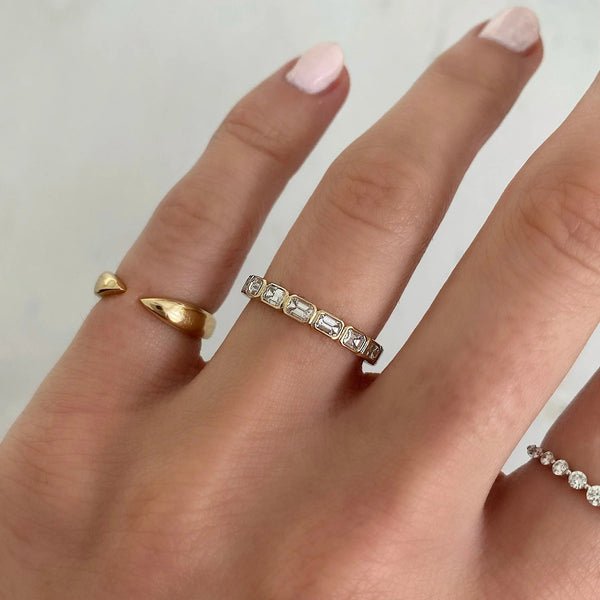
| The setting style of the moment | Whatever is everywhere now reads as “then” later | Bezel, plain, or classic pavé |
| Mixed metals in one band | Strongly tied to a period | One metal; mix across separate rings instead |
| Novelty profiles and textures | Distinctive now, dated soon | Court, D-profile, or a simple flat |
The one that surprises people: finish dates faster than design. A high-polish band looks its best on day one and progressively worse after that, because a mirror surface displays every fine scratch — and gold is softer than household dust, so those scratches are guaranteed. By year three it does not read as a beautifully aged object; it reads as a shiny thing that has been scuffed. A brushed or satin finish is a surface of controlled fine lines to begin with, so new marks blend in and the band looks consistent for decades. It can also be refreshed in minutes. If you want shine, ask for polished edges with a brushed centre — the gleam sits where nothing rubs it.
What ages well
- A rounded outer edge. A court or D-profile slides past gloves, fabric and rope where a squared edge catches. It costs nothing, is invisible in a photograph, and makes more practical difference over twenty years than any other single choice.
- Detail placed where it is protected. Milgrain on an outer edge wears smooth within years. The same detail on an inner edge or a gallery stays crisp almost indefinitely.
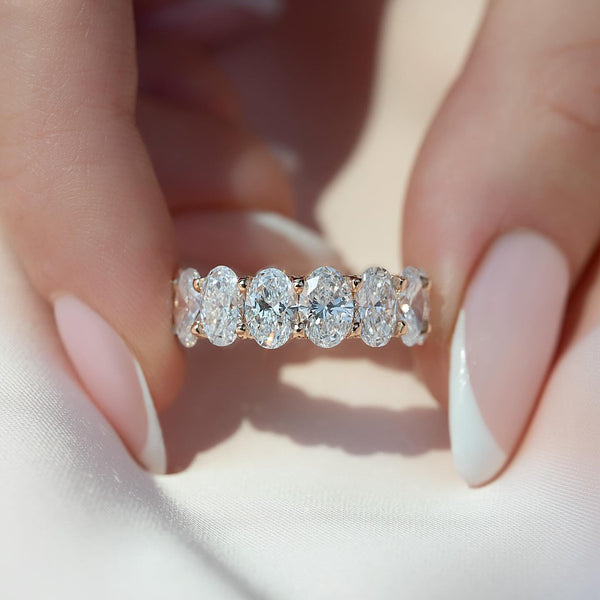
- Half rather than full coverage. If the band carries stones, half coverage looks identical from above — nobody sees the underside of your finger — and it keeps the ring resizable and the most-abraded section stone-free.
- 14K rather than 18K, for a ring worn daily. More alloy means harder metal, so it holds its shape and finish better. 18K buys richer colour and higher metal value; 14K buys durability.
- Something that can be resized. Over decades, size changes are near-certain. A full eternity band cannot be resized at all.
Engraving, which ages differently than expected
Interior engraving — a date, initials, a few words — is the one decorative choice that improves rather than dates, because it is private and it is protected. It also survives: an inside surface takes far less abrasion than an outer edge.
Two practical notes. Deep-cut engraving lasts considerably longer than shallow laser marking, and it is worth asking which you are getting. And engraving is one of the things that removes a change-of-mind return right in most markets, since it makes the piece personalised — worth knowing before, not after.
The honest counter-argument
All of the above optimises for a ring that never looks dated. That is not the only reasonable goal.
A ring that is unmistakably of a moment is also a record of that moment, and plenty of people find the period character of an inherited ring is exactly what they love about it. Deliberately choosing something distinctive, knowing it will read as of its time, is a coherent choice rather than a mistake.
What is worth avoiding is drifting into it — choosing whatever is currently everywhere because it is currently everywhere, and being surprised later.
A practical test
Before approving a design, ask yourself two questions.
Would this have looked odd twenty years ago? If the answer is yes, it will probably look odd twenty years from now. Designs that would have been unremarkable in 2006 and unremarkable today tend to stay that way.
Am I choosing this because I like it, or because I have seen it a great deal recently? Those feel identical in the moment and produce different outcomes. If it is the second, wait a week and look again.
Frequently asked questions
What wedding band width never dates?
Roughly 2.5 to 4 mm. Width fashions swing every decade toward very wide or very thin, and both extremes read as of-their-moment later, while the middle range has never looked wrong. Proportion dates faster than decoration does.
Is a polished or brushed finish better long term?
Brushed or satin, for a ring worn daily. A mirror surface displays every fine scratch, and since gold is softer than household dust those scratches are inevitable — so a polished band looks scuffed rather than aged within a few years. A brushed surface absorbs new marks and can be refreshed in minutes.
Does engraving a wedding band affect returns?
Usually yes — engraving makes a piece personalised, which removes the change-of-mind cancellation right in most markets that have one. Worth knowing before rather than after. Deep-cut engraving also lasts considerably longer than shallow laser marking, so ask which you are getting.
Should I avoid a distinctive design so it does not date?
Not necessarily. A ring that is unmistakably of a moment is also a record of it, and period character is often exactly what people love about an inherited ring. What is worth avoiding is drifting into a choice because it is currently everywhere — choosing distinctiveness deliberately is a coherent decision.
Polished edges, brushed centre.
The version most people are happiest with in year five, and it costs no more than either alone.
Leave a comment