Oval diamonds
Why Two Oval Rings Are Priced Differently
Same carat, same colour, same clarity, same metal — and a price gap that looks inexplicable. There are six reasons, and only one of them is a bargain.
Written by the Mapple Gems workshop, Surat · Updated 22 August 2026
Short answer
Two oval rings quoted at the same 4Cs are rarely the same ring. The gap usually comes from gram weight (which can differ twofold), cut quality that no laboratory grades on an oval, position within a grade band, the maker-versus-reseller chain, whether duties are included, and a round-carat pricing threshold. Ask for grams and millimetres before comparing prices.
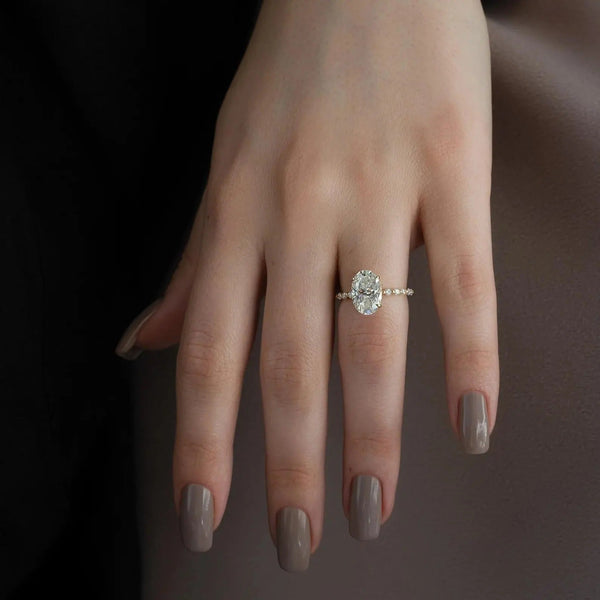
You find two oval lab grown rings. Both 2ct. Both G. Both VS2. Both 14K yellow gold. One is meaningfully more expensive. It is a reasonable moment to assume somebody is overcharging.
Sometimes that is true. More often the two rings are genuinely different objects, and the differences are in specifications neither listing publishes.
The six reasons
| Reason | How to check it | Is the cheaper one a bargain? |
|---|---|---|
| Gram weight of the finished ring | Ask for grams and shank thickness in mm | No — less metal, shorter life |
| Cut quality of the oval | Handheld video; measurements vs standard mm | No — ungraded on any fancy shape |
| Position within a grade band | Plot diagram; polish and symmetry separately | Sometimes — if position is favourable |
| Maker or reseller | Ask for a part-finished photograph | Sometimes — fewer margins in the chain |
| Duties and taxes included or not | Ask whether the price is landed | No — the bill arrives later |
| Carat sitting just under a threshold | Compare exact weights, not rounded ones | Yes — the one genuine saving |
Gram weight is the biggest single variable
Two rings described identically can differ twofold in the amount of gold they contain. Gold trades on a public daily market, so unlike almost everything else in jewellery the metal component is independently verifiable: grams × fineness × the day's price. That makes gram weight the one number that turns a price comparison into arithmetic.
Under an oval it matters more than usual, because an oval head loads the shank unevenly. A ring at 1.5mm and a ring at 2mm look nearly identical in a photograph and are not the same object at year twelve. If a seller will not state grams and shank thickness, that is information, not an oversight.
Cut is the invisible premium
No laboratory grades cut on any fancy shape. Cut grades exist only for round brilliants. So on an oval, the difference between a bright, well-proportioned stone and a flat one appears nowhere on the certificate and everywhere in the ring.
Poor cutting on an oval is usually deliberate: a deeper pavilion retains more weight from the same rough, which produces a heavier stone with a stronger bow-tie. The tell is measurements. If an oval measures noticeably larger than standard for its weight, it was cut shallow to look big; if it measures smaller, weight was hidden below the girdle. Either way somebody optimised for the certificate rather than for the stone.
From our bench in Surat
There is a version of this conversation that costs the customer money and it happens constantly: someone comes to us with a budget they will not name, hoping to be quoted keenly. What actually happens when a budget is withheld is that the workshop protects the margin somewhere invisible, and the invisible place is almost always the shank.
So the concession is against our own short-term interest: name the figure. A stated budget lets us tell you where to save on purpose — a grade the metal will hide, a weight just under a threshold, three-quarter pavé instead of full — rather than quietly taking half a millimetre off the band. And we should say plainly that our own product pages do not yet publish gram weight or shank thickness, which is exactly the check this article asks you to run on everyone.
The one saving that is genuinely free
Prices step up at round carat figures — 0.50, 0.70, 1.00, 1.50, 2.00. Those are trading thresholds. Physical size, meanwhile, rises smoothly and continuously.
So a 1.90ct oval and a 2.00ct oval at the same ratio differ by roughly two tenths of a millimetre in length. Nobody detects that on a hand. But one sits below a threshold and one sits above it. The same works at 0.90 rather than 1.00 and at 1.40 rather than 1.50.
Ask for both quotes. It is the only place in this article where the cheaper stone is simply the better buy.
Two figures that are not evidence of value
An insurance valuation above what you paid. A valuation states retail replacement cost, which is deliberately conservative and reflects what it would cost to replace the piece at retail. A figure higher than your purchase price is normal and is not proof of a bargain.
A permanent struck-through price. If a comparison price is always there, it is a pricing device rather than a discount.
Worth remembering too that lab grown prices have fallen substantially since 2021 and have now settled near production cost. Some retailers repriced and some did not, so the same specification can cost 40–60% more at a legacy seller with older inventory. That is a real gap and it has nothing to do with the stone.
The six-row comparison
Put both rings in one table and fill it in. The blank cells are the answer.
- Metal and karat — as a fineness number, 585 or 750.
- Finished gram weight.
- Centre stone in millimetres, plus length-to-width ratio.
- Accent stone count and size.
- Shank width and thickness at the base.
- Production time and transit time, quoted separately.
Frequently asked questions
Why are two oval rings with the same 4Cs priced so differently?
Usually because they are not the same ring. Gram weight can differ twofold, cut is ungraded on an oval, position within a grade band varies, and the price may or may not include duties. Ask for grams, shank thickness and millimetres before comparing.
How can I verify the metal component of a price?
Gold trades on a public daily market, so grams multiplied by fineness multiplied by the day's price gives you a verifiable floor for the metal. It is the one component of a jewellery price you can check independently, which is why gram weight is the number to insist on.
Does a higher insurance valuation mean I got a good deal?
No. A valuation states retail replacement cost, which is intentionally set at what replacing the piece would cost at retail. A figure above your purchase price is routine and is not evidence of value.
Should I tell a jeweller my budget?
Yes. Withholding it does not produce a keener quote — it produces savings made where you cannot see them, usually a thinner shank. A stated figure lets a maker save deliberately on things that do not show, such as a colour grade the metal hides.
How do I tell whether a seller made the ring?
Ask for a photograph of a piece part-finished — cast but not yet set. No reseller can produce one at any price, because nobody photographs a half-finished ring for a catalogue. It is the single most useful verification question in jewellery.
Ask us for grams and millimetres
We make in our own workshop in Surat, so we can answer both — and send a part-finished photograph if you want one.
Leave a comment