Fine Jewelry
Wearing Fine Jewellery at Work
Some jobs are hard on rings, some forbid them outright, and a few make them genuinely unsafe.
Written by the Mapple Gems workshop, Surat · Updated 26 September 2026
Short answer
Match the piece to the working day rather than hoping it copes. For hands-on work: low profile, bezel or flush settings, 1.8–2 mm shank, brushed finish. For roles with frequent hand-washing or gloves, expect faster plating wear and more film on the stone. And where a job involves machinery, electricity or heavy lifting, the ring should come off — which is an argument for a plain, replaceable work ring alongside a good one, not for buying something cheap.
Most jewellery advice assumes a hand that types and occasionally does the washing up. A great many people’s hands do considerably more, and the right answer is a design question rather than a compromise.
There is one situation where the advice is not about wear at all: any work where a ring can be caught and pulled. Machinery with rotating parts, ladders and scaffolding, heavy lifting where a ring can snag on an edge, and live electrical work all carry a specific hazard that has nothing to do with damaging the jewellery — a ring caught on something while the hand moves away transfers the entire force to one finger. Many workplaces prohibit rings for exactly this reason, and where a policy exists it should be followed rather than worked around. The right response is not a cheaper ring; it is no ring on that hand during that task. A plain band kept in a locker, or a silicone band that breaks away under load, covers the wish to wear something without the risk. We say this even though it is an argument for buying one fewer piece of jewellery, because it is the one part of this subject where the stakes are not financial.
By kind of working day
| If your day involves | What to specify |
|---|---|
| Desk work, keyboards | Anything — watch profile height on a mouse hand |
| Constant hand-washing | Yellow/rose or platinum; avoid plated |
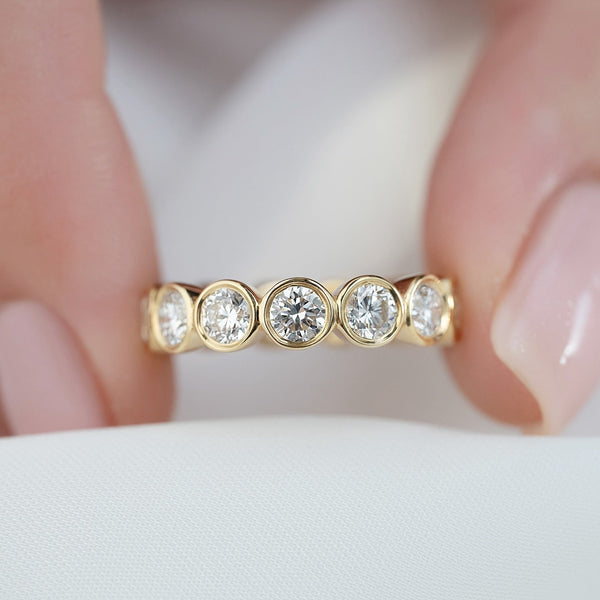
| Gloves on and off all day | Low profile, no prongs to snag |
| Lifting, carrying, gripping | 2 mm shank, flush or bezel, brushed |
| Client-facing, formal | Whatever you like — keep it clean |
| Machinery, electrical, heights | Ring off; follow the site policy |
Frequent hand-washing changes the metal choice
Healthcare, hospitality, childcare, food handling — anywhere hands are washed dozens of times a day — puts a specific load on jewellery that is easy to miss.
Plating wears through faster. White gold is a yellowish alloy plated with rhodium, and repeated washing accelerates that. Expect replating more often than the usual one to two years, or choose yellow, rose or platinum, which need none.
Soap and lotion film the stone. The residue collects on the pavilion — the underside where light enters and leaves — which is why rings on frequently-washed hands look dull long before they look worn. Clean weekly with warm soapy water and a soft brush from underneath, and ask for an open gallery so that is actually possible.
And nothing in soap, sanitiser or chlorine harms a diamond or moissanite — both are chemically inert. It is only ever the metal and the film.
Gloves
A surprisingly specific problem. Prongs catch on the inside of a glove going on and coming off, dozens of times a day, and that is a genuine cause of loosened settings — more than the work itself in many roles.
Two fixes. Bezel or flush settings, which have nothing to catch. Or wearing the ring on a chain during shifts, which many people do and which needs the same soldered jump ring and lobster clasp that any pendant needs.
The work-ring arrangement
Common, sensible and worth normalising: a plain, inexpensive band for work and a proper ring for everything else. It is not a compromise or a sign of not caring — it is how people keep a good ring in good condition for fifty years.
Two notes on the work ring itself. Silicone is the right choice where snagging is a hazard, because it breaks away under load. And if you would rather it were metal, remember that tungsten cannot be resized and cannot be repaired — though it is, counter-intuitively, the easiest ring to remove in an emergency, since it is cracked off with pliers rather than cut.
Practical habits
- A dish, never a pocket. Coat and trouser pockets are how rings go through the wash. Build the habit of one specific place.
- Never a locker without a lock, or a windowsill in a shared space.
- Check your insurance covers it away from home — away-from-home cover is a separate clause and frequently limited.
- Cold hands shrink, so a ring that fits indoors can slide off outdoors in winter. Err on the snug side if you work outside.
- Bench check every two years — more relevant for a working hand, not less.
Keep reading
Frequently asked questions
Can I wear my engagement ring at work?
In most jobs yes, with the design matched to the day — low profile, bezel or flush settings, a 1.8–2 mm shank and a brushed finish for hands-on work. Where the job involves machinery, electrical work or heights, the ring should come off and any site policy should be followed.
Does constant hand-washing damage a ring?
Not the stone — diamond and moissanite are both chemically inert. It wears rhodium plating faster, so white gold needs replating more often, and soap residue films the pavilion, which is why rings on frequently-washed hands look dull. Clean weekly from underneath and ask for an open gallery.
Why do settings loosen if I wear gloves?
Prongs catch on the inside of a glove going on and coming off, dozens of times a day, which loosens settings more than the work itself in many roles. Bezel or flush settings have nothing to catch; alternatively wear the ring on a chain during shifts.
Is a separate work ring a good idea?
Yes, and it is how people keep a good ring in good condition for decades. Silicone is right where snagging is a hazard, because it breaks away under load. If you prefer metal, note that tungsten cannot be resized or repaired, though it is the easiest ring to remove in an emergency.
Tell us what your hands do all day.
It changes the setting, the shank and the finish — and it is a better brief than any style reference.
Leave a comment