Fine Jewelry
Building a Small Jewellery Collection That Actually Works
Six pieces, bought in order, covering almost everything — instead of twenty that half work.
Written by the Mapple Gems workshop, Surat · Updated 8 September 2026
Short answer
Buy in this order: everyday studs, a fine everyday chain, a plain stacking band, everyday hoops, one occasion piece, and a second stacking band in the same metal. Hold the metal and karat constant across all six — that single decision is what makes separate pieces read as a collection. Buy solid rather than plated, and buy fewer, better-built things rather than more.
Most jewellery boxes contain a lot of pieces and a small rotation of things actually worn. That gap is usually not a taste problem — it is that the pieces were bought individually, for individual reasons, and do not work together.
The one rule that does most of the work
Pick a metal and a karat, and stay with it. Not just “gold” — 14K or 18K, decided once. This is what lets any two pieces be worn together without thought, and it is why a small collection in one metal feels considered while a larger mixed one feels accumulated.
The reason is specific: 18K contains a quarter more pure gold than 14K, so two yellow pieces at different karats read as visibly different shades sitting next to each other. Rose gold is worse, since alloy recipes vary between workshops.
Our practical suggestion is 14K for a collection meant to be worn daily. More alloy means harder metal, so it resists marking better, and the saving over 18K funds better construction across more pieces.
The six, in buying order
| # | Piece | Specification that matters |
|---|---|---|
| 1 | Everyday studs | 3–5 mm, bezel or four-prong, good backs |
| 2 | Fine chain | Solid not hollow; 16–18 inch; strong clasp |
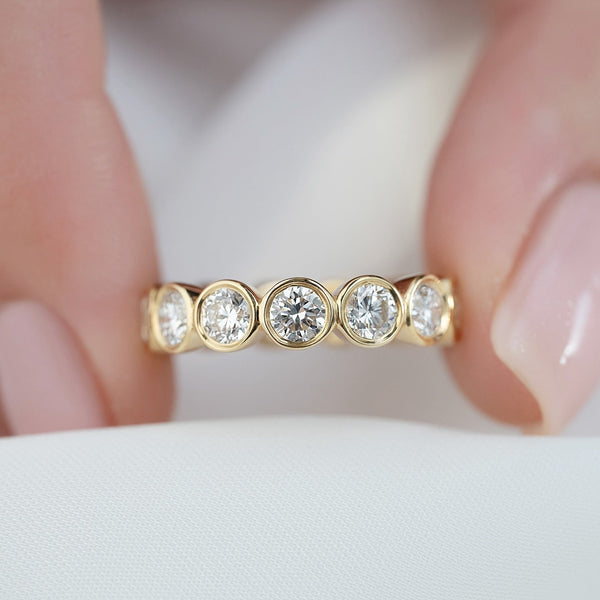
| 3 | Plain stacking band | 1.8–2.5 mm wide, ≥1.8 mm thick, comfort fit |
| 4 | Everyday hoops | 12–20 mm, light, hinged closure |
| 5 | One occasion piece | Tennis bracelet or drop earrings — built for 100 wearings |
| 6 | Second band | Different texture, same metal — stacks with #3 |
Six pieces, worn in combination, cover work, weekends, and most occasions. Adding a seventh unrelated piece adds less than upgrading any of these.
The mistake that costs most: wearing an occasion piece every day. An occasion piece is built for perhaps a hundred wearings — finer settings, more stones, lighter construction, because it is not taking daily contact. Worn every day it gets a thousand wearings in three years, and that is the single most common cause of the repairs we see at around year four: loose stones, worn settings, a stretched clasp. It is not that the piece was badly made; it is being used ten times harder than it was designed for. The everyday pieces on this list exist precisely so the occasion piece stays an occasion piece. That is the real function of a small collection.
Specifications worth insisting on
- Solid, never plated. Plating wears through where contact is constant, and everyday pieces are exactly where contact is constant.
- Chains: solid rather than hollow. Solid bends and can be repaired; hollow crushes and cannot. Ask directly — it is rarely stated.
- Bands: 1.8 mm thickness minimum. Below that a stacking band deforms, and a deformed band no longer sits flush against its neighbour.
- Earring backs. Upgrade them. Butterfly backs are why single earrings go missing, and better backs cost very little.
- Gram weight, stated. The most checkable quality signal there is, and almost nobody publishes it.
Where moissanite fits best
Across a collection like this, the small-stone pieces are where it makes most sense — studs, hoop accents, a tennis bracelet, pavé on a band. At 1.5–5 mm there is too little depth for the extra dispersion to build, so there is no visible compromise, and the saving multiplies across several pieces rather than one.
It also makes matching straightforward. Building a graduated set across studs, hoops and a bracelet means matching colour across many small stones, which is a sorting exercise with mined material and simple with grown material.
Storing and maintaining six pieces
- Separate compartments or pouches. Most scratching happens in storage, where set stones at Mohs 9 sit against gold under 3.
- Never wear a stone-set band directly against a plain one. Put a plain band between two set ones, or accept the abrasion.
- Clean fortnightly, from underneath — that is where the film that dulls stones collects.
- Bench check every two years for anything stone-set. It is the only step that prevents an actual loss.
What we would not buy
Being direct, since this is a list about spending well.
A large number of inexpensive plated pieces. They wear through, they cannot be repaired, and the accumulated spend usually exceeds one good solid piece. Hollow chains, for the same reason. And a second occasion piece before the everyday ones exist — that is the sequence that produces a full box and a three-item rotation.
Keep reading
Frequently asked questions
What jewellery should I buy first?
Everyday studs, then a fine solid chain, then a plain stacking band, then everyday hoops, then one occasion piece, then a second band in the same metal. Six pieces worn in combination cover work, weekends and most occasions — and holding the metal and karat constant across all of them is what makes them read as a collection.
Should I buy 14K or 18K for everyday jewellery?
14K, for pieces worn daily. More alloy means harder metal, so it resists marking better, and the saving over 18K funds better construction across more pieces. Whichever you choose, stay with it — 18K contains a quarter more gold, so two yellow pieces at different karats read as visibly different shades.
Can I wear an occasion piece every day?
You can, but it is the most common cause of repairs at around year four. An occasion piece is built for perhaps a hundred wearings — finer settings, more stones, lighter construction — and daily wear gives it a thousand in three years. The everyday pieces exist precisely so the occasion piece stays occasional.
Is it better to buy several cheap pieces or one good one?
One good solid piece. Plated jewellery wears through where contact is constant and cannot be meaningfully repaired, so the accumulated spend on several usually exceeds one solid piece that lasts. The same logic applies to hollow chains, which crush rather than bend and cannot be restored.
Pick the karat first, then buy in order.
Solid 925 silver or solid 10K, 14K and 18K gold — nothing plated, and we will tell you the gram weight.
Leave a comment