Engagement Rings
What “Custom” Actually Means
Three quite different things are sold under one word, at three different prices.
Written by the Mapple Gems workshop, Surat · Updated 12 September 2026
Short answer
Three tiers hide behind the word. Configured — an existing design with your choice of stone, metal and size, which is what most “custom” listings mean. Modified — an existing design altered at the CAD stage: a thicker shank, a lower profile, a different prong count. Bespoke — designed from nothing. Most people want modified, do not know it is available, and pay for configured or bespoke instead. Ask which tier you are in, and ask what modifications are possible.
“Custom” is used so loosely that it has stopped carrying information — a bit like “handcrafted”. The distinction matters because the middle tier is where nearly all the value sits, and it is the one least often offered.
The three tiers
| Tier | What you choose | Cost and time |
|---|---|---|
| Configured | Stone, metal, size — from set options | Lowest; standard production |
| Modified | The above, plus dimensional changes at CAD | A little more; a few extra days |
| Bespoke | Everything, from a blank page | Substantially more; weeks longer |
The middle tier is where the value is, and almost nobody asks for it. A great many people look at a design and think “this, but the band is too thin” — then either accept it or start an expensive bespoke conversation. Neither is necessary. An existing CAD file can usually be adjusted in an afternoon: shank taken from 1.5 to 1.9 mm, profile lowered by 2 mm, four prongs changed to six, a V-prong added over a point, a halo removed, a hidden halo added, the head widened for a slightly different stone. Those are file edits, not new designs, and they cost a fraction of bespoke while fixing the things that actually determine whether a ring lasts. If a seller cannot do any of them, they are almost certainly not the maker — which is useful to know either way.
Modifications worth asking for
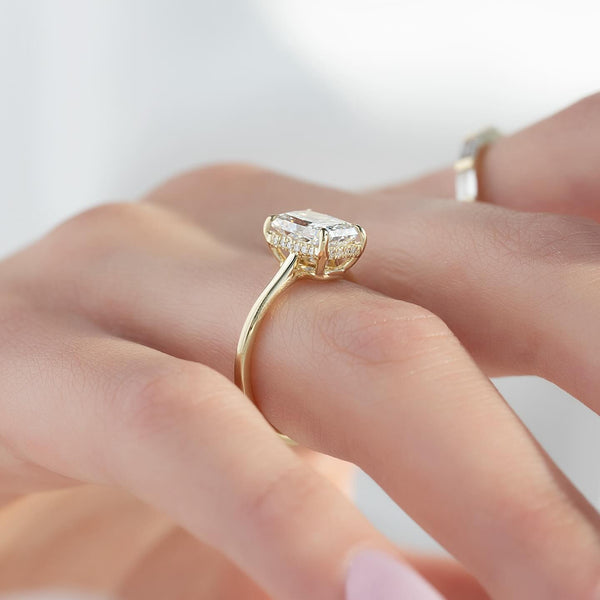
- Shank thickness raised to 1.8 mm or more. The single most valuable change, costs a small amount of gold, and decides whether the ring survives decades.
- Profile height lowered. Fixed at casting, so it must be asked for now. Usually possible by a millimetre or two without changing how the ring looks from above.
- Six prongs instead of four on anything above about 8 mm, with thicker prong stock.
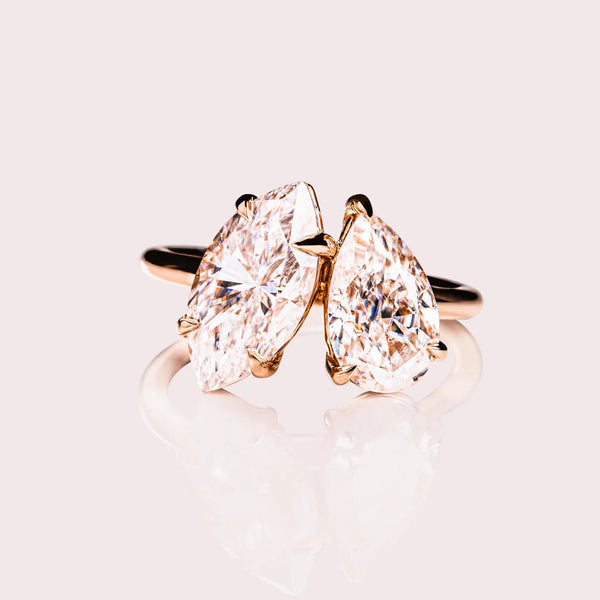
- A V-prong over every point on pear, marquise and heart shapes, and a prong over each corner of an emerald or Asscher.
- Full pavé reduced to half. Identical from above, cheaper, keeps the ring resizable, and halves the settings to maintain.
- A euro shank — flattened underside — if your rings spin.
- A platinum head on a gold band, for better prong wear and a neutral setting around the stone.
Every one of these is a durability or fit improvement rather than a decorative one, which is exactly why they are worth the small premium.
When bespoke is genuinely the right answer
It is a real service and sometimes the only route. Four situations justify it: resetting stones from an existing piece into something new; reproducing a family ring that no longer exists or cannot be worn; an unusual stone shape or size that no stock head fits; or a design you have genuinely not seen anywhere, which is rarer than people think.
Outside those, modification usually gets you the same outcome for meaningfully less. It is worth being asked which situation you are in rather than assuming.
Questions that reveal the tier
- “Can you make the shank 1.9 mm instead?” A maker says yes and quotes the difference. A reseller cannot.
- “Can I see the side elevation before casting?” Only someone with the CAD file can send one.
- “What is the finished gram weight?” Off a job card for a maker; unavailable otherwise.
- “Can you photograph one part-finished?” Cast but not yet set — nobody reselling can produce that at any price.
What modification cannot fix
Being straight about the limits. A modification adjusts an existing design; it does not rescue a fundamentally wrong one. If the proportions of a ring are not what you want — the head too large for the band, the whole silhouette off — changing dimensions will not resolve that, and starting from a design closer to your intent is better.
And nothing can be modified after casting. The window is at CAD approval, which is why that stage deserves a day rather than an hour.
Keep reading
Frequently asked questions
What is the difference between custom and bespoke jewellery?
Three tiers hide behind “custom”. Configured means an existing design with your choice of stone, metal and size. Modified means an existing design altered at the CAD stage — a thicker shank, a lower profile, different prongs. Bespoke means designed from nothing, and costs substantially more.
Can an existing ring design be changed before it is made?
Usually yes, and cheaply. A CAD file can normally be adjusted in an afternoon — shank thickness raised, profile lowered, four prongs changed to six, a V-prong added over a point, full pavé reduced to half. These are file edits rather than new designs, and they fix the things that determine whether a ring lasts.
When is fully bespoke worth it?
When resetting stones from an existing piece, reproducing a family ring that no longer exists, accommodating an unusual stone shape or size that no stock head fits, or building something genuinely unlike anything available. Outside those, modification usually reaches the same outcome for meaningfully less.
How can I tell if a seller actually makes the ring?
Ask whether the shank can be made 1.9 mm instead, for the side elevation before casting, for the finished gram weight, and for a photograph of a piece part-finished — cast but not yet set. A maker answers all four quickly; nobody reselling can produce the last one at any price.
Ask “this, but thicker” before you ask for bespoke.
Most of what people want from a custom ring is a modification, and it costs a fraction of starting over.
Leave a comment