Engagement Rings
Choosing a Ring Together When You Want Different Things
Most disagreements are about two separate questions being answered at once. Separate them and they usually dissolve.
Written by the Mapple Gems workshop, Surat · Updated 17 September 2026
Short answer
Split the decision into what it looks like and what it is made of. Aesthetic preferences belong to the person wearing it; construction decisions — shank thickness, profile height, prong cover, resizability — are practical questions with better and worse answers, and they are where a partner’s input actually helps. Most “we disagree about the ring” is really budget anxiety expressed as taste, and naming the number resolves it faster than discussing shapes.
Choosing together is increasingly the norm, and it works well — but it does introduce a decision with two people in it. Here is a way to structure it that avoids the arguments that are not really about rings.
Separate the two questions
| Aesthetic — personal preference | Structural — better and worse answers |
|---|---|
| Stone shape | Shank thickness (1.8 mm minimum) |
| Metal colour | Profile height — fixed at casting |
| Halo, solitaire or side stones | A prong over every point and corner |
| Plain or decorated | Whether the design can be resized |
| Vintage or contemporary | Whether a straight band will sit flush |
The left column is not up for debate — it belongs to whoever wears it every day for the next forty years. The right column is worth two people looking at, because those decisions are permanent and easy to overlook.
Most disagreements about rings are disagreements about money wearing a costume. One person keeps steering toward smaller stones and simpler settings; the other reads that as a difference in taste and starts defending a style. In our experience it is almost always a budget conversation that has not happened yet — one of you has a number in mind and has not said it, and every design suggestion is quietly a proxy for it. Settle the figure first, out loud, as a single number. It is a design constraint rather than an awkward topic, and once it exists the aesthetic conversation becomes genuinely about aesthetics. A great many couples find the disagreement disappears entirely at that point, because it was never about ovals.
A sequence that works
- Agree the budget as one figure, and say whether it includes shipping and duty.
- Answer the lifestyle question: will it come off for work? About half the time this single answer removes most durability constraints and the conversation gets much simpler.
- The wearer picks the look — shape, metal, style. Without negotiation.
- Both check the construction against the right-hand column above. This is where a second pair of eyes earns its place.
- Decide the wedding band at the same time, since it is cheaper and fits better designed together.
Common disagreements, and what usually resolves them
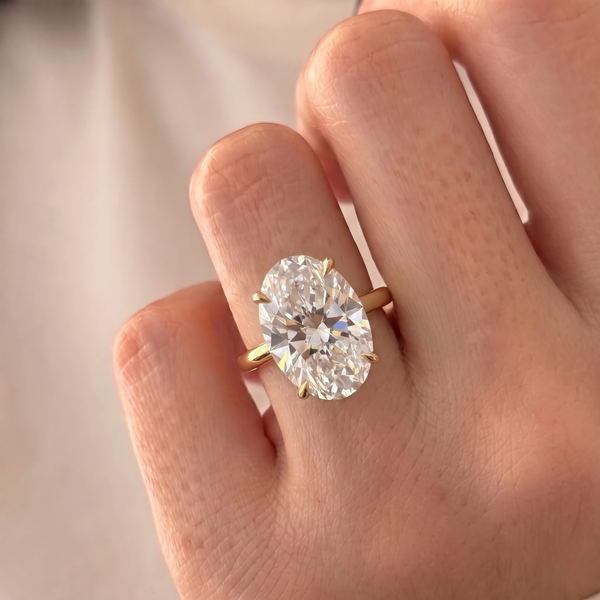
“I want bigger / I want subtler.” These are reconcilable more often than they look, because apparent size is a ratio rather than a carat figure. A tapered shank, an elongated shape or a halo all buy visible size — and with moissanite, a step cut moderates the fire while keeping the dimensions. You can frequently have the size one person wants at the discretion the other wants.
“I think it’s too much money.” Worth taking seriously rather than talking around. The efficient answer is usually to keep the construction and reduce the stone: clarity to SI1 below a carat, colour to G–H in warm metal, and just under a round weight. Those are invisible savings, unlike a thinner shank.
“I don’t want to choose — surprise me.” Fine, and it still needs the finger measured properly and the lifestyle question answered. A surprise about the design is different from a surprise about the size.
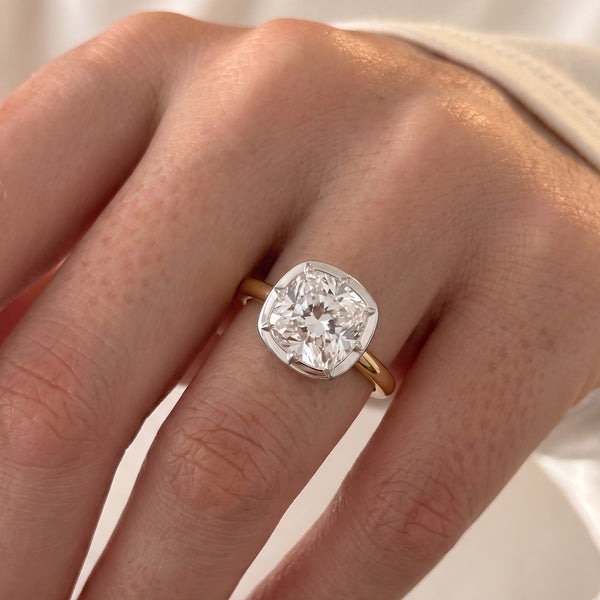
“We like different metals.” A two-tone build genuinely solves this — a white head with a warm band — and it has an optical benefit too, since white metal at the stone lets the colour grade drop.
Whose opinion should carry more weight
Being direct about it: the person wearing the ring should decide what it looks like. They will see it several thousand times a year for decades, and no amount of shared decision-making outweighs that.
Where the other person’s input matters most is on the practical column — asking whether the shank is thick enough, whether the profile is too high, whether the design can be resized. Those are the questions that get missed when someone is focused on how a render looks.
If you genuinely cannot agree
Two options that work rather than compromise into something neither of you wanted.
Buy the structure now and revisit the stone later. A stone is a drop-in component that can be swapped in a few years; a shank and a profile height cannot. Building a well-made ring with a modest centre keeps every option open.
Or propose with a plain band and design it afterwards, with no time pressure and both of you looking at the same renders. If the band is bought in the karat you expect the final ring to be, it becomes the wedding ring rather than a spare.
Keep reading
Frequently asked questions
How do we choose an engagement ring together if we disagree?
Split it into what it looks like and what it is made of. Aesthetic choices belong to the person wearing it; construction decisions such as shank thickness, profile height, prong cover and resizability are practical questions where a second opinion genuinely helps. Settle the budget as one figure first — most ring disagreements are budget anxiety expressed as taste.
One of us wants a bigger stone and the other wants subtler — what now?
These are more reconcilable than they look, because apparent size is a ratio rather than a carat figure. A tapered shank, an elongated shape or a halo all buy visible size, and with moissanite a step cut moderates the fire while keeping the dimensions — so you can often have the size one wants at the discretion the other wants.
Where should we cut costs if the budget is tight?
Keep the construction and reduce the stone — clarity to SI1 below a carat, colour to G–H in warm metal, and a weight just under a round number. Those are invisible savings. A thinner shank is not: it is the one economy that shortens the ring’s life.
Whose preference should decide the design?
The person wearing it, on how it looks — they will see it several thousand times a year for decades. The other person’s input matters most on the practical column: shank thickness, profile height, prong placement and resizability, which are the questions most easily missed while looking at a render.
Tell us the number and both of your constraints.
Size, discretion, budget — those three can usually all be satisfied at once, by different routes.
Leave a comment