Education
A Plain-English Jewellery Glossary
Every term you will meet on a product page or a grading report, defined without the marketing.
Written by the Mapple Gems workshop, Surat · Updated 5 September 2026
Short answer
Jewellery vocabulary splits into three kinds: measurable terms (karat, girdle, DEW, gram weight) that mean something exact; construction terms (shank, gallery, bezel, milgrain) that describe parts of an object; and marketing terms (heirloom quality, artisan, conflict-free) that are undefined. This glossary covers the first two, and tells you plainly which words belong in the third.
Parts of a ring
| Shank | The band itself. Its width and thickness in millimetres decide whether the ring holds its shape. |
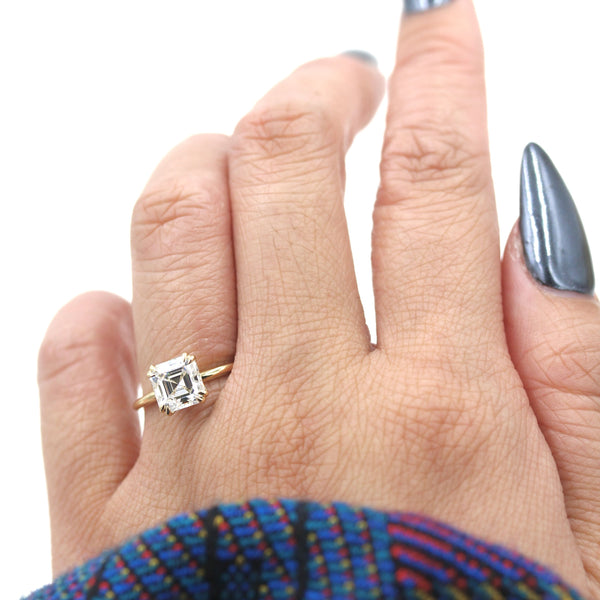
| Head | The part holding the centre stone, including prongs and basket. |
| Gallery | The structure beneath the stone linking head to shank. Open galleries let light in and clean easily. |
| Shoulders | Where the shank meets the head. Often where a wedding band gap appears. |
| Profile height | Finger to top of stone, in millimetres. Fixed at casting; decides snagging and rolling. |
| Comfort fit | A domed interior so only the centre touches. Often needs a half size smaller than a flat interior. |
Settings
| Prong / claw | Metal fingers gripping the stone. Shape matters more than count; they thin rather than break. |
| V-prong | Wraps a point from both sides. Required on pear, marquise, heart and emerald corners. |
| Bezel | A metal collar around the girdle. The most secure setting; slightly reduces edge light. |
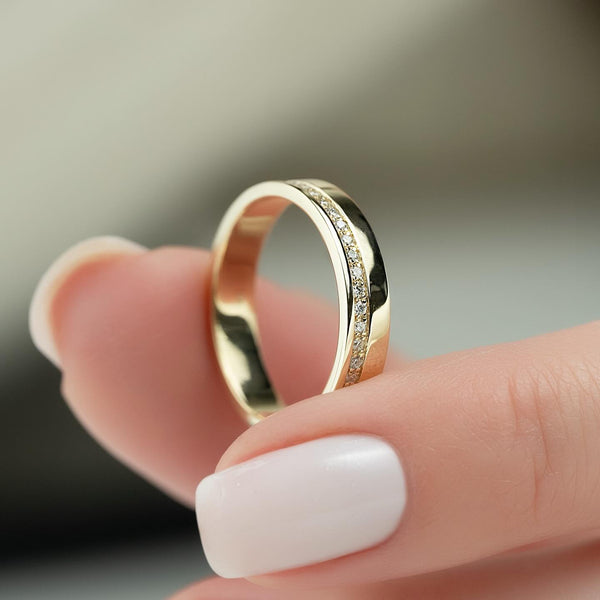
| Pavé | Small stones held by tiny shared beads. Most sparkle per pound; most maintenance. |
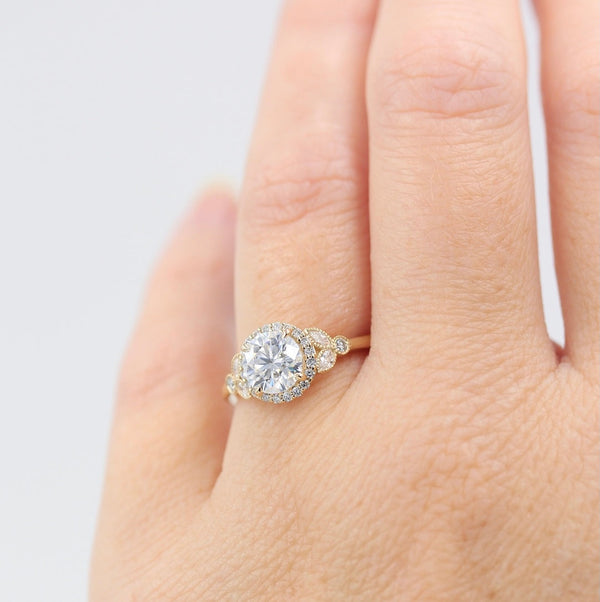
| Halo | A ring of small stones around the centre. Buys apparent size; adds upkeep. |
| Channel | Stones held between two continuous metal walls. Secure; hard to resize. |
| East-west | An elongated stone set sideways. Only applies to shapes with a long axis. |
Stones and grading
| Girdle | The stone’s outer edge. Too thin risks chipping; too thick hides weight you paid for. |
| Table | The flat top facet. An oversized table spreads a stone wide but flattens its life. |
| Pavilion | The lower half below the girdle. Its angles decide whether light returns to your eye. |
| Dispersion | Splitting of white light into colours. Moissanite 0.104 vs diamond 0.044. |
| Bow-tie | A dark band across oval, pear and marquise cuts. Only visible in video. |
| Melee | Small accent stones, under roughly 0.2 ct. Never individually certified, in any material. |
| Fluorescence | A glow under UV light. Invisible in ordinary lighting; often carries a price discount. |
| CVD / HPHT | The two lab growth methods. Not a quality ranking once a stone is cut and graded. |
DEW is the term worth learning properly. Moissanite is about 15% less dense than diamond, so a stone the same physical size weighs noticeably less. Rather than quoting a true carat weight that would understate the size, the trade quotes diamond equivalent weight — the weight a diamond of those dimensions would have. So a “1 ct moissanite” is 6.5 mm across, the size of a 1 ct diamond, and actually weighs nearer 0.88 ct. Nothing is hidden by this; it is a size statement written in weight language. The practical consequence is simple: when comparing moissanite, compare millimetres, never carats.
Metals
| Karat (K) | Gold purity. 10K = 41.7%, 14K = 58.3%, 18K = 75%. More alloy means harder metal. |
| 585 / 750 / 925 | The same thing in parts per thousand: 14K, 18K, sterling silver. |
| Rhodium plating | The bright white finish on white gold. Wears; needs redoing every 1–2 years. |
| Solid vs plated | Solid is the same alloy throughout. Plated is a surface layer over base metal. |
| Hollow | Tube rather than solid wire. Crushes rather than bends; cannot be reshaped. |
| Hallmark | An official state assay mark. A maker’s 585 stamp is a fineness mark, not a hallmark. |
Terms that sound technical and are not
Each of these is undefined, unregulated, and conveys tone rather than information. The useful move is to replace each with a measurable question.
- “Heirloom quality” → ask for the shank thickness and gram weight.
- “Handcrafted” / “artisan” → ask for a photograph of a piece part-finished.
- “Certified” → ask which laboratory, and for the report number.
- “Conflict-free” on a grown stone → there is no mine; the term does not apply.
- “Diamond quality” → ask what the stone actually is, by name.
The numbers worth knowing by heart
If you remember five things from this page, make it these. 1 ct round = 6.5 mm. Shank ≥ 1.8 mm for daily wear. Moissanite Mohs 9.25, gold Mohs 2.8, household dust Mohs 7. 585 = 14K, 750 = 18K. And prong check every two years — the only maintenance step that prevents a real loss.
Keep reading
Frequently asked questions
What does DEW mean in moissanite?
Diamond equivalent weight. Moissanite is about 15% less dense than diamond, so a stone of the same physical size weighs less — and rather than quote a true carat figure that would understate the size, the trade quotes the weight a diamond of those dimensions would have. A “1 ct moissanite” is 6.5 mm across and actually weighs nearer 0.88 ct.
What is the shank of a ring?
The band itself — the part encircling the finger. Its width and thickness in millimetres determine whether the ring holds its shape over years of wear, and 1.8 mm thickness is the practical floor for a ring worn daily.
What is melee in jewellery?
Small accent stones, generally under about 0.2 ct — the stones in a pavé band, halo or tennis bracelet. Melee is never individually certified in any material, because grading fees would far exceed each stone’s value. It is sold by the parcel to a stated colour and clarity range.
Is a 585 stamp the same as a hallmark?
No. 585 is a fineness mark meaning 58.3% gold — the same as 14K — applied by the maker. A hallmark is an official mark applied by a state assay office, which is mandatory in some countries such as the UK, France, the Netherlands and Ireland, and not required in many others.
If a word on our site is not clear, tell us.
We would rather rewrite a description than have you decode it.
Leave a comment