Wedding Bands
When Your Ring Stops Fitting
Finger size changes over a lifetime. Which fixes are permanent, which are reversible, and when to wait.
Written by the Mapple Gems workshop, Surat · Updated 12 September 2026
Short answer
Fingers change with heat, cold, time of day, age and life circumstances — so a ring that fitted perfectly may not always. For a temporary change, use reversible fixes: sizing beads, a ring guard, or simply wearing it on a chain. For a settled change, resize properly. The key question is whether the change is permanent, because resizing removes or adds metal and is not free to undo. When in doubt, choose the reversible option and wait.
Almost every ring worn for decades will need this conversation at some point. Knowing the options in advance turns it from a worry into a routine bench visit.
Why fingers change
| Cause | Duration | Right response |
|---|---|---|
| Time of day | Hours | Nothing — size at end of day |
| Hot or cold weather | Seasonal | Sizing beads, removable |
| Exercise or salt intake | Hours to days | Nothing |
| Weight change | Months to permanent | Wait, then resize if settled |
| Pregnancy | Temporary, then may not fully revert | Chain or guard now; resize later |
| Age and knuckle changes | Permanent, gradual | Resize, possibly more than once |
Resizing is not free to undo, so the first question is always “is this settled?” Making a ring smaller removes a section of metal permanently. Making it larger either stretches the metal thinner or adds a piece with two solder joins. Do that repeatedly — down, then back up, then down again — and the shank ends up thinner, with several joins in the section that already takes the most wear. That is how rings end up needing a full reshank sooner than they should. So for anything that might reverse, use a reversible fix first: sizing beads that can be removed in minutes, or a ring guard, or wearing the ring on a chain for a season. Resize once, when the size has held for six months or more.
If the ring is too loose
- Sizing beads. Two small beads of metal added inside the shank at the bottom. They take up roughly a quarter to half a size, hold the ring upright, and can be removed later without trace. The best first move by a distance.
- A euro shank — the underside flattened. It resists rotation by design rather than by tightness, so it suits anyone whose ring spins rather than slips.
- A ring guard or spring insert. Fully reversible, though some designs are visible from the side.
- Proper resizing, once the change has settled.
A loose ring is genuinely worth acting on rather than tolerating — loss is the real risk, and cold water makes it far worse.
If the ring is too tight
Do not force it, and do not wear it tight for long — a ring that cannot be removed easily is a practical problem in an emergency, and it will need cutting off rather than sliding off.
Options: wear it on a chain around the neck, which many people do for a season or during pregnancy; wear it on a different finger temporarily; or resize up if the change is settled. A jeweller can also tell you whether the design can be sized up at all — some cannot go far.
Which designs resize, and how far
- Plain or half-set shanks: straightforward, typically a couple of sizes either way.
- Fully pavé shanks: difficult and expensive — stones must be removed and reset.
- Channel set: limited, because the channel walls have a fixed geometry.
- Euro shanks: small adjustments only; the flat section changes shape with size.
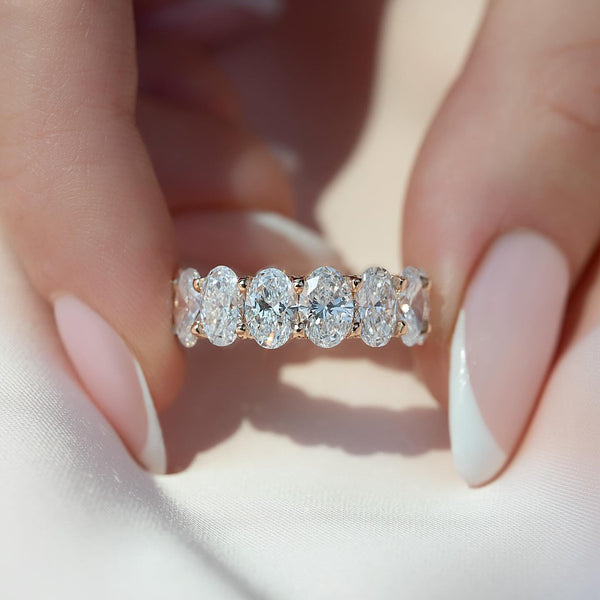
- Full eternity: cannot be resized at all. It is a remake, not a repair.
This is worth knowing before buying, which is why a half or three-quarter band is the more practical choice for a ring intended to last decades — it looks identical on the hand and keeps this option open.
If a ring is genuinely stuck
Practical steps, in order: cool the hand under cold water, raise it above your head for a few minutes, then use soap or hand cream as lubricant and turn rather than pull. Turning works where pulling does not.
If it will not come off and the finger is uncomfortable or discoloured, that is a matter for a doctor or an emergency department rather than a jeweller — and a ring is far easier to repair than the alternative. A cut ring can almost always be rejoined invisibly by a bench jeweller afterwards.
Getting the new size right
When you do resize, do it properly: measure at the end of the day at room temperature, check that the ring passes the knuckle as well as sitting at the base, and remember that width changes fit — a wide band sits more snugly than a narrow one at the same nominal size.
And send the inner diameter in millimetres rather than a converted size, for the same reason as always: five incompatible sizing systems exist, and double conversion is how rings arrive wrong.
Keep reading
Frequently asked questions
How many times can a ring be resized?
A few times, but each one costs something. Sizing down removes metal permanently; sizing up either stretches the shank thinner or adds a piece with two solder joins. Repeated changes leave a thinner shank with several joins in the section that already takes the most wear, which brings forward the need for a full reshank.
What are sizing beads?
Two small beads of metal added inside the shank at the bottom. They take up roughly a quarter to half a size, hold the ring upright so it does not spin, and can be removed later without trace. For a change that might reverse, they are the best first move — unlike resizing, they are fully reversible.
Should I resize straight away if my ring feels loose?
Not immediately — first ask whether the change is settled. Fingers vary with time of day, temperature, exercise and season. Use a reversible fix such as sizing beads or a ring guard, and resize properly once the size has held for six months or more. A loose ring is still worth acting on, since loss is the real risk.
What if a ring is stuck on my finger?
Cool the hand under cold water, raise it above your head for a few minutes, then use soap or hand cream and turn the ring rather than pulling. If it will not come off and the finger is uncomfortable or discoloured, see a doctor or an emergency department rather than a jeweller — a cut ring can almost always be rejoined invisibly afterwards.
Beads first, resize later.
Reversible costs almost nothing and can be undone. Permanent cannot — so wait until the size has held.
Leave a comment