Lab Grown Diamonds
Emerald or Asscher: The Same Cut in Two Outlines
Identical faceting philosophy, two completely different results on the hand — and one of them faces up considerably smaller.
Written by the Mapple Gems workshop, Surat · Updated 5 October 2026
Short answer
Both are step cuts — long parallel facets, a large open table, a window rather than a mirror — so both need one grade higher on clarity and colour and neither receives a cut grade. The difference is the outline. An emerald is rectangular at around 1.30–1.45 and lengthens the finger. An Asscher is square at 1.00–1.05, carries its weight in depth and so faces up noticeably smaller — roughly 5.5 mm against 7.0 × 5.0 mm at one carat.
These two are chosen by the same kind of buyer for the same reasons, and the decision usually comes down to one thing people do not realise they are choosing.
At the same carat weight an Asscher shows you meaningfully less stone than an emerald, because a square outline has to put the weight somewhere and it puts it in DEPTH. Carat is mass, not area. A rectangular outline spreads that mass across a longer face; a square one cannot, so it goes downward into the pavilion. At one carat an emerald cut measures roughly 7.0 × 5.0 mm and an Asscher roughly 5.5 × 5.5 mm — and the eye reads the emerald as distinctly the larger stone, because apparent size is driven by the longest dimension across the finger. That is not a fault in the Asscher; it is the price of the shape, and the depth it buys is exactly what produces the deep, tunnelling “hall of mirrors” look the cut is loved for. But it means a straight carat-for-carat comparison flatters the emerald, and a like-for-like comparison of visible size means stepping the Asscher up in weight. Ask for millimetres on both and compare those. It is the single number that settles which of these two you actually want.
Side by side
| Emerald | Asscher | |
|---|---|---|
| Outline | Rectangular | Square |
| Typical ratio | 1.30 – 1.45 | 1.00 – 1.05 |
| At 1 ct | ~7.0 × 5.0 mm | ~5.5 × 5.5 mm |
| Effect on the finger | Lengthens | Neutral, compact |
| Character | Long broad flashes | Deep concentric “tunnel” |
| Corners | Four, cropped | Four, more steeply cropped |
| Wedding band | Often needs a contour | Usually takes a straight band |
The last row is a real practical advantage of the Asscher and it rarely gets mentioned: a square outline does not extend along the finger, so a straight band frequently sits flush where an emerald cut would gap.
What they share
Everything that makes step cuts demanding applies equally to both.
- One grade higher on clarity and colour. A large open table with few facets is a window, so there is no scintillation to break up the view of the interior or disguise a warm tint. VS2 as a floor, VS1 above two carats.
- No cut grade exists. Both are fancy shapes, so rotating video in ordinary indoor light is the grading.
- Every corner needs its own prong. The cropped corners are the thinnest points of the girdle and the chip risk — prongs go on the corners, not the flat sides, which is a surprisingly common error.
- Reflections repeat. Step facets act like mirrors angled at each other, so one inclusion in the pavilion can appear as several images. Only video shows this.
- Watch for a dead centre. A shallow step cut goes flat and glassy in the middle — all window, no return — and it appears on no report.
What actually differs in how they look
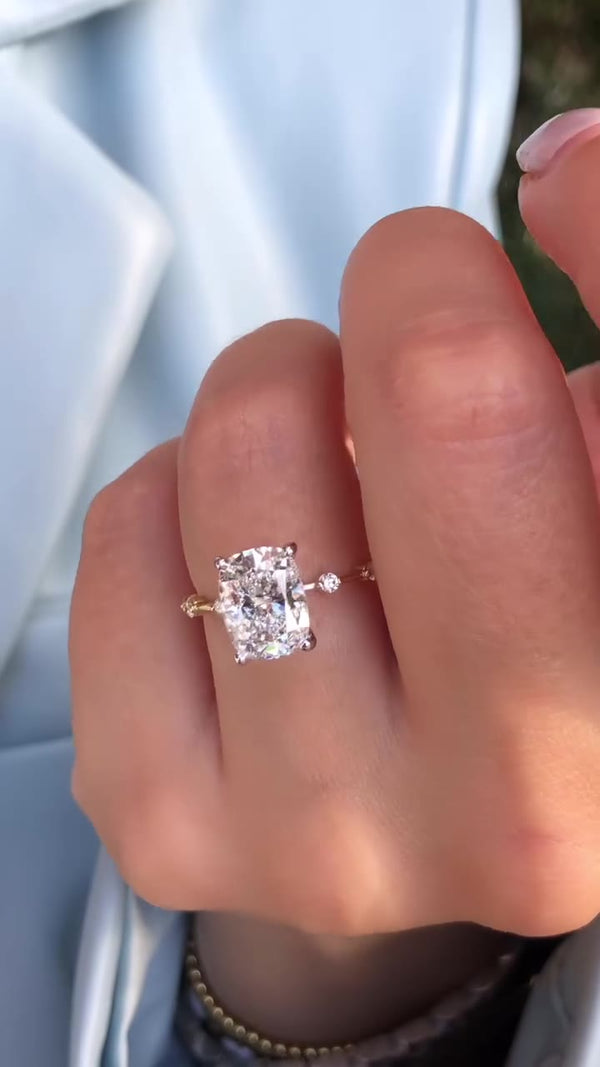
An emerald cut reads as architectural and calm: long parallel lines running the length of the stone, broad slow flashes as the hand moves, and a sense of scale from the elongation. It suits a solitaire, and it pairs particularly well with tapered baguette side stones, which repeat the same geometry.
An Asscher reads more concentrated. The cropped corners are steeper and the facets step inward toward the table, producing a distinct concentric, tunnelling effect when you look straight down — sometimes described as a hall of mirrors. It is a more antique-feeling stone, and it suits a setting that frames it squarely rather than one trying to make it look bigger.
Neither has much fire, and that is the point of both — step cuts show the least dispersion of any faceting style. If you specifically want rainbow flashes, neither of these is the shape.
Choosing between them
- If visible size matters most, the emerald wins at any given weight — or budget for a heavier Asscher.
- If you want the finger to look longer, emerald. If you want compact and geometric, Asscher.
- If a straight wedding band matters, Asscher is the easier fit.
- Derive the ratio yourself from the measurements line — it is never printed, and an emerald at 1.25 reads very differently from one at 1.50.
- Ask for video on both, in ordinary indoor light, and look at the centre of each.
If the stone is moissanite
One more consideration, running in their favour. Moissanite disperses light more than twice as strongly as diamond, and step cuts show the least of that dispersion of any faceting style — emerald least of all, Asscher just behind.
So for anyone who wants a large moissanite without conspicuous rainbow flashes, these two shapes are the answer, and the effect compounds with a warm metal setting, which reflects into the pavilion and calms the stone further. It is the closest moissanite comes to reading like a diamond at size.
Keep reading
Frequently asked questions
What is the difference between an emerald cut and an Asscher?
The same step-cut faceting in two outlines — an emerald is rectangular at around 1.30–1.45, an Asscher square at 1.00–1.05 with more steeply cropped corners. The emerald lengthens the finger; the Asscher reads compact with a deeper concentric look.
Which looks bigger at the same carat weight?
The emerald, clearly — roughly 7.0 × 5.0 mm against 5.5 × 5.5 mm at one carat. A square outline cannot spread the weight across a longer face, so it puts it into depth. Compare millimetres rather than carats to see it.
Do both need a higher clarity grade?
Yes, equally — one grade higher on clarity and colour than you would buy on a brilliant. A large open table with few facets is a window rather than a mirror, so nothing breaks up the view of the interior or disguises a warm tint.
Which works better with a straight wedding band?
The Asscher, usually — a square outline does not extend along the finger, so a straight band frequently sits flush where an emerald cut would gap. Test it with a straight edge against the CAD side elevation before casting either way.
Ask for millimetres on both before you choose.
Carat for carat these two are not comparable, and the measurements line settles it in ten seconds.


Leave a comment