Fine Jewelry
Wearing Fine Jewellery in Heat and Humidity
Written from Surat, where the monsoon lasts four months — the practical version, not the generic one.
Written by the Mapple Gems workshop, Surat · Updated 21 September 2026
Short answer
Four things change in hot, humid air. Fingers swell, so a ring sized in winter can be tight in summer — size at the end of a hot day. Silver tarnishes far faster, and it does so whether worn or not, so airtight storage matters more. Sunscreen films stones and is the cause of almost every “it went dull” message we get. And the metal, not the stone, is what reacts — sweat, chlorine and salt affect alloys, never moissanite or diamond.
Most jewellery care advice is written for temperate climates. If you live somewhere genuinely hot — or spend a fortnight somewhere that is — a few things behave differently, and the differences are practical rather than dramatic.
Sunscreen is the single commonest cause of a stone looking dull, and it is not damage — it is a film. We hear this most often from customers in hot climates and after beach holidays: the ring looked lifeless within days of arriving somewhere sunny. Moissanite and diamond are both chemically inert, so nothing in sunscreen affects the stone itself. What happens is that lotion, sweat and fine sand collect on the pavilion — the underside — where light enters and leaves. A film there kills light return completely while the top of the stone still looks clean, which is why people conclude something has gone wrong with the material. The fix takes two minutes: warm water, a drop of washing-up liquid, and a soft toothbrush used from underneath, through the gallery. In a hot climate this is a weekly job, not an annual one — and doing it weekly is the difference between a ring that looks alive and one that never quite does.
Sizing for a hot climate
Fingers are measurably larger in heat, at the end of the day, after exercise, and after salty food or alcohol. In a place with a genuine hot season, the swing across a year is enough to matter.
Size at the warmest part of a normal day, not on a cool morning. A ring that is comfortable when your hands are at their largest will be slightly loose in cooler months, which is entirely liveable — where the reverse is not.
Two design consequences worth knowing. A euro shank — flattened on the underside — stops a slightly loose ring spinning, without needing a resize. And a full eternity band cannot be resized at all, which makes three-quarter coverage a considerably better choice in a climate where fingers change seasonally.
What humidity does to each metal
| Metal | In hot, humid air |
|---|---|
| Sterling silver | Tarnishes markedly faster; needs airtight storage |
| Rose gold | Highest copper content, so most likely to mark skin |
| Yellow gold | Very stable; the sensible default |
| White gold | Plating wears faster with more washing; replate sooner |
| Platinum | Unaffected; the most robust choice |
| Plated anything | Wears through fastest — avoid for daily wear |
The green mark that rose and yellow gold sometimes leave is the copper in the alloy reacting with sweat — not the stone, not poor quality, and it washes off. It appears more in humid heat simply because there is more sweat, and it often starts after years of no problem because skin chemistry changes.
Storage matters more here
- Never a bathroom cabinet. It is the worst location anywhere and considerably worse in a humid climate.
- Silver in an airtight bag with an anti-tarnish strip. Tarnish is an air reaction that continues whether the piece is worn or not, so an unworn silver piece in an open box will be dark within weeks in monsoon air.
- Dry everything fully before storing, including under the stone where water sits in the gallery.
- Silica gel sachets in the jewellery drawer are cheap and genuinely effective.
- One pouch per piece regardless of climate — set stones at Mohs 9 and above score any metal they touch.
Water: pools, sea and cold shock
Chlorine attacks the alloy, not the stone. Over repeated exposure it can weaken solder joints and degrade the metal around settings — so the risk from a swimming pool is to prongs, not to the gem.
Salt water plus sand is abrasive and gets into every gallery. Rinse the same day.
And the specific loss hazard worth naming: cold water shrinks fingers quickly. A ring that fits perfectly in warm air can slide off in the sea within seconds, and with sunscreen on the hands it is quicker still. If you are going into water, the ring should not be on your hand.
What to buy if you live somewhere hot
- Solid gold or platinum for daily wear — plated pieces do not survive frequent washing.
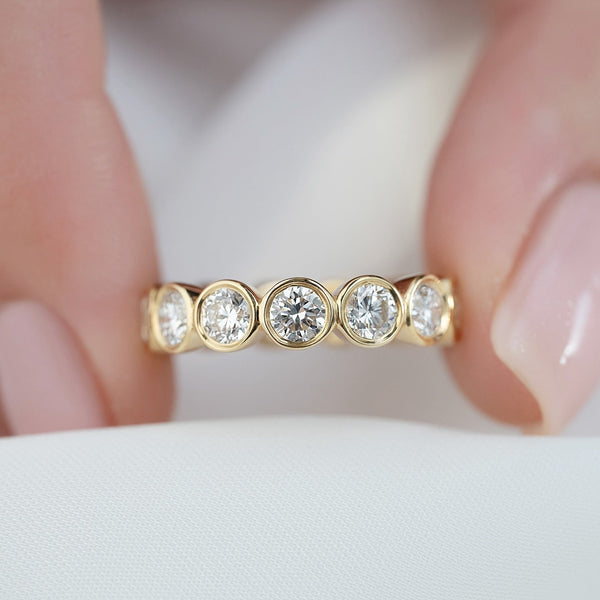
- Bezel or low settings, which trap less lotion and clean more easily than a deep gallery.
- An open gallery rather than a closed back, so you can actually clean underneath the stone.
- Three-quarter rather than full eternity, so seasonal size changes stay solvable.
- Yellow gold over white, if you would rather not replate more often than the rest of the world.
Keep reading
Frequently asked questions
Why does my ring look dull after a beach holiday?
Sunscreen, lotion and fine sand film the pavilion — the underside where light enters and leaves — which kills light return while the top still looks clean. Both moissanite and diamond are chemically inert, so nothing has damaged the stone. Warm soapy water and a soft brush from underneath restores it in two minutes.
When should I have my ring sized if I live somewhere hot?
At the warmest part of a normal day, not on a cool morning. A ring comfortable when your hands are largest will be slightly loose in cooler months, which is liveable — the reverse is not. A euro shank stops a slightly loose ring spinning without a resize.
Does chlorine damage jewellery?
It attacks the alloy rather than the stone — over repeated exposure it can weaken solder joints and degrade metal around settings, so the risk is to prongs. Separately, cold water shrinks fingers quickly, so a ring that fits in warm air can slide off in a pool or the sea within seconds.
How do I stop silver tarnishing in humid weather?
An airtight bag with an anti-tarnish strip, plus silica gel in the drawer. Tarnish is an air reaction that continues whether the piece is worn or not, so an unworn silver piece in an open box darkens within weeks in humid air. Never store jewellery in a bathroom.
Ask us for an open gallery.
In a hot climate, being able to clean underneath the stone matters more than almost any other design decision.
Leave a comment