Ring construction
Settings for a Softer Stone
If the stone cannot defend itself, the setting has to. Six specifications that decide whether a softer alternative survives.
Written by the Mapple Gems workshop, Surat · Updated 24 August 2026
Short answer
For anything below Mohs 9 — white sapphire, cubic zirconia, topaz — use a bezel, keep the profile low, avoid points and thin girdles, and specify an open gallery so the piece can be cleaned without abrasives. The setting cannot make a soft stone hard, but it can remove most of the contact that wears one out.
Setting advice is almost always written for diamond, then applied to everything else. That works badly, because a diamond at Mohs 10 shrugs off the contact that gradually destroys a stone at 8.
The thing doing the damage is not dramatic. Household dust contains quartz at Mohs 7, and anything close to that hardness gets its facet edges rounded off by ordinary handling. A setting cannot change the material. What it can do is control how much of the stone is exposed to the world.
1. Bezel, not prongs
A bezel wraps a rim of metal around the girdle and holds the stone continuously rather than at four or six points. For a softer stone this does three useful things at once.
It shelters the girdle and the facet edges nearest it — the first parts to abrade. It removes the raised prongs that catch on clothing and drag the stone across whatever the hand meets. And it gives the lowest possible profile, so the stone sits down in the ring rather than standing proud of it.
A thin-rim full bezel is usually the best version: most of the protection, least stone covered.
2. Avoid points and thin girdles
Hardness and toughness are different properties. Hardness resists scratching; toughness resists chipping. Chips happen where material is thin — at points and at narrow girdles — and that is true in any material.
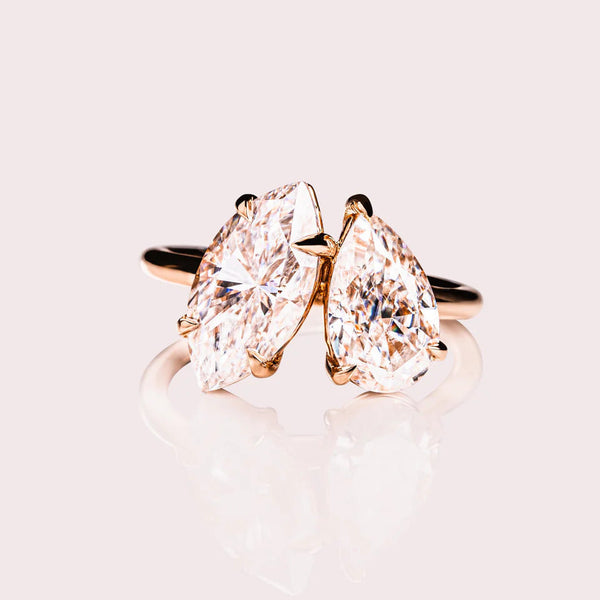
In a softer stone the margin is smaller, so a marquise, pear or princess is a poor choice. Round, oval and cushion outlines are far more forgiving, and a cushion's rounded corners make it arguably the easiest fancy shape to protect.
If a pointed shape is non-negotiable, then V-prongs on every point are non-negotiable too — and a bezel is still better.
3. Keep the profile low
Profile height is how far the stone sits above the finger. It is fixed at casting, it cannot be changed afterwards, and it is invisible in the top-down render most people approve from.
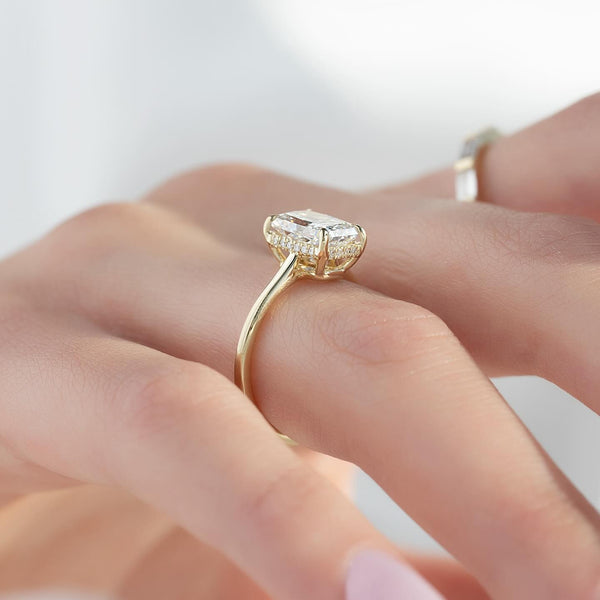
A high setting is a stone that meets more things. On a softer material that is a wear multiplier rather than just a comfort question. Ask for the side elevation with profile height stated in millimetres before approving anything, and skip the hidden halo, which adds one to two millimetres purely to create a view most people never look at.
4. Open gallery, always
The gallery is the structure under the stone. Asking for it open matters more here than anywhere, because it is the only way the pavilion can be cleaned properly.
Film from sunscreen and hand cream collects on the underside of a stone, which is exactly where a faceted gem returns light from. With a closed basket no cloth reaches it, the stone dulls from beneath, and the owner reaches for something abrasive to fix it — which is how a soft stone gets sanded by its own maintenance.
5. Match the setting to the wear pattern
| Stone | Mohs | Setting | Realistic use |
|---|---|---|---|
| Lab grown diamond | 10 | Any — prongs fine | Daily, indefinitely |
| Moissanite | 9.25 | Any — prongs fine | Daily, indefinitely |
| White sapphire | 9 | Bezel preferred | Daily, expect repolishing eventually |
| Cubic zirconia | 8.25–8.5 | Bezel, low profile | Occasion wear |
| White topaz | 8 | Bezel, low profile | Occasion wear |
The right-hand column is the honest one. No setting turns an occasion stone into a daily-wear stone. A bezel buys years; it does not change the material.
6. The metal is softer than everything above
Gold sits at roughly Mohs 2.8 — below household quartz. Whichever stone you choose, the metal marks from the first week, and over twenty years the ring thins while the stone usually does not.
Which makes shank thickness the specification that decides the piece's lifespan: 1.8mm minimum at the base, and 14K rather than 18K where the metal is doing structural work, because more gold means a softer alloy.
From our bench in Surat
We hold a view that is not universal in the trade, and it follows the same logic in reverse: for any significant stone set in 925 silver, a bezel should be the default rather than an option. Sterling sits at about Mohs 2.6 against a diamond's 10 — a wider gap than against gold. Silver prongs deform and thin far faster, so the stone stays perfect while the thing holding it gives way.
The concession that goes with it: a bezel is more labour than a four-prong head, so we are recommending the more expensive build and we benefit from that. We still think it is right in silver. In gold, with a hard stone, a prong setting is entirely reasonable and we will happily make one.
What to specify
- Thin-rim full bezel, or an end bezel if the shape has vulnerable ends.
- Round, oval or cushion outline rather than anything pointed.
- Profile height in millimetres, on a side elevation.
- Open gallery beneath the stone — not a closed cup.
- Shank 1.8mm at the base; euro shank if worn daily.
- No hidden halo — it buys height you do not want here.
- A cleaning routine that is a soak and a soft brush, never a polishing cloth or toothpaste.
Frequently asked questions
What setting is best for a softer gemstone?
A thin-rim full bezel. It shelters the girdle and the facet edges nearest it, removes raised prongs that catch, and gives the lowest profile so the stone meets fewer things. Combine it with a round, oval or cushion outline rather than a pointed shape.
Can a good setting make a soft stone last in daily wear?
It buys years rather than changing the material. Below Mohs 9, quartz in household dust still abrades exposed surfaces, so cubic zirconia and topaz remain occasion stones however well they are set. White sapphire at 9 does better and can be repolished.
Why does an open gallery matter for a softer stone?
Because film collects on the pavilion, which is where a faceted stone returns light from. A closed basket means no cloth reaches it, the stone dulls from beneath, and people reach for abrasives — which damages a soft stone far more than the dirt did.
Should I avoid a marquise or pear in a softer stone?
Yes where possible. Chips happen where material is thin, and points are the thinnest part of any cut. Round, oval and cushion outlines are far more forgiving. If a pointed shape is essential, V-prongs on every point are mandatory and a bezel is better still.
Why is a bezel recommended for stones set in silver?
Sterling silver sits at roughly Mohs 2.6, a wider gap against a hard stone than gold gives. Silver prongs deform and thin quickly while the stone stays perfect, so a continuous bezel with no thin projecting element is the more durable build.
Rim, gallery and profile are all choices
Every piece is made to order in our own workshop in Surat, so all three are decided before casting rather than after.
Leave a comment