Engagement Rings
Designing a Ring Around an Inherited Stone
A stone you already own changes the order of every decision — and one step has to happen before any design conversation.
Written by the Mapple Gems workshop, Surat · Updated 28 September 2026
Short answer
Have the piece identified before it is cleaned, polished or taken apart — polishing erases hallmarks and maker’s marks permanently, and those are what could make it worth more intact than remade. Then get the stone measured and assessed unmounted: exact millimetres, depth, girdle condition, and any chips at points. The design follows from those numbers. And if the stone is a genuine antique cut, do not recut it and do not surround it with a modern brilliant halo.
This is one of the best things you can do with a piece nobody wears: keep the material and the history, and end up with something that gets worn. But the order matters, and the irreversible steps come first.
The most costly mistake is made with good intentions: having the old piece cleaned up before bringing it in. Polishing works by removing metal, so it softens or erases hallmarks, maker’s marks, assay marks and hand-cut detail — permanently. Those marks are frequently the only evidence of what a piece is, and a signed or datable piece is valued as an object rather than as materials, which can be a different order of magnitude. We have seen rings arrive with the inside already buffed smooth and no way left to identify them. So the sequence is: identify, document, then decide. Photograph the marks close up, get the stone measured and assessed, and only then have the design conversation. A gentle clean is fine. A polish is not, and it cannot be undone — and neither can taking the piece apart, which is why nothing should be unset until you know what you have.
The order of operations
- Photograph everything — the piece from several angles, the marks inside the shank, and the view from underneath.
- Have it identified before any cleaning. Age, likely origin, and whether the cut is genuinely antique.
- Decide intact or remade. A signed or period piece is usually worth more as it is; an unmarked worn ring nobody wears usually is not.
- Have the stone measured unmounted — millimetres, depth, girdle condition, and any damage at points or edges.
- Then design, from those numbers rather than from a picture.
What the assessment needs to establish
| Question | Why the design depends on it |
|---|---|
| Exact millimetres and depth | A head is built to a stone, not a carat figure |
| Girdle thickness | Very thin girdles need protective settings |
| Chips at points or edges | Prong placement can hide small damage |
| Antique cut or modern? | Changes the whole design direction |
| Treated or untreated | Some treated stones dislike bench heat |
| What the accents are | Old melee is rarely worth resetting |
That last row is worth expecting. Small accent stones from an old piece are usually not worth re-using: they are uncertified, often chipped at the girdle from being unset, and matching new ones is cheaper and better than salvaging. Keeping the centre stone is the point; the melee rarely is.
If it is a genuine antique cut
The test is the open culet — a small dot visible through the table when you look straight down. Modern brilliants are cut to a point; an open culet means an old mine, old European or transitional cut, and it is the best dating clue on an unmarked stone.
Three things follow. Do not recut it to modern proportions — it loses weight, loses its period character, and loses the thing that made it distinctive. Do not ring it with a modern brilliant halo, which puts a high-dispersion row around a deliberately calmer stone and makes the centre look dull by comparison. And expect it to look different: antique cuts show broad, slow flashes rather than the fine scintillation of a modern brilliant, because they were cut for candlelight rather than LED.
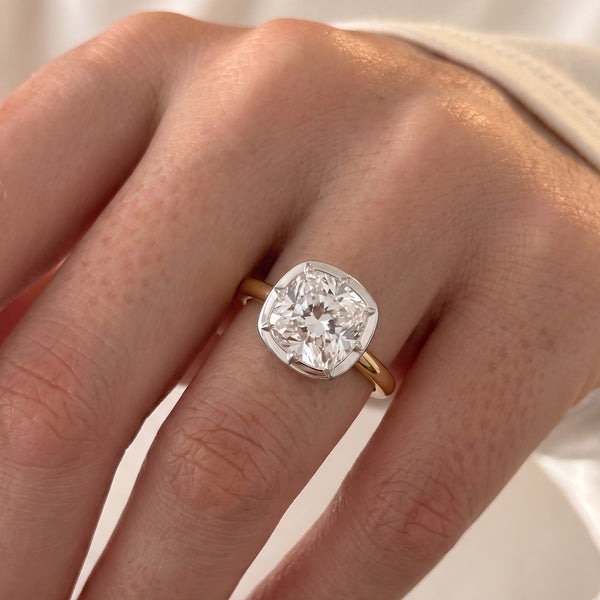
Settings that suit them: a simple bezel or a low-profile basket, ideally with a slightly warm metal, and hand detail rather than pavé.
Building the new ring
- The head is made to the stone. A stone from 1930 will not drop into a stock head; the seats are cut to its actual girdle. Expect that to be part of the work.
- Protect any existing damage. A prong can be oriented over a small chip at the girdle — an ordinary request that costs nothing.
- Use the old gold. It has verifiable value from gram weight and karat, and a workshop can credit or physically reuse it, which offsets the new work.
- Keep the shank at 1.8–2 mm. The point of remaking is a ring that lasts another fifty years, not a thin one around an old stone.
- Tell the bench the stone’s history — age, any treatment, anything unknown. Heat is used in setting and repairs.
Two things worth carrying over
Engraving. If the original band carries an inscription, transcribe and photograph it before anything happens to it — and consider having it re-engraved inside the new ring, centred on the upper interior so a future resize cannot cut through it.
The story. Provenance is the only thing that reliably makes a piece worth more than its materials, and it exists solely as information. Write a paragraph: who owned it, roughly when it was acquired, and the fact that it has been remade. That last part matters — a jeweller in fifty years will otherwise be puzzled by an antique stone in a modern setting.
If more than one person has a claim
Common, and worth naming. One inherited ring frequently has to serve several people, and remaking can genuinely solve that: a larger piece can become two smaller ones, or the centre stone can go into a ring while a band or accents become a pendant.
Two conditions: agree it before anything is altered, since remaking is as irreversible as selling — and document the original first, so what existed is preserved even when the object is not.
Keep reading
Frequently asked questions
Can I use an inherited stone in a new ring?
Usually yes, and it keeps both the material and the history. Have the piece identified before it is cleaned, polished or taken apart, then have the stone measured unmounted — exact millimetres, depth, girdle condition and any chips. The design follows from those numbers.
Should I have an old ring cleaned before taking it to a jeweller?
A gentle clean is fine; a polish is not. Polishing removes metal and with it hallmarks, maker’s marks and hand-cut detail, permanently — and those are often the only evidence of what a piece is. A signed or datable piece is valued as an object rather than as materials.
How do I know if an inherited stone is an antique cut?
Look for an open culet — a small dot visible through the table looking straight down. Modern brilliants are cut to a point. If it is antique, do not recut it and do not surround it with a modern brilliant halo, which makes the calmer centre stone look dull by comparison.
Can the old accent stones be reused?
Usually not worth it. Old melee is uncertified, often chipped at the girdle from being unset, and matching new stones is cheaper and better than salvaging. Keeping the centre stone is the point; the old gold, however, has verifiable value and can be credited or reused.
Send us photographs before you send us the piece.
The marks inside the shank and the stone from directly above. We will tell you what you have before anything is altered.
Leave a comment