Wedding Bands
Milestone Anniversaries: What the Hand Can Actually Take
By the tenth year the constraint is no longer taste or budget — it is how much finger is left.
Written by the Mapple Gems workshop, Surat · Updated 4 October 2026
Short answer
Before adding a band, measure the total stacked width — an engagement ring at 2 mm plus two 3 mm bands is already 8 mm of finger, and most people stop being comfortable around there. If the stack is full, the better milestone gifts are upgrades to the existing rings: a platinum head, a stone swap, a reshank, or a right-hand ring instead. And after ten or fifteen years, the ring often needs bench work — which makes a service the most useful present of all.
Anniversary jewellery is usually approached as a shopping question. By the second decade it is really a design question about a hand that already has rings on it.
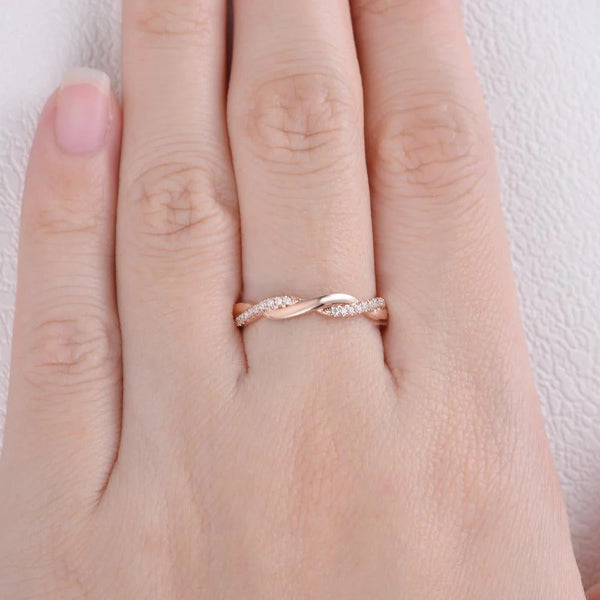
Nobody plans a stack — it accumulates one milestone at a time, and the constraint that eventually stops it is width, which nobody measured at any point along the way. Each addition looks modest on its own: a 2.5 mm band at five years, a 3 mm eternity at ten. But they sit on the same finger as the original engagement ring and the original wedding band, and the widths simply add up — typically to 8 mm or more by the second decade, which is where most people find the ring column starts pressing the neighbouring fingers and catching when the hand closes. At that point a further band is not a gift, it is a piece that gets worn twice. The fix is to decide the total early: pick the width the finger can carry, and reserve the OUTER POSITION — the side away from the knuckle — for future anniversary bands, so each addition has a planned home rather than displacing something. And one construction rule matters more with every band added: never let a stone-set band sit directly against a plain one, because stones at Mohs 9 or above cut a visible groove into gold at under 3. A plain spacer band between them costs very little and prevents it entirely.
Widths, added up
| Stack | Total width | In practice |
|---|---|---|
| Engagement ring alone | ~2 mm | Comfortable for anyone |
| + wedding band | ~4.5 mm | The standard pair |
| + one anniversary band | ~7 mm | Noticeable; still fine for most |
| + a second | ~9.5 mm | The usual comfort limit |
| Three or more added | 12 mm+ | Occasion wear, realistically |
Two practical notes. Narrow bands stack better than one wide one — two 2 mm bands read as more than a single 4 mm and can be worn separately. And a full eternity cannot be resized, which is a poor bet on a finger that has twenty more years of change ahead; a three-quarter eternity looks identical on the hand and keeps the option.
When the stack is full
This is where the genuinely good milestone gifts live, and almost none of them are new bands.
- A stone upgrade. The head is a separate component, so a larger centre stone is a straightforward swap that keeps the ring, the engraving and the hallmarks.
- A platinum head. Platinum prongs wear better than gold ones, and a white head lets a warmer colour grade read neutral. Genuinely useful rather than decorative.
- Side stones or a halo added to the existing ring — more presence without more finger.
- A right-hand ring. A separate finger with no width constraint, and the one place where a larger, more dispersive stone is entirely the point.
- Earrings or a chain. Obvious, and frequently the answer.
The gift most people never think of
A full service, and after ten to fifteen years it is often the most valuable thing you can give the ring.
What is typically due by then: prong tips re-tipped (they flatten between years three and ten and are the reason stones are lost), white gold replated, and a check on whether the shank has thinned toward a reshank. A ring that looks immaculate from above can be a third thinner underneath, because the underside takes almost all the contact.
The instruction to give with it: “do not polish.” Polishing is done by default at the end of most bench work, it removes metal every time, and on an older ring it softens hallmarks and hand-cut detail permanently.
If you do add a band
- Match by fineness number — 585 or 750 — not by colour word. 14K beside 18K in the same colour clashes in daylight.
- Run the straight-edge test against the side of the existing ring: visible daylight means a contour band rather than a straight one.
- Order it slightly differently sized. Rings sitting outboard of others often need a fraction more, and a finger at year fifteen is rarely the size it was at year one.
- Keep 1.8 mm thickness even on a narrow band — thin bands in a stack deform against each other.
- Decide the wear order and leave the outer position free for the next one.
A note on remaking
At twenty or twenty-five years, some couples take a different route entirely: remaking the existing rings into one piece rather than adding a fourth. A worn band and an outgrown ring can become a single wider ring, or the stones can move into a new setting.
It keeps the material and the history, and it usually beats selling, because selling recovers only the metal while remaking preserves the labour already paid for. Two conditions: document what exists first, and if either ring is genuinely antique, have it identified before anything is altered.
Keep reading
Frequently asked questions
How many rings can one finger comfortably take?
Measured by total width rather than count — most people stop being comfortable somewhere around 8 to 9.5 mm, which is an engagement ring plus a wedding band plus two anniversary bands. Beyond that the column presses neighbouring fingers and catches when the hand closes.
What is a good milestone anniversary gift if the stack is full?
Upgrades to the existing rings rather than another band — a larger centre stone (the head is a separate component), a platinum head, added side stones or a halo, or a right-hand ring where there is no width constraint. Or a full service, which is often overdue by then.
Can a stone-set band sit against a plain one?
It should not — stones at Mohs 9 or above cut a visible groove into gold at under 3, over years of small movements. A plain spacer band between them costs very little and prevents it entirely, and it steadies the stack at the same time.
What does a ring need after ten or fifteen years?
Usually re-tipped prongs, replating if it is white gold, and a check on whether the shank has thinned toward a reshank. A ring immaculate from above can be a third thinner underneath. Tell the bench “do not polish” — it is done by default and removes metal each time.
Measure the stack before you add to it.
Send us the total width and what is already on the finger, and we will tell you honestly whether another band is the right gift.


Leave a comment