Engagement Rings
Planning the Whole Stack From Day One
You are not buying one ring. You are buying the first of two or three that have to live together on one finger.
Written by the Mapple Gems workshop, Surat · Updated 26 September 2026
Short answer
Decide four things at the start: total stacked width the finger will carry, which metal everything will be (matching fineness numbers, not colour words), whether the engagement ring needs a contour band — test it before casting — and the wear order, since a stone-set band must never sit directly against a plain one. Anniversary rings usually join later, so leave the outer position free. Ordering the band with the ring is cheaper and fits better than reverse-engineering one afterwards.
Almost everyone buys the engagement ring alone and works out the rest as it happens. That is fine, and it produces a predictable set of avoidable problems — a band that will not sit flush, two metals that fight each other, and a stack too tall to wear comfortably.
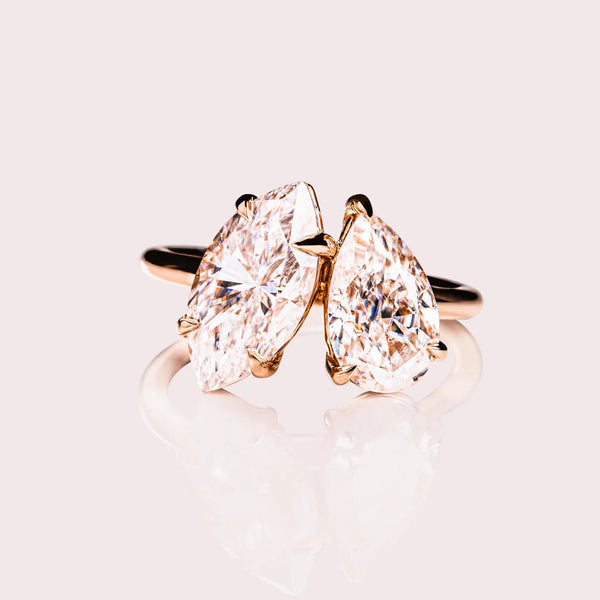
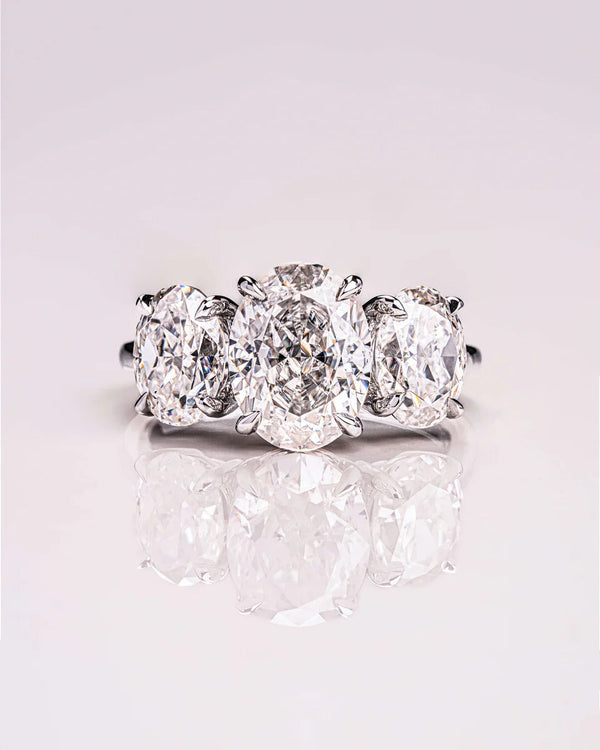
Whether a straight band will sit flush is decided at casting — and it can be tested on the render, before anything is made, in about ten seconds. A wedding band sits against the engagement ring, and whether it meets it cleanly depends on the shape of the ring’s lower profile: how far the setting extends along the finger, and how the shoulders taper. Three-stone, pear, oval and side-stone designs almost always leave a gap; solitaires usually do not; halos vary. The test is the straight-edge test — hold a ruler or a card against the side of the ring as it sits on the finger, or against the side elevation of the CAD. Visible daylight between the two means a contour band. That is not a problem, it is simply information — but knowing it before casting means the contour is designed as part of the pair, which fits better and costs less than commissioning one later to match a ring that already exists. Ask for the side elevation and do the test then. It is the cheapest decision on this page.
The four decisions
| Decision | Decide it now because |
|---|---|
| Total stacked width | Two 3 mm bands plus a ring is 8–9 mm of finger |
| Metal, by fineness | 14K beside 18K in the same colour clashes |
| Contour or straight | Fixed by the ring’s geometry at casting |
| Wear order | Decides what abrades what for decades |
Width: the one people underestimate
A stack is cumulative and it adds up faster than expected. An engagement ring shank at 2 mm, a wedding band at 3 mm and an anniversary band at 3 mm is 8 mm of metal on one finger — enough to restrict how far the finger bends, and enough to press against the neighbouring fingers.
Two practical consequences. Sizing changes: a stack of three fits differently from one ring, and the rings should be sized as a group if they are always worn together. And narrower reads better in a stack — two 2.5 mm bands look more considered than two 4 mm ones, and leave room for a third later.
Wear order, which is a durability question
The rule that matters most and is almost never mentioned: never put a stone-set band directly against a plain one. Set stones sit at Mohs 9 or above and gold sits under 3, so over years of constant contact the stones cut a groove into the plain band. The plain ring always loses.
So if the stack includes a pavé or eternity band and a plain one, put a spacer between them, or accept the wear knowingly and keep the plain band on the outside where it takes less pressure.
The same logic applies to metals: platinum against gold wears the gold one-directionally, because platinum displaces metal rather than losing it. A platinum ring and a gold band are a legitimate pairing — with a spacer, or with the expectation that the gold one needs attention sooner.
Leave room for what comes later
Anniversary bands, eternity rings and push presents arrive over decades, and the stack has to absorb them.
- Keep the outer position free rather than filling both sides at the wedding. Additions almost always go on the outside.
- Choose three-quarter over full eternity for anything that may need resizing — and a finger worn with a stack for twenty years will change.
- Record the fineness number and gram weight of every piece, so a future band can be matched by a bench that did not make the first two.
- Consider soldering only when the stack is final — it stops rubbing and spinning entirely, but it permanently ends wearing them separately and complicates resizing.
If the stack is already partly bought
Most of this still applies. Send whoever is making the next piece the fineness number, gram weight and shank dimensions of what already exists — not the colour name, since “yellow gold” is not a specification and rose recipes vary between workshops.
If the metals will not match well, change the finish instead of the colour: a brushed band beside a polished ring reads as a deliberate pair, with none of the wear complications of mixing metals.
And if a straight band was bought and does not sit flush, the options are a contour band, a spacer, or wearing them on separate fingers — all of which are more sensible than forcing two rings together and letting them wear each other.
Keep reading
Frequently asked questions
Should I buy the wedding band at the same time as the engagement ring?
If you can, yes. Whether a straight band sits flush is fixed by the engagement ring’s geometry at casting, so designing the pair together means any contour is built as part of the set — which fits better and costs less than commissioning one later to match a ring that already exists.
How do I know if I need a contour band?
Hold a straight edge against the side of the ring as worn, or against the side elevation on the CAD. Visible daylight between them means a contour. Three-stone, pear, oval and side-stone designs almost always need one; solitaires usually do not; halos vary.
In what order should stacked rings be worn?
Never put a stone-set band directly against a plain one — set stones at Mohs 9 or above cut a groove into gold under 3 over years of contact. Use a spacer between them, and note that platinum against gold also wears the gold one-directionally, since platinum displaces metal rather than losing it.
How wide can a stack be before it is uncomfortable?
It adds up faster than expected — a 2 mm shank plus two 3 mm bands is 8 mm of metal on one finger, enough to restrict bending and press on neighbouring fingers. Narrower reads better in a stack anyway, and leaves room for an anniversary band later.
Ask for the side elevation and hold a card against it.
Ten seconds, before anything is cast, and it settles the wedding band question for good.
Leave a comment