Lab Grown Diamonds: Busting the Myths
Are they real? Do they last? Are they worth it? We separate the facts from the fiction — and show where moissanite fits in.
For decades, the jewelry world ran on one simple message: if a stone didn't come out of the ground, it didn't count. That idea is finally being retired. Lab grown diamonds are now one of the fastest-growing choices for engagement rings and fine jewelry — partly because they are chemically the same as mined diamonds, and partly because they cost a fraction of the price.
The myths that keep circling:
“They're not real diamonds.” • “They're cheap fakes.” • “You can spot one a mile away.” • “They're worthless.”
Let's go through them one by one and look at what's actually true.
“Lab grown diamonds aren't real diamonds”
The assumption: if a human was involved, it must be artificial.
A lab grown diamond is crystallized carbon arranged in exactly the same structure as a mined diamond — same 10/10 hardness, same brilliance, same way of bending light. A diamond is defined by that carbon lattice, not by where it formed. In a landmark 2018 ruling, the U.S. Federal Trade Commission removed the word “natural” from the core definition of a diamond. In plain terms: a lab grown diamond is a diamond.
“They're made from cheap, fake materials”
“Man-made” makes people picture glass or plastic. In reality, they're grown from pure carbon using two proven methods.
|
CVD
Chemical Vapor Deposition
A diamond seed sits in a sealed chamber. Carbon-rich gas is heated until carbon atoms settle onto the seed layer by layer, building a rough diamond over several weeks. |
HPHT
High Pressure, High Temperature
This copies what happens underground. Extreme pressure and heat turn carbon into a diamond crystal — compressed into weeks instead of millennia. Fast-forwarded geology, not a fake. |
“You can spot a lab diamond just by looking”
Some people swear lab stones look “too clean.”
To the naked eye there's no reliable difference. Even trained gemologists can't separate them with a standard loupe — it takes specialized lab equipment to detect microscopic growth patterns. Both are graded on the same 4Cs (Cut, Color, Clarity, Carat) by labs like IGI and GIA, and most lab stones carry a tiny laser inscription confirming their origin.
“Lab grown diamonds have no value”
The scare line: they're worthless the moment you buy them.
Lab diamonds do have lower resale value — but here's what the myth skips: most mined diamonds don't appreciate either. They're luxury purchases, not investments. The real value of a lab diamond is upfront: you typically pay 30–50% less for the same look and quality. That's money you keep — for the wedding, the honeymoon, or a bigger, brighter stone.
Lab Grown vs Mined Diamonds
What's inside the stone is identical. The differences come down to origin, price, and footprint — not beauty or durability.
Where Moissanite Fits In
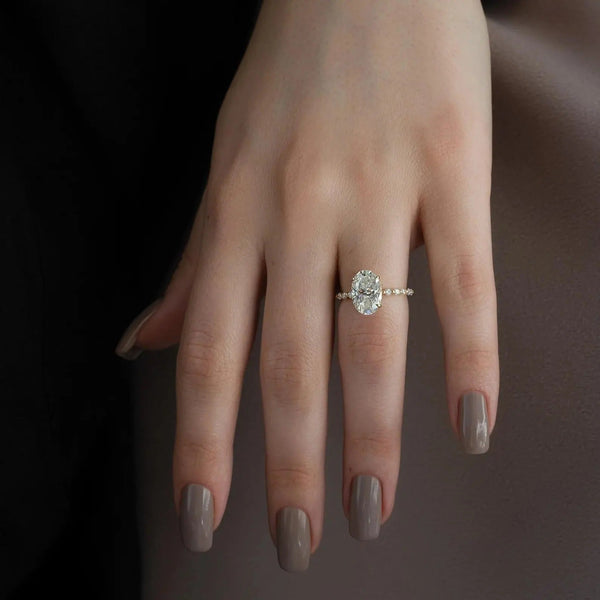
If you're exploring lab grown diamonds, you're probably weighing moissanite too. A lab diamond is pure carbon. Moissanite is silicon carbide — a different mineral that ranks 9.25 on the Mohs scale (still extremely tough and everyday-safe) and throws even more fire and rainbow sparkle than a diamond.
It's also the most budget-friendly of the three, which is why so many couples choose it for maximum size and sparkle. At Mapple Gems, every ring is handcrafted around brilliant, conflict-free moissanite — the look and durability you want, at a price that leaves room for everything else.
The Bottom Line
It comes down to what matters most to you. If a stone's geological history feels meaningful, a mined diamond may appeal. If you care about ethics, sustainability, and getting more stone for your money, a lab grown diamond is a clear winner — and if you want the most sparkle at the friendliest price, moissanite is hard to beat. Whatever you choose, don't let outdated myths make the decision for you.
Frequently Asked Questions
Are lab grown diamonds real diamonds?
Yes. They share the exact same chemical and physical makeup as mined diamonds and are recognized as real diamonds by the FTC.
How are lab grown diamonds made?
Through two methods — CVD and HPHT — both of which recreate the natural conditions of diamond formation.
Can anyone tell a lab diamond from a mined one?
Not by eye. It requires specialized lab equipment, and most stones carry a microscopic inscription confirming their origin.
Are they as hard as mined diamonds?
Yes — both score a 10 on the Mohs scale, the hardest rating possible.
Are lab grown diamonds worth buying?
For most buyers, yes — identical look and durability for 30–50% less than a mined diamond.
What's the difference between a lab grown diamond and moissanite?
A lab diamond is pure carbon (Mohs 10). Moissanite is silicon carbide (Mohs 9.25) with more colorful fire — usually at the lowest price of the three.
Find Your Perfect Ring
Handcrafted, conflict-free moissanite engagement rings and bridal sets, designed for brilliance that lasts.
Shop the Collection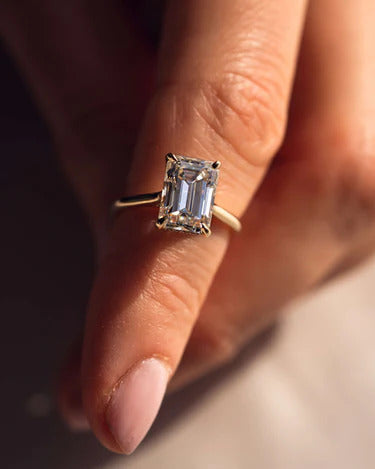
Leave a comment