Engagement Rings
Solitaire, Halo or Three-Stone: Choosing a Silhouette
Four shapes, four different sets of consequences — only one of which is about how it looks.
Written by the Mapple Gems workshop, Surat · Updated 24 September 2026
Short answer
A solitaire has the fewest failure points and takes any band. A halo buys roughly 2.6 mm of apparent size for a fraction of the stone cost, at the price of more settings to maintain. Three-stone adds width and needs its stones matched. Pavé shanks add sparkle but commit you to periodic bench work and complicate resizing. Choose by how much maintenance you want and whether a straight band must sit flush — both are decided here, not later.
Silhouette is usually chosen from photographs. It is worth also choosing it from consequences, because each one commits you to a different long-term relationship with the ring.
The four, compared
| Solitaire | Halo | Three-stone | |
|---|---|---|---|
| Apparent size | The stone | +2.6 mm | Wider, not larger |
| Settings to maintain | 4–6 | 25–45 | 10–14 |
| Straight band fits | Usually | Often not | Rarely |
| Catches on things | Depends on height | Less — halo shields | Least — sits low |
| Fire (moissanite) | The stone alone | Multiplied | Depends on side cut |
| Upgrade later | Easiest — swap the stone | Halo is sized to the stone | Sides constrain the centre |
The row nobody weighs is the second one: a silhouette is a decision about how many settings you are agreeing to maintain for the next forty years. Every set stone is a maintenance point. A solitaire has four to six prongs on one stone — a setter checks it in minutes and re-tips it cheaply. A halo with a pavé shank can carry forty or more individual settings, each with its own beads raised by hand, each thinning at its own rate. Neither is wrong, and a well-made halo lasts perfectly well. But it is a commitment to periodic bench work in a way a solitaire is not, and it should be chosen knowingly rather than discovered at year six when the first small stone goes missing. The honest framing: a halo buys you visible size now and costs you attention later; a solitaire costs you size now and asks almost nothing afterwards. Both are reasonable trades — but they are trades, and almost no listing presents them that way.
Solitaire
Choose it if you want the simplest long-term ownership, the easiest upgrade path, or a ring a plain straight band will sit against without a contour.
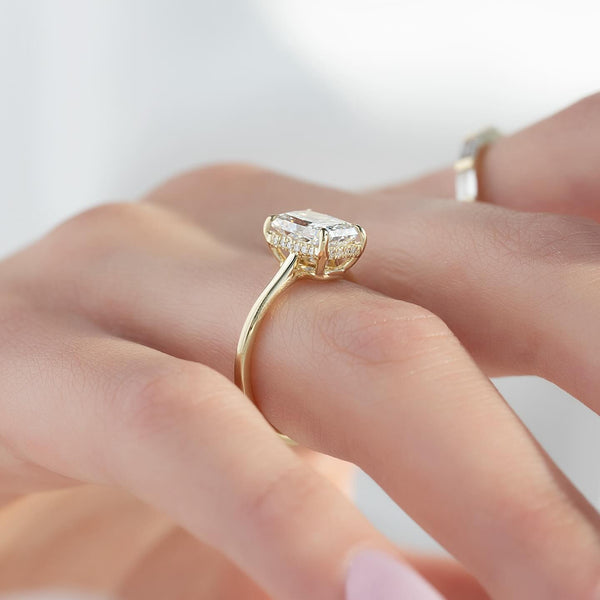
Its weakness is that everything depends on the stone, so there is nowhere to hide a poorly cut one — and it is the silhouette where profile height matters most, since a high solitaire is the classic catcher on knitwear and pockets. Ask for the height in millimetres and a side elevation.
The under-used variant: a tapered shank, which makes the stone read larger, sits more comfortably and uses less gold. It is the only apparent-size lever that improves all three.
Halo
Choose it if visible size is the priority. A 1.3 mm halo row adds about 2.6 mm to the overall diameter — taking a 6.5 mm centre to roughly the footprint of a 9 mm stone, at a small fraction of the cost of buying one.
Two things to know. The halo shields the centre, which genuinely reduces catching and impact risk. And in moissanite, a halo does not merely frame the fire — twenty to forty small brilliants all disperse at once, multiplying it. If you like the size but not the rainbow, a hidden halo or a warm metal setting gets you most of the effect with far less of it.
Three-stone
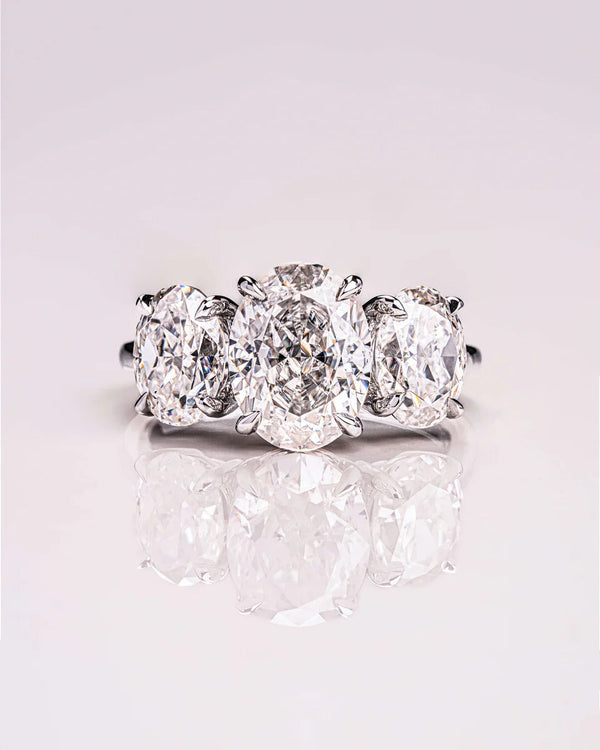
Choose it if you want presence and width rather than a larger-reading centre, or you like the meaning people attach to it.
The specific requirement is matching: three stones side by side is the one condition under which most people can see a colour difference at all, so sides within one grade of the centre matter more than the grades themselves. Step-cut sides — tapered baguettes or trapezoids — add width with less competing sparkle, which is the quiet upgrade in moissanite.
And ask for the total width across the setting, because that number decides the wedding band question.
Pavé and hidden detail
These are modifiers rather than silhouettes, and they can be added to any of the above. Two consequences worth stating.
Pavé cost is labour, not stones — forty separate drill-seat-and-bead sequences by hand under magnification. That is why a level stone row is the clearest sign of careful work, and why pavé carries the maintenance profile it does.
A fully set shank cannot be resized, and a partly set one has limits. Keep the underside plain if the finger may change — three-quarter coverage looks identical on the hand.
Deciding, in three questions
- Does it come off for work, gardening and the gym? If not, favour lower profiles and fewer settings — three-stone and bezel-set solitaires.
- Must a plain straight band sit flush against it? Only a solitaire reliably allows that. Everything else usually needs a contour, and it should be ordered at the same time.
- Is the centre stone likely to be upgraded later? A solitaire makes that trivial. A halo is built to one stone size, so changing the centre means rebuilding the halo.
Whichever silhouette wins, the construction specifications do not change: 1.8 mm shank minimum, a prong over every point and corner, and a side elevation approved before casting.
Keep reading
Frequently asked questions
Is a halo or a solitaire better?
They trade differently. A halo buys about 2.6 mm of apparent size for a fraction of the cost of a larger stone, but carries 25–45 individual settings to maintain. A solitaire has four to six, takes a plain straight band, and makes upgrading the centre stone trivial. Choose by how much maintenance you want.
Which engagement ring style catches on things least?
Three-stone settings sit low and catch least; a halo shields the centre and helps too. A solitaire depends entirely on profile height, which is fixed at casting — so ask for the height in millimetres and a side elevation rather than judging from a top-down render.
Which styles need a contour wedding band?
Three-stone rings almost always, halos frequently, and solitaires usually not. Test it by pressing a straight edge against the side of the ring as worn — visible daylight means a contour is needed. Order the band with the ring, when the fitting is part of the build.
Can I change the centre stone later?
Most easily on a solitaire — the stone lifts out and a different one drops in, and the head can be replaced separately if a different size needs a different setting. A halo is built to one stone size, so changing the centre means rebuilding the halo around it.
Tell us whether it comes off for work.
That one answer narrows the silhouette faster than any amount of browsing.
Leave a comment