Canada · Education
Buying Jewellery Priced in US Dollars From Canada: The Real Cost
The price on the page is the start of the sum, not the end. Four separate charges sit between a US-dollar price and what leaves your account. Here they are, and how to shrink each one.
Written by the Mapple Gems workshop, Surat · Updated 9 November 2026
Short answer
When a Canadian buys a ring priced in US dollars, four costs stack up: the exchange rate, a foreign transaction fee of about 2.5% on most Canadian credit cards, customs duty and GST/HST assessed by the CBSA, and a courier brokerage fee. Courier parcels from outside the US and Mexico are only exempt from duty and tax up to CAD $20, so a ring will be assessed. Compare sellers on the total landed cost, not the sticker price.
We price in US dollars for Canadian customers at the moment. That is a plain fact about our checkout, and we would rather explain exactly what it means than show a Canadian-dollar figure that might not match what your bank actually charges. The same four layers apply to any jewellery you buy from outside Canada, from us or anyone else, so this is worth knowing whoever you buy from.
The four layers of cost
| Layer | Who charges it | Typical size | How to reduce it |
|---|---|---|---|
| 1. Exchange rate | Visa, Mastercard or Amex network | Close to the market rate, with a small spread | Little to do; it is the same for everyone on that network |
| 2. Foreign transaction fee | Your card issuer | About 2.5% on most Canadian credit cards | A no-foreign-transaction-fee card, or a US-dollar card |
| 3. Duty and GST/HST | Canada Border Services Agency | Depends on tariff classification, value and province | Nothing legitimate; never under-declare |
| 4. Brokerage or handling fee | The courier, for clearing the parcel | Varies by courier and value | One shipment instead of two; ask before ordering |
Layers one and two: what your card does
When you pay in US dollars, the card network converts the amount to Canadian dollars, and then your bank adds its own foreign transaction fee on top. On most Canadian credit cards that fee is around 2.5%, and it usually does not appear as a separate line, so people miss it. It also applies to many debit cards used for online purchases.
A worked example, using an illustrative exchange rate rather than today’s:
- Ring price: US$800
- At an exchange rate of, say, 1.38: CA$1,104.00
- Plus a 2.5% foreign transaction fee: CA$27.60
- On your statement: about CA$1,131.60, before anything at the border
Some Canadian cards waive the foreign transaction fee, and some banks issue US-dollar credit cards that avoid the conversion altogether. If you already hold one, this is the purchase to use it on.
Layers three and four: what happens at the border
A parcel from India is assessed by the CBSA when it arrives. Courier shipments from countries other than the US and Mexico are only exempt from duty and taxes when their value for duty is CAD $20 or less. Above that, the full value is assessed, not just the part over $20. Any jewellery worth wearing is well above it.
What you can owe on arrival:
- Customs duty, depending on how the item is classified and where it was made.
- GST, or HST in participating provinces, with provincial sales tax handled differently again in places such as Quebec and British Columbia.
- The courier’s brokerage fee for doing the clearance paperwork, usually collected with the duty and tax before delivery.
We do not quote rates here, because classification decides them and the rules change. Check the CBSA’s own pages before relying on any figure, including ours.
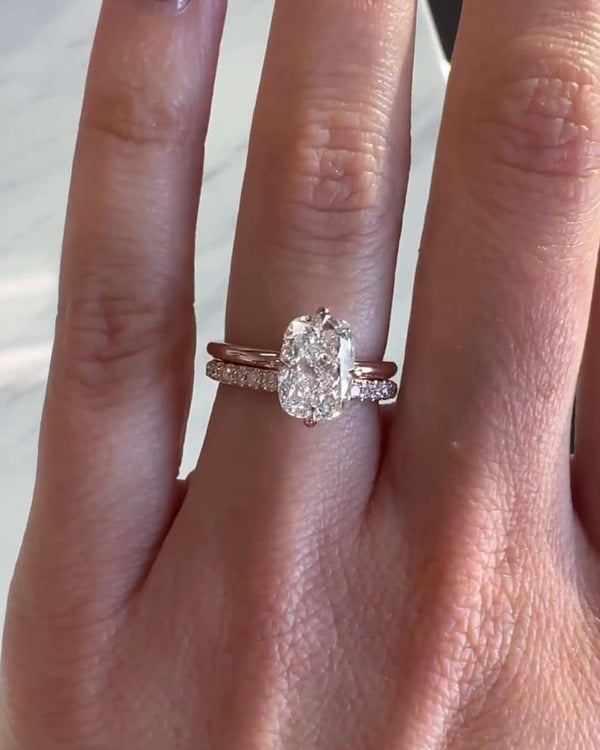
From the bench: order the ring and band together. Duty and tax scale with value, but the courier’s brokerage fee is charged per shipment. Order an engagement ring now and the wedding band in a year and you pay that fee twice, and wait at the border twice. Ordered together, they travel in one parcel with one clearance. It also means the band is made to sit against your actual ring, which is the better reason. What you must not do is the opposite: splitting one order into several small parcels to stay under the CAD $20 threshold is specifically not allowed, and the CBSA treats it as one importation.
How to compare a US-dollar price with a Canadian shop
A price in a Canadian store’s window already includes the import cost that store paid, its own margin and sales tax at the till. A US-dollar price online includes none of those. So comparing CA$1,500 in a mall with US$800 online is comparing a finished number with a starting one.
Do the comparison properly: take the online price, convert it, add 2.5% if your card charges it, then add duty, GST/HST and brokerage. Compare that total with the Canadian shop’s price including tax. Sometimes the gap is large, sometimes small. And compare the rings, not just the prices: metal and karat, gram weight, centre stone size in millimetres and shank thickness. Two rings with the same name can be very different amounts of gold.
The cost people forget: getting it wrong once
If an order is ever refunded, the money comes back through the same conversion, at that day’s rate, and many card issuers do not refund their foreign transaction fee. A return across a border also carries its own shipping and paperwork. The cheapest cross-border purchase is the one you only make once, so the time spent getting the size and specification right is worth more here than when buying locally. Send your size in millimetres if unsure, and ask every question before ordering.
Before you pay: a checklist
- Check whether your card charges a foreign transaction fee, and use one that does not if you have it.
- Ask whether duty, GST/HST and brokerage are prepaid or payable at the door.
- If it is a gift going to another address, sort that out first, because the recipient pays at the door.
- Order pieces that belong together in one shipment.
- Compare total landed cost against a Canadian price including tax.
- Pay with a method that gives you dispute rights, such as a credit card.
General information, not financial or legal advice. Card fees, exchange rates, thresholds and CBSA rules change. Check your card agreement and the CBSA before relying on any of it.
Keep reading
Frequently asked questions
Will my Canadian credit card charge a fee for a purchase in US dollars?
Most Canadian credit cards add a foreign transaction fee of about 2.5% to purchases billed in a foreign currency, on top of the converted amount. Some cards waive it, and US-dollar credit cards issued by Canadian banks avoid the conversion entirely. Check your card agreement.
Do I pay duty on jewellery shipped from India to Canada?
Usually yes. Courier shipments from countries other than the US and Mexico are only exempt from duty and taxes up to a value for duty of CAD $20. Above that, the CBSA assesses duty and GST/HST on the full value, and the courier normally adds a brokerage fee. Check the CBSA for current rules.
Can I split an order into small parcels to avoid duty?
No. The CBSA does not permit dividing an order into several packages so that each stays under the threshold, and treats them as one importation. It is also impractical for jewellery, which is worth far more than CAD $20.
Why is the price in US dollars and not Canadian dollars?
Our checkout currently charges Canadian customers in US dollars. Your card converts the amount to Canadian dollars at its network rate, and your bank may add a foreign transaction fee, so the figure on your statement will differ slightly from a simple currency conversion.
How do I compare an online US-dollar price with a Canadian jeweller?
Work out the landed cost: convert the price, add any card fee, then add duty, GST/HST and brokerage. Compare that with the Canadian price including tax. Then compare the rings themselves: metal and karat, gram weight, stone size in millimetres and shank thickness.
Ask us anything before you order.
Gram weight, stone millimetres, shank thickness, and whether a ring and band can ship together — we will put it in writing.


Leave a comment