Education
Ordering a Second Piece From the Same Workshop
The advantage is not loyalty or discount — it is that somebody already has the file.
Written by the Mapple Gems workshop, Surat · Updated 8 October 2026
Short answer
Returning to the same workshop means the CAD file, your ring size in millimetres, the exact alloy and the melee parcel specification already exist — so a matching band, a second piece or a repair can be made to the same numbers rather than reverse-engineered. That is a real advantage and it is informational, not sentimental. It only holds if the workshop actually keeps records, so ask. And it is transferable: with a written specification, any bench anywhere can do the same.
People assume the benefit of going back is goodwill. The genuine benefit is much more boring and much more useful: matching is a data problem, and someone already solved it once.
Matching a second piece to a first is almost entirely a question of information — and the hardest part to reconstruct is the one nobody thinks about: the melee. Small accent stones under about 0.20 ct are never individually certified in any material, so they are bought as a parcel with a stated size, colour and clarity range. That parcel is what the setter worked from. Years later, matching pavé on a wedding band to the pavé on an engagement ring means matching that parcel — not a grade on a report, because no report exists. A workshop that recorded the parcel specification can order to it; one that did not is guessing, and a row of accents that is slightly whiter or slightly larger than its neighbour is visible on a hand in daylight even when it is invisible in a photograph. The same applies to the exact alloy, since two 14K yellows from different suppliers are not the same yellow, and to the contour, which was fitted to a geometry someone measured. None of this is proprietary and none of it is complicated — it is simply a record that either exists or does not. Ask before you need it.
What should already be on file
| Record | What it saves later |
|---|---|
| The CAD file | A contour band fitted, not guessed |
| Melee parcel specification | Accents that actually match |
| Exact alloy and fineness | The same yellow, not a near one |
| Size in millimetres | No conversion errors |
| Shank and profile dimensions | A stack that sits level |
| Finish and edge treatment | Pieces that read as a set |
Where it matters most
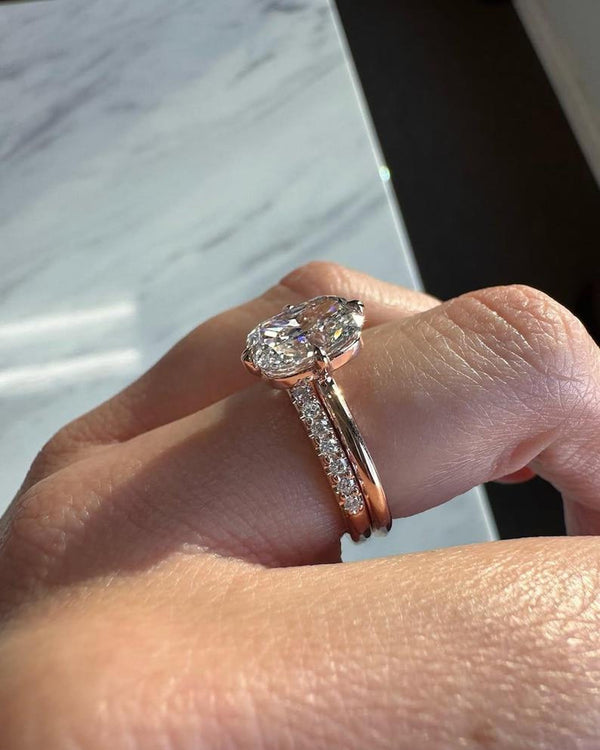
- A wedding band to an engagement ring. Whether a straight band sits flush is decided by the engagement ring’s geometry, and that geometry is in the file. Without it, someone is measuring a finished ring and approximating.
- An anniversary band into an existing stack. Matching by fineness number is the minimum — 14K beside 18K in the same colour clashes visibly — but matching the actual alloy is better.
- Replacing a lost accent stone. The parcel specification is the only reference that exists, since melee is never individually certified.
- Any repair involving heat. A bench that knows the exact alloy and what the stones are works with less risk.
- A head replacement or stone upgrade. Seats are cut to a specific stone, so the original dimensions matter.
Ask these before you assume it
Record-keeping varies enormously and nobody advertises it, so three short questions are worth asking with the first order rather than the second.
“Do you keep the CAD file, and for how long?” “Will you record the melee parcel specification against my order?” And “can I have the written specification for my own records?”
The third is the important one, because it removes the dependency entirely. A written specification — metal and karat, gram weight, centre stone millimetres, accent count and size, shank width and thickness — means any bench anywhere can match, quote or rebuild the piece whether or not the original workshop still exists. Keep it with your photographs and any report, stored somewhere separate from the jewellery.
What returning does not buy you
Worth being straight about. It does not mean a second piece should be exempt from the same questions — gram weight, shank thickness at the base, production and transit days separately all still apply, and a good workshop will not mind being asked twice.
It does not automatically mean a better price. And it does not mean the same workshop is the right choice for routine repairs: re-tipping, resizing and polishing are better done at a bench near you, and sending a piece across a border for ordinary maintenance is time and shipping risk for no gain. The reason to go back to a maker is information, not skill.
One thing to check before anyone else touches the piece: third-party work usually voids a maker’s warranty. Ask what is excluded while the warranty is still live.
Planning the second piece into the first
The cheapest version of all this is to decide the sequence early. If a wedding band will follow an engagement ring, order both together — one production run, one shipment, one customs clearance, and any contour fitted as part of the build rather than reverse-engineered later.
If a stack will grow over years, commit to one metal and one fineness number and write it down, then leave the outer position free for future bands and keep total stacked width in mind — comfort ends for most people somewhere around 8 to 9 mm.
And never plan a stone-set band directly against a plain one: stones at Mohs 9 or above cut a groove into gold at under 3, and a plain spacer band solves it for very little.
Keep reading
Frequently asked questions
Is there an advantage to buying again from the same jeweller?
Yes, and it is informational rather than sentimental — the CAD file, your size in millimetres, the exact alloy and the melee parcel specification already exist, so a matching piece is made to the same numbers rather than reverse-engineered. It only holds if they keep records, so ask.
Why is matching accent stones so difficult?
Because melee under about 0.20 ct is never individually certified in any material — it is bought as a parcel with a stated size and range. Matching later means matching that parcel, so a recorded parcel specification is the only reference that exists.
What if the original workshop no longer exists?
A written specification removes the dependency — metal and karat, gram weight, stone millimetres, accent count and size, shank dimensions. With it, any bench anywhere can match, quote or rebuild the piece. Ask for it with the first order and keep it separate from the jewellery.
Should repairs go back to the original maker?
Not routine ones — re-tipping, resizing and polishing are better done locally, and shipping a piece across a border for ordinary maintenance is risk for no gain. The reason to return to a maker is information rather than skill. Check first whether third-party work voids a live warranty.
Ask for the written specification with the first piece.
It is what makes the second one easy — whoever ends up making it.

Leave a comment